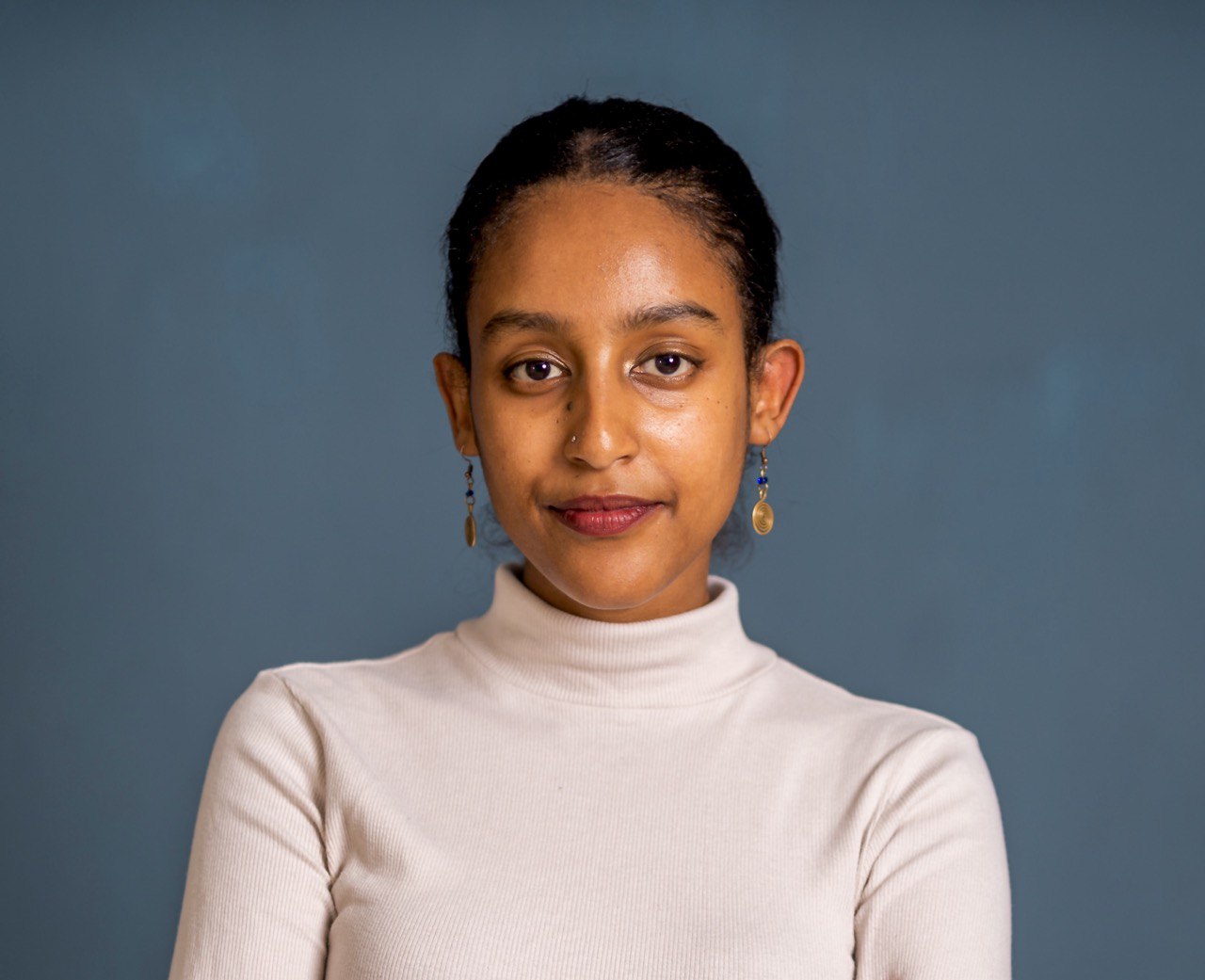

Hanna Lemma, a researcher specialising in gender equality and social inclusion, is the director of Addis Powerhouse, a feminist organisation that seeks to reverse discriminatory norms and inequality in women’s rights in Ethiopia. Originally from Addis Ababa, the capital of the largest country in the Horn of Africa, Hanna Lemma, unlike most Ethiopian women, received strong educational support from her family, who set aside the gender roles prescribed by society and encouraged her to study and forge her own path. “They encouraged me to work for gender rights. In the society we live in, we all understand the inequality that exists, and the fact that they prioritised education and empowerment is undoubtedly what brought me here,” says Lemma, who became involved in the feminist movement in 2017.
It was during the spread of Covid-19 that Hanna Lemma took her activism a step further. During the lockdown, a group of females began to worry about the effects of the pandemic on women, the vast majority of whom had no access to digital tools or educational opportunities. To amplify their voices and the issues that concerned them, Hanna Lemma founded Addis Power House in 2020. It began as a digital platform featuring newsletters and content on gender equality.
“We saw the potential to become a digital platform for producing feminist knowledge. We have been very active on social media and currently have a podcast and carry out storytelling projects,” she explains. “We have seen that, when it comes to advocacy, storytelling is essential so that people can see how women live and form their own opinions,” she adds.
Today, Addis Powerhouse provides educational training and conducts research to gather evidence that it later uses to demand improvements to laws protecting women’s rights. In addition, the collective seeks to ensure that women have adequate social and political representation, by highlighting issues such as bullying and gender-based violence. This raises awareness in society and moves away from patriarchal practices that relegate women to a secondary role. Ultimately, the organisation wants to bring women out of silence, marginalisation and neglect and, of course, put an end to the systemic violence they experience: 40.3% of women aged 20 to 24 in the country were married before the age of 18, meaning that child marriage remains a persistent problem in Ethiopia. In 2018, 26.5% of women also had experienced physical violence and/or sexual abuse by their intimate partners.
Ethiopia: the case of the Nobel Peace Prize winner that became an authoritarian leader
Abiy Ahmed Ali became Prime Minister of Ethiopia in April 2018, after almost five years of social instability caused by protests led by the dissatisfied Oromo ethnic group. Ahmed, an Oromo and the first member of this ethnic group to lead the country, began his term with a series of striking measures that brought great hope to a country accustomed to authoritarian leadership. Along the way, he released thousands of political prisoners, paved the way for the return of exiled opposition groups that had been designated as ‘terrorists’, and introduced reforms that allowed for greater freedom of expression and social equality. It was a period full of optimism, during which progress was even made towards normalising relations with neighbouring Eritrea, with which Ethiopia had fought a brutal war between 1998 and 2000. For these and other reasons, Ahmed was awarded the Nobel Peace Prize in 2019.
However, during this period when he was receiving recognition in Oslo, a conflict was brewing in Ethiopia itself. In November 2020, in the Tigray region, a civil war broke out between the Ethiopian army and the political and social force that dominated the area, the Tigray People’s Liberation Front. This left-wing organisation had dominated national politics up until 2018, having led the rebellion that overthrew dictator Mengistu Haile Mariam in 1991. In this conflict, a third party in the dispute, Eritrea, was also involved. All parties committed blatant human rights violations during the two years of fighting. A fragile peace agreement was reached in 2022, however the war ultimately destroyed the international respect Ahmed had enjoyed, and ultimately became the Nobel Peace Prize laureate who chose to go to war.
Ahmed’s positive advances of 2018 have steadily receded, and today the space for criticism has been dramatically reduced in Ethiopia. During this rise and fall, Ethiopian women have experienced the fluctuations of the country’s political and social context. In Ahmed’s first government, women held half of the ministerial positions, and Sahle-Work Zewde was appointed President, becoming the first woman to hold the position in Ethiopia’s history. But the war changed the dynamic, and female representation began to decline. In addition, the conflict in Tigray inflicted deep trauma on women — mothers who not only lost their sons but also saw their daughters turned into trophies of war, systematic targets used to inflict pain on the opponent. It is estimated that between 40% and 50% of women in Tigray experienced some form of sexual violence during the conflict.
Despite the war and the authoritarian shift that is constricting civil society organisations, Ethiopia is currently one of the African countries where the legal framework offers the strongest protection for women’s rights. Although, as the UN points out, there is still work to be done in areas such as workplace equality. In fact, the main problem in Ethiopia is not the laws themselves but their implementation and the patriarchal culture. The authorities set aside many of the rights established in law in a conservative society that still does not accept women in a leading role, viewing them primarily as mothers and homemakers.
Are most families similar to yours, which supported you on your feminist journey, common, or do families generally reject causes such as gender equality?
It is not at all common. In a patriarchal country like Ethiopia, boys’ education is prioritised. When girls study, they are told that it is only until they get married, that they must prioritise marriage, family and the home over education. Although my family’s experience is not unheard of, it is certainly not the norm, especially considering that they encouraged me to become an advocate for women’s equal rights. In many societies, feminists tend to be seen as women who do not marry and are not humble, perceived as women who reject social norms and the values of marriage and family.
Ethiopia is a diverse country. Are there major differences between ethnic groups and regions when it comes to respecting women’s rights?
Definitely. As a nation, Ethiopia follows a patriarchal value system that is reflected in our culture in general, but also within specific ethnic groups — and there are many of them. While most are patriarchal, violence takes different forms depending on the culture itself. For example, child marriage is very common in the north of the country, among Amhara ethnic groups; but further south, towards the east, female genital mutilation is a very common form of gender-based violence, regarded as a cultural and religious practice. So each region has its own customs, but there is undoubtedly a great deal of gender-based violence rooted in a deeply entrenched patriarchal culture.
What are the main forms of discrimination faced by women in Ethiopia?
I would start with political representation and decision-making. Not many women make it to decision-making tables. Even when they are represented in politics, it is mainly superficial and symbolic. So our political influence is low. I would also say that economically we are the most disadvantaged group. We earn less money and, because of our economic disadvantage, women are often victims of marriages and relationships in which they suffer economic, psychological and physical abuse. I would also include domestic violence among these disadvantages. Furthermore, in many armed conflicts, women are the main victims of conflict-related sexual violence. Overall, intensive efforts are being made to improve women’s political participation, ensure their economic well-being and protect them from gender-based violence, whether through improving laws or strengthening law enforcement.
In 2018, half of the ministerial positions were held by women, although that percentage has fallen, and at the beginning of 2025 it stood at 36%.
It was international news that the Ethiopian cabinet appointed 50% women ministers. It was a major achievement because few countries in the world have been able to reach such gender parity. But afterwards, in 2021 and 2022, conflicts emerged and, as a result, many women were removed from their ministerial positions. Although explanations were given, in conflict contexts it is generally assumed that men are better able to manage urgent and emerging risks. So, for the most part, men ended up taking those positions. I would say that women’s political representation has ceased to be a priority in Ethiopia, and you can see a decline in their presence in the political sphere.
You co-authored the report Gender Parity Reform as Autocratic Genderwashing? Analysing Ethiopia’s Post-Protest Experiment, in which you examine genderwashing in autocratic countries. Despite political self-interest, what positive effects does genderwashing have?
I always support women’s political representation, whether it is symbolic or merely formal. At Addis Power House, we advocate for greater inclusion of women in political dialogue. For us, women’s representation is non-negotiable. It always has a positive impact. It motivates other women to take up political positions; they feel capable of doing so. In addition, women’s leadership has an impact on many of the agendas that matter to women, because women leaders are able to raise issues that concern us.
How do the authorities and laws protect women and their rights?
The Constitution guarantees equal rights. A new gender policy has recently been published, but even the previous one, approved in 1993 and still in force, was very open in terms of women’s empowerment and political participation. Compared with other countries, the Ethiopian legal system is strong. It is something we always emphasise, but in practice, implementation is where we fail, and this is largely due to the patriarchal system in which we live.
The far right is very active on social media and easily spreads an engaging message opposed to gender equality. How do you view the use of social media in your work and in confronting hate speech?
There is an anti-rights rhetoric that we are importing from the West. Feminism is often accused of being imported from the West. We have tradwife content creators and anti-rights content creators who directly attack women’s rights defenders and human rights defenders in general, and this is creating extreme polarisation on social media. We receive very critical comments which, at least, help us gather evidence about people’s positions. These discourses on social media are one of the problems we face. But we definitely need to be on social media. The more knowledgeable people participate in the conversation and the more content creators share information, the better we will be able to resist misinformation and, in addition, generate our own knowledge.