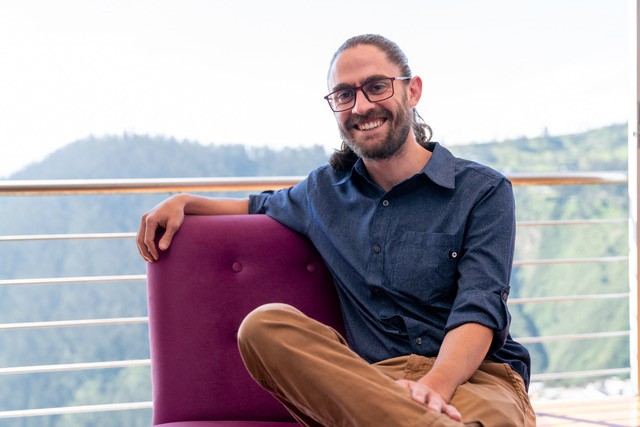
Pedro Bermeo, born in 1991 in Quito, Ecuador, is legal coordinator and spokesperson for YASunidos, a collective formed in 2013 with the aim of organising a popular vote on oil extraction in Block 43 of Yasuní National Park. Despite being a city dweller, he has been closely connected to natural environments since childhood, discovering the importance of preserving the environment at the alternative Pestalozzi school, on family cycling trips, through the advice of a mountaineer grandfather and at the climbing sectors of Cojitambo. A close relationship that became umbilical in 2013, when Pedro Bermeo’s life changed considerably.
“I was carrying out a photography project on protected areas in Ecuador when, in 2013, the decision was made to exploit Yasuní. At that time I was working as a photographer, but later on, because of the problems we faced due to the lack of lawyers, the YASunidos assembly asked me to study Law, a discipline that allows us to achieve small, slow changes, but which supports other organised fields,” recalls this photographer, and lawyer by circumstance, about the decision-making of this horizontal organisation which today, following popular environmentalism, fights for social and environmental causes beyond Yasuní.
YASunidos was born in 2013 in opposition to the oil extraction project in Block 43, the last of a series of wells that began to be established in Yasuní National Park after the first block, Block 16, was put out to tender in 1985. The members of this organisation put forward two reasons for opposing the project: the adverse effects on the environment and the risk of contact with communities living in isolation reported in the area. For this reason, they began collecting signatures to hold a referendum. They gathered 757,000, far more than required, but more than 400,000 were rejected by the electoral authorities, who alleged formal errors relating to the weight of the paper, the code or the identity document. This situation gave way to a legal process through various courts that would not be resolved until a decade later, in 2023, when the courts ruled in favour of YASunidos: they validated its signatures and, as a result, the referendum on oil exploitation in Block 43 in Yasuní was held.
Violence, powerlessness and extractivism in the Ecuadorian Amazon
Yasuní National Park, created in 1979, covers 10,300 km² in eastern Ecuador, in the regions of Pastaza, Napo and Orellana. If the 17,267 km² of protected Indigenous and environmental zones are added, the resulting 27,567 km² make up the area declared a Biosphere Reserve by UNESCO in 1989. This territory, known as Yasuní, is one of the most biodiverse places in the world, home to more than 2,000 species of trees, 204 mammals, 610 birds, 121 reptiles and 150 amphibians. Inhabited since time immemorial by Indigenous peoples, it is currently home to more than 400 native communities: the Waorani, Kichwa and Sapara are the main groups in a territory that is also inhabited by the Tagaeri and Taromenane peoples, who have not yet been contacted.
This idyllic environment, however, is marked by centuries of violence and plunder. First came the genocide committed by the Spanish; then the massacres by the independent states —which promoted ferocious conquests of the rainforest such as those of the caucheros—; and finally, in the present, it is the structures of organised crime that control the territory and keep the communities living in fear; a hidden violence, less explicit but equally unpunished, in which those who oppose an extractivist system are murdered.
In this context, in the Amazon the native communities are scattered across small settlements that are generally accessible only by rivers and waterways, which make it possible to travel through this tangle of nature that human beings have not yet managed to tame. In most cases, the settlements lack access to basic services such as drinking water, and the infrastructure is so basic that, when there is heavy rain, the damage is considerable. Moreover, except for a few persevering communities, people have been ‘forced’ to set aside their way of life, their work and their traditions, to become just another cog in the machinery of the extractive activities that, driven by the Government and drug traffickers, pollute the territory. The Amazon gives a great deal: minerals, timber, oil, fruit… But it receives very little in return.
Unfortunately, this situation is repeated in the other Amazonian countries. Countries that are incapable of exercising authority over their own territories. This is the case of Ecuador, a plurinational state that recognises the rights of nature in its Constitution, but which is immersed in a growing wave of violence: until relatively recently it was one of the safest countries in Latin America, but now not only is it no longer safe, but, leaving aside the black hole that is Haiti, it tops the statistics for violent deaths in the region. Daniel Noboa’s Government promised to resolve the situation by means of an iron fist and the help of the United States, but the strategy is not working and, along the way, society’s rights and freedoms are being curtailed by constant states of emergency.
The implementation of the referendum result should have begun in 2024. However, Daniel Noboa says it will have to wait until at least 2029. Why is the will of the people not being implemented?
First, I have to say that every president spoke out in favour of Yasuní during their campaign, but when they came to power they did the opposite. In these 13 years of struggle, they have all done exactly the same thing. Right now, a popular mandate that, according to the Constitution, must be complied with immediately and obligatorily is being flagrantly breached. After the referendum, the Government had one year to withdraw progressively from Block 43: it had to suspend extraction and then proceed with the orderly removal of the wells. It has not done so. Daniel Noboa says there must be a natural decline of the wells that will take between 5 and 12 years. That is not a valid argument, and we have filed an action before the Constitutional Court, which has put the case on ice because it is being threatened by the Government. In this process, what bothers us most is that when the consultation began in 2013, there was not a single well there. It is precisely because our participation rights were violated that we are now in this situation in which the wells have to be removed.
The Inter-American Court of Human Rights has also ruled in favour of YASunidos. What is the status of this case running parallel to the referendum?
Yasuní is a gigantic territory, with more than a million hectares, from the Napo River to the Curaray. It is a much larger territory than what is recognised as Yasuní National Park. That is where Block 43 is located, which represents 20% of the country’s oil, of its proven reserves, an extremely heavy oil that is difficult to extract. In the park, the intangible zone is like a buffer strip, a buffer zone, which exists because of the presence of peoples in isolation. Oil cannot be exploited there. The issue is that the peoples are beyond the intangible zone, as has been demonstrated before the Inter-American Court. That is why, according to its ruling, the State must create a commission in which we, the plaintiffs, take part, so that the intangible zone can be extended to all the places where there has been a proven presence of isolated peoples: in Block 43, but also in Block 31, in Block 16, in Block 55 and in other areas of Yasuní National Park. We are still waiting for this step.
After more than a decade of struggle, how do you assess the evolution of extractivism in Yasuní?
In a way, all the protests and the popular vote have served to slow down extractivism. Since 2023, there have been no new wells in Block 43, and others that were planned in the buffer strip are not going ahead either. That is a very concrete victory. I believe that, if YASunidos had not carried out this struggle, it would not have been achieved. In addition, interest in exploiting the area has fallen considerably; companies are realising that it is not profitable to exploit a territory where there is an organised citizenry against it, one that won a popular vote with 60% support — and I say 60 and not 58, because we won with 60, but the overseas vote was not counted.
16 communities in Yasuní voted in favour of continuing the exploitation. Who are these people and why do they accept the presence of extractive economies?
My thesis investigates why the most impoverished communities vote in favour of protecting Yasuní, while the economic elites vote against it. The most impoverished people understand the value of the commons, and they defend life and nature. But there is an exception, of course, which occurs specifically in Sucumbíos and Orellana, which are the oil provinces par excellence. They are provinces with a very small population where there is a great deal of oil-related migration, people who live in the area because of the extractive activities. Obviously, they are going to change the outcome of the vote. On the other hand, there is a relationship of dependence on oil. Block 16 is entirely controlled by the oil company: the electricity, the rubbish collection system and the few jobs there are all provided by the oil company. Basically, there is absolute control over the populations. Beyond that, their territories have now been exploited for more than 50 years, and people can no longer live from hunting, or even drink water from the rivers because they are polluted. In this extractive logic, they were robbed of the possibility of maintaining a relationship with nature and now they depend on extractive activity. So their common good is no longer nature, but the oil companies’ money.
Are there differences between the left of Rafael Correa, who began the exploitation of Block 43, and the right of Daniel Noboa?
The country is extremely dependent on extractivism, and governments of both left and right have maintained this extractivist raison d’être. We live in a capitalist system in which, in a way, oil and mining are the lifeblood of capital. However, it is important to recognise that there is a big difference between the Correa era and what is happening right now in Ecuador. We are a left-wing collective and, despite our criticism of extractivist policy, we recognise the successes of the Correa government in social rights, education and health. Right now, by contrast, fascism is arriving. The richest family in the country (Noboa’s) is in power, writing off its own debts, but beyond that, on the extractive issue, the Nobis group has mining projects linked to Canadian companies and other transnationals for which they are obtaining permits irregularly, without free, prior and informed consultation, without environmental consultation, flagrantly violating the rights of peoples and nationalities. So yes, there are differences.
Moreover, the situation is delicate for human rights defenders. They have just killed Monika Silva, a European activist who denounced corruption and environmental cases. Eduardo Mendúa, one of the leaders of the [Indigenous organisation] Conaie, was murdered in 2023. Like them, there are many more cases. We see how the level of violence is increasing, and there is an evident link between the current Government and organised crime, even drug trafficking. At the same time, as Noboa controls all the powers of the State, there is a new persecutory dynamic: persecuting leaders of social organisations, freezing bank accounts, initiating legal proceedings. For example, a YASunidos colleague has been charged with the crime of financing terrorism. The collective has also been persecuted through the Electoral Disputes Tribunal, which imposed a fine of 18,000 dollars on us over 39 cents corresponding to a bank surcharge that we supposedly reported ‘incorrectly’.