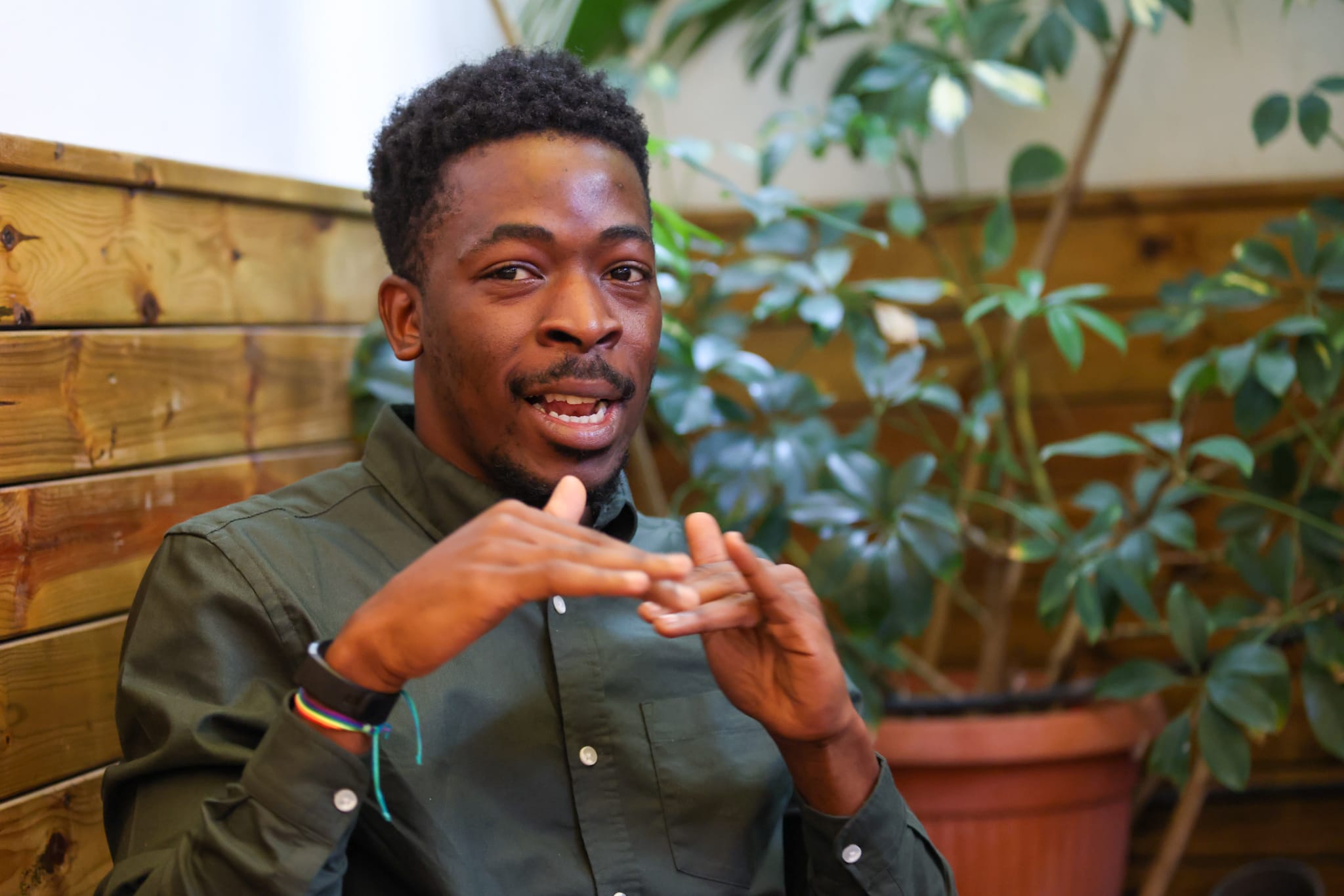

Gonzalo Abaha Nguema Mikue, who holds a degree in Humanities, is an LGTBIQ+ activist and National Coordinator of the organization Somos Parte del Mundo. He was born in 1996 in Evinayong, Equatorial Guinea, a tropical region renowned for its pineapples. Due to its relatively cooler climate, Evinayong was one of the urban centers inhabited by Europeans during the colonial era. Today, the region’s economy is predominantly based on agriculture, while its social fabric remains deeply conservative, shaped by the influence of the Fang ethnic group, to which Gonzalo Abaha belongs and which constitutes the country’s largest ethnic community.
Like most gay people in Equatorial Guinea, Gonzalo Abaha was rejected by both his family and his community. He endured the ordeal of so-called conversion therapy, during which he was forced to visit traditional healers and churches where he could be kept for days without food. When these efforts failed to change him, he was ultimately thrown out of his home. As a result, he spent years drifting through the city of Bata, never far from his family but deliberately avoiding any contact with them. If his relatives lived in or frequented the northern part of the city, he stayed in the south—keeping as much distance as possible from their rejection and reproach. It was an extremely difficult period marked by homelessness and severe hardship. Yet he not only survived but eventually rebuilt his life through his own determination and the support of his “chosen family”: Somos Parte del Mundo.
“When I first started attending the meetings, I finally felt at ease because nobody asked me why I talked the way I did or why I behaved the way I did. That feeling of not being judged meant a great deal to me. And that’s when I realized I had found the family I’d been looking for“ recalls the activist, who is also a writer and the author of two books that have sparked controversy in Equatorial Guinea due to their explicit language and their exploration of feminist and LGTBIQ+ themes: Rats Fall in Love Too (“Las ratas también se enamoran”, 2021) and You’re So Weird (“Lo rarito que eres”, 2025).
After years of perseverance in Bata, Gonzalo Abaha embraced a new opportunity in 2023 and settled in Malabo. He later continued his professional development in Spain through an AECID scholarship at the NGO Acción Triángulo before returning to Malabo, the country’s former capital. Today, it is considered the safest and most open city in Equatorial Guinea for the LGBTQIA+ community and is home to the strongest organizational base of Somos Parte del Mundo, from where the organization works to expose and challenge the discrimination faced by LGTBIQ+ community across the country.
Founded in 2016 by a group of individuals who had previously been meeting in bars, on beaches, and in other clandestine locations, Somos Parte del Mundo is an organization dedicated to protecting the rights of LGTBIQ+ people. It began to gain recognition beyond its own community in 2019 after publishing reports documenting human rights violations in Equatorial Guinea. Among the organization’s main objectives are the establishment of a legal framework that criminalizes the promotion of homophobia and the repeal of discriminatory laws, such as those that allow conversion therapy to be carried out in churches or by traditional healers. More broadly, the organization advocates for national legislation to be aligned with the Yogyakarta Principles, a document containing 29 principles adopted in 2006 under the auspices of the Office of the United Nations High Commissioner for Human Rights, setting out legislative recommendations to protect human rights, including those relating to gender identity.
Across Africa, LGTBIQ+ communities continue to face persecution, and no other continent subjects them to such widespread and persistent discrimination. In many countries, the law fails to protect individuals from violence and hate speech motivated by sexual orientation, while in others, the simple act of loving someone of the same sex remains a criminal offense. In fact, authorities in 32 of Africa’s 54 countries criminalize consensual same-sex sexual relations, while both in those countries and elsewhere, so-called conversion practices continue to take place. Homosexuality is often regarded as a spirit possession or as a “white people’s disease” that must be driven out of the body. The harshest forms of persecution are found in countries where homosexuality is punishable by death, including Somalia, Mauritania, northern Nigeria—where sharia law is enforced—and Uganda. Yet Africa is also a continent of contrasts. Among the handful of countries that recognize LGTBIQ+ rights, most of them in Southern Africa, South Africa stands out as a landmark example: it has recognized same-sex marriage since 2006 and, even earlier, in 1996, became the first country in the world to constitutionally prohibit discrimination on the grounds of sexual orientation.
In Central Africa, Equatorial Guinea is a small country bordering Cameroon and Gabon, with a coastline on the Atlantic Ocean, and a former Spanish colony. Teodoro Obiang, who has been in power since 1979, leads Africa’s longest-serving dictatorship. Until relatively recently, he claimed that there were no homosexual people in the country. Faced with mounting evidence, he has been forced to acknowledge the existence of gay, lesbian, transgender, and bisexual people. This recognition, however, has been accompanied by an escalation of repressive policies, supported by legislation – some of it inherited from Franquism (Spanish dictator) – and by the approval of a conservative, patriarchal society that refuses to accept homosexuality.
According to a 2020 report by Somos Parte del Mundo, Equatorial Guinean authorities “dismantled safe neighborhoods such as Los Ángeles in the city of Malabo” and launched “an institutional campaign promoting homophobia.” Police checkpoints were established in neighborhoods and venues frequented by lesbian and bisexual women, particularly bars and nightclubs; television programs critical of homophobia, such as Guinea en Femenino, were taken off the air; and legislative initiatives, aimed at restricting LGTBIQ+, rights were introduced. In addition, particularly from 2023 onward, the government intensified its crackdown on civil society organizations. In August of that year, Trifonia Melibea Obono – the writer, activist, and founder of Somos Parte del Mundo – was detained for 48 hours.
Africa’s particular situation is compounded by an increasingly unfavorable global context, marked by a broader rollback of minority rights across the West. Donald Trump has championed a conservative Christian white supremacist agenda, while the anti-woke movement continues to gain momentum. Across Europe, far-right parties have pledged to repeal legislation protecting women and other vulnerable groups. Yet it is in Africa where these shifting political trends are being translated most rapidly into discriminatory legislation. In countries such as Mali, Senegal, Ghana, and Gabon, in some cases fueled by the rise of jihadist movements, new anti- LGTBIQ+ laws are undoing much of the progress achieved since the beginning of the twenty-first century.
How did your relationship with your family change once they found out you were gay?
Homosexuality is seen as a white people’s disease; Black people cannot be homosexual in Equatorial Guinea. When my family found out, they eventually threw me out of the house because, to them, it is a form of demonic possession that I could pass on to the rest of the family. You are excluded from the community, and you have to fend for yourself on the streets. But before they throw you out, you are subjected to conversion therapy because they believe they can reverse the situation and make you “normal,” so to speak. It involves traditional healers, churches, and rituals. I went through that between 2015 and 2016. They also use corrective rape against lesbian women, while for gay men and transgender women they resort to forced marriage or forced parenthood. It is a well-established system of violence. Then there is the violence outside the home: society condemns you, you face physical and verbal attacks, and you risk being detained. That is the reality of being gay here in Equatorial Guinea, and your family completely turns its back on you.
Your story of resilience and success is an exception. Your reports show that most people end up turning to sex work.
We’ve all gone through sex work. When you’re living on the streets, you need to eat. Obviously, you have to do whatever you can to survive. In my case, I had already dropped out of school by the time I was forced to leave home, but thanks to the organization, which offered small educational grants, I was able to return to my studies. But I can’t say that everyone else should do the same because that would be deeply unfair. The whole process is incredibly difficult. The physical violence is visible, but psychologically, the damage is devastating. Just imagine, a family that fed you and cared for you suddenly throws you out of the house, and you are no longer even allowed to greet your younger siblings. It leaves a lasting mark.
Many people who are going through what you experienced must be turning to Somos Parte del Mundo for help. How are you able to support them?
At present, we have three departments. The Education Department provides educational scholarships; the Security Department offers legal assistance, supports people who have been detained, visits them in prison, and helps them obtain official documents; and the Health Department runs a solidarity pharmacy and, at times, provides free medical testing through a laboratory operated by a community of Catholic nuns with whom we collaborate. We also run safe houses in Bata and Malabo, where people who have been thrown out of their homes can stay temporarily. At the moment, we have eight residents in Malabo and three in Bata. In addition, we offer training programs and psychological counseling services. We used to be particularly active in producing human rights reports, but in recent years the level of violence and threats to people’s lives has increased significantly. As a result, we have decided to step back from that work. The current geopolitical context simply does not allow it, and there is no protective framework to keep us safe.
Basically.
Repression depends on how visible you are, and the government is deeply concerned about what is said abroad. That is why the community is subjected to attacks. In 2024, an investigation was launched against me, alleging that I was affiliated with the political opposition and that I was speaking about politics outside the country. When they found nothing, they raided our offices and investigated our staff, claiming that we were operating as a criminal organization involved in drug trafficking. The more visible you become, the greater the level of aggression you face. At the same time, visibility can also provide a degree of protection: if something happens to you, people will ask questions. But overall, there is institutionalized homophobia.
Military personnel are allowed to detain and torture gay people without facing any consequences. Or you may go to renew your identity documents and, if you speak in a way they perceive as effeminate, you immediately find yourself being interrogated. Or you may be walking down the street while a group of young people throw stones at you or beat you, and the police simply walk past without intervening. Or a transgender person may fall ill, go to a hospital, and be told by a nurse that she cannot treat “someone like that” because she fears becoming infected, or because she believes that the evil spirit could somehow contaminate her food, be eaten by her children, and make them homosexual. All of this is tolerated because violence is institutionalized. In fact, until recently, Equatorial Guinea’s official position in international forums was that there were no homosexual people in the country.
There was already widespread homophobia before colonial rule. Homosexual people were ostracized, forced to live deep in the forest, and were not allowed to remain in their villages. With colonialism and Francoism, there was a perfect convergence between National Catholic ideology and our pre-colonial traditions. After independence, there were promises that the legal system would gradually be reformed, but nothing has changed. Legislation inherited from the Franco era (Franquismo) is still applied, including the 1954 Vagrancy and Criminal Conduct Law, while the Military Justice Code – which prohibits homosexuality in the armed forces – also remains in force. There has been very little political will to reform these laws, and the consequences are felt not only by LGBTQIA+ people but also by women and other vulnerable groups.
In addition, Equatorial Guinea has adopted its own discriminatory measures. A 2003 order issued by the Ministry of the Interior prohibits the use of tourist establishments and entertainment venues for prostitution and other activities deemed to violate public morality and decency. More recently, since 2024, a provincial decree has barred homosexual people from entering bars and nightclubs, effectively restricting their rights to freedom of assembly and expression.
They changed their narrative in 2022. The reports we produced had an impact, and they began saying, “Yes, there are homosexual people, but we, the government, do not do anything to them. It is the population that does not accept them”. That is misleading, because in reality it is the authorities themselves who encourage and sustain the persecution.