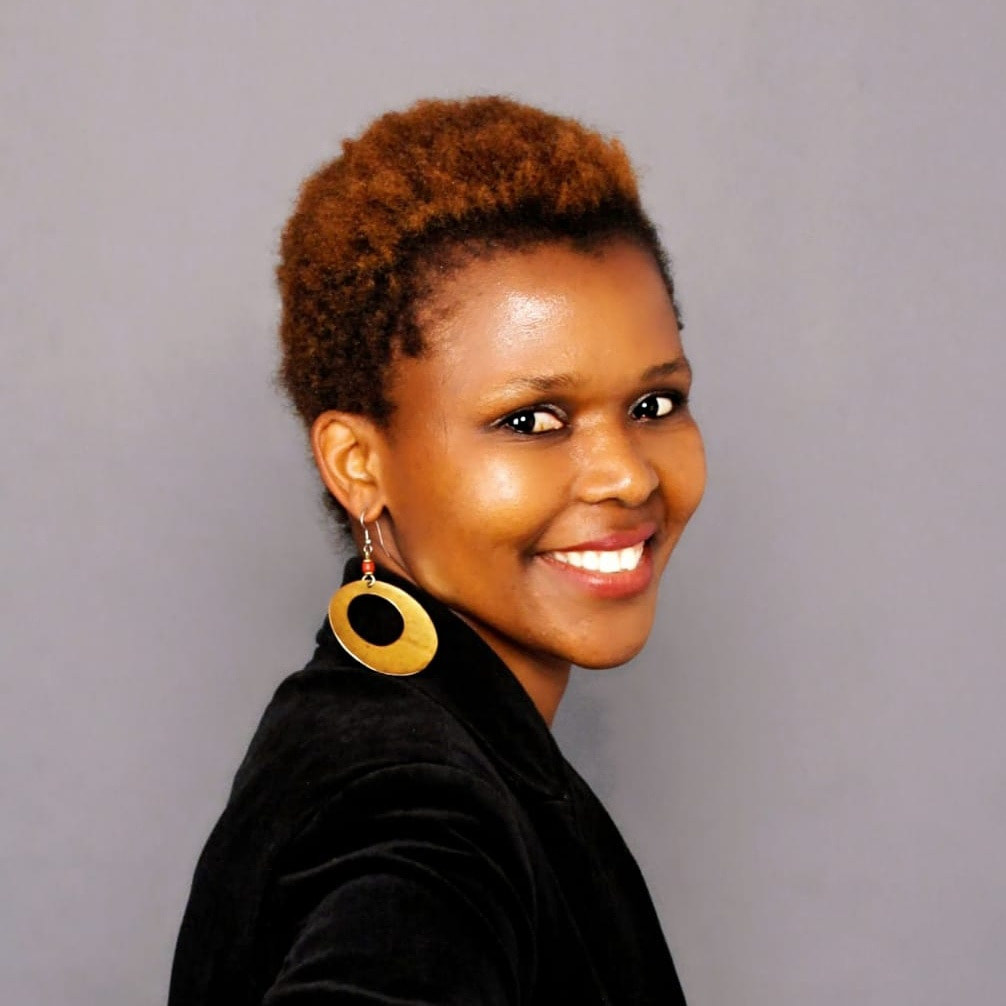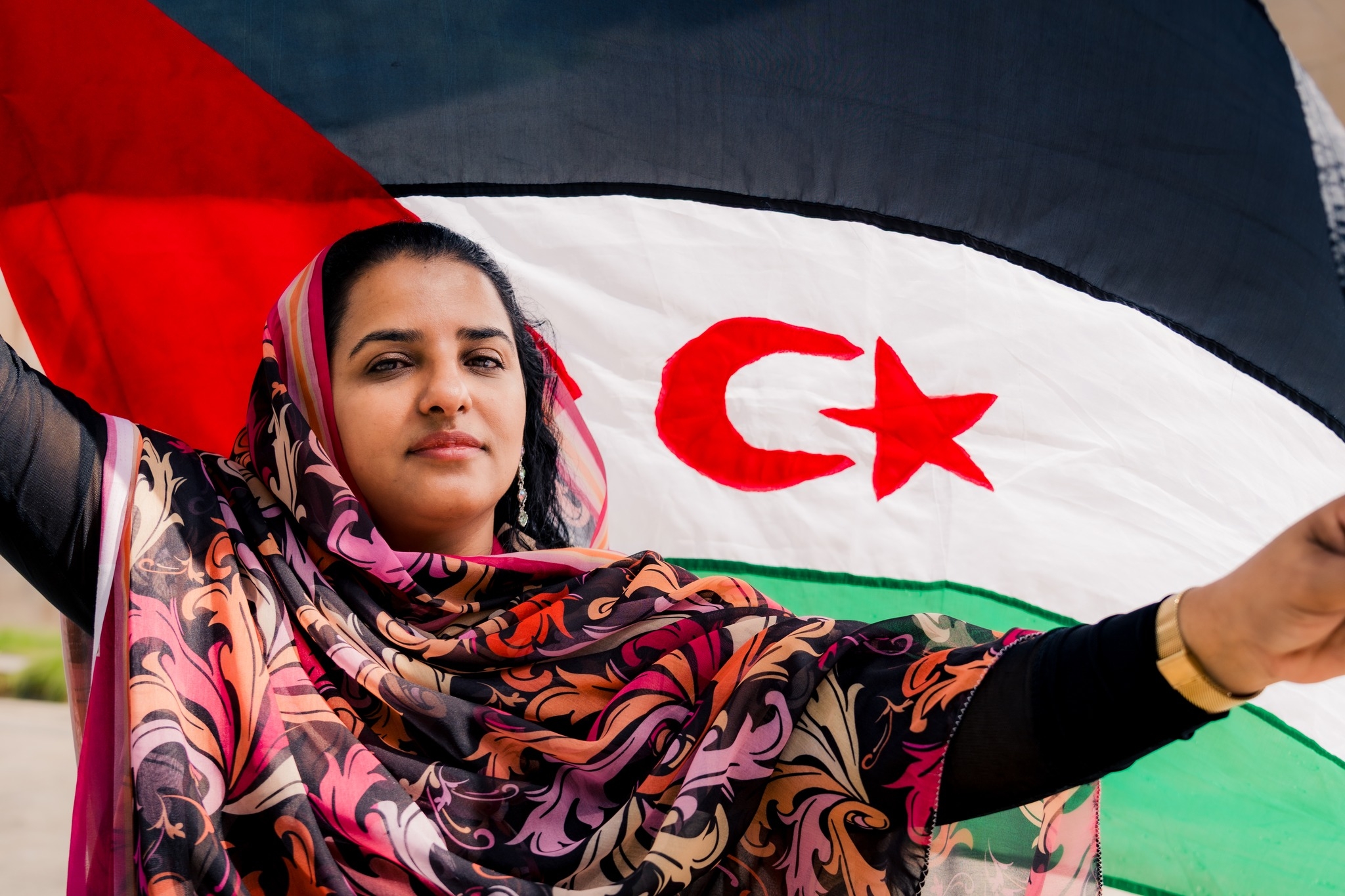

Asria Mohamed was born and raised in the Sahrawi refugee camps in Algeria. A journalist and artist, she currently resides in Oslo (Norway), where she continues to work for the Sahrawi cause by attending conferences and public events. Through the Norwegian Support Committee for Western Sahara, she raises awareness regarding the Western Sahara issue while also supporting and advising those interested in the cause. The journalist presents and produces a podcast relating to the Western Sahara and over the last couple of years she has been focusing on her own personal project: Jaimitna.
Jaimitna comes from Jaima (a Sahrawi tent), a human rights storytelling art project. It is an art installation consisting of a Jaima, in which there are melhfas each belonging to a different Sahrawi woman human rights defender, accompanied by a QR code that takes you to each of their personal stories. “Documenting history and narratives is very important. One of the reasons the Western Sahara cause is not known outside Spain or outside the Sahara is because there is a lack of documentation and writing, as our culture uses story telling. We are a society rooted in oral tradition, which is a strength. But when you are oppressed and living under occupation, it can also become a weakness: “we do not write our own history, while Morocco does,” Asria explains in this interview. For the human rights advocate, part of her role is to “combat the Moroccan narrative and cultural appropriation.”
Despite Asria Mohamed growing up in a refugee camp, she does not have an unhappy memory of her childhood. “I had a happy childhood: we didn’t have a set time to go to bed and we played barefoot. We didn’t have much, but we were happy. You don’t realise your surroundings because everyone around you lives in the same conditions. It was only when you left the camp that you took a step back and thought, “Why us?” she explains. “But then sadness turns into anger, because you realise that this is happening due to the occupation and because the international community allows it.” She insists that two truths can be perfectly valid at the same time: “I had a happy childhood, but it wasn’t a perfect one. I had a happy childhood even though I suffered from malnutrition, but I only remember the good things”.
Western Sahara, fifty years of occupation and oblivion
The story of Asria Mohamed is that of so many Sahrawis who have been born and raised in the refugee camps in Algeria. As a non-decolonised territory, 2025 marked the fiftieth anniversary of Morocco’s occupation of Western Sahara. Notably, on 6 December 1975, more than 300,000 Moroccans arrived from the North and occupied the Sahrawi territory. This event, which would mark the beginning of the occupation, was named the ‘Green March’. Before this movement, orchestrated by the monarch who was reigning at the time, Hassan II, Western Sahara was considered the 53rd province of the Spanish State.
Until then the Spanish Government was in control of the territory, and was committed to organising a referendum. However, this never took place. In 1973, the Popular Front for the Liberation of Saguia el Hamra and Río de Oro was formed; it would later become what we now know as the Polisario Front. When military attacks by Morocco on the occupied territory intensified, a significant number of Sahrawis were forced to flee. They settled in refugee camps in neighbouring Algeria. The situation has remained unchanged to this day. Those who remained in Western Sahara, and also the current generation, have to live with the repression of the Moroccan regime, arbitrary detentions and persecutions. Freedom is neither an option in Western Sahara nor in the rest of Morocco, as this is a taboo subject.
The Spanish State left Western Sahara definitively in 1976; Mauritania, which had retained part of the territory in the Madrid Agreements, signed between Morocco and Spain in 1975 and consequently withdrew from the Western Sahara in 1979. In 1991, the UN established the United Nations Mission for the Referendum in the Western Sahara (MINURSO) and a ceasefire was signed (until that year, intense armed struggles had been taking place between the Polisario Front and the Moroccan army). Although there is officially no open war between the two sides, the reality is far from what is written on paper and conflict and repression continue to be the protagonists day after day in the occupied territories.
The Abraham Agreement
The signing of the Abraham Agreement in December 2020 marked a turning point in this conflict. Through this agreement, Morocco normalized diplomatic and economic relations with Israel; which led the United States to recognise Morocco’s dominion over Western Sahara. In 2023, Israel also recognized Moroccan sovereignty over the Sahrawi territory. A year earlier, in 2022, unilaterally and without parliamentary consultation, the Spanish Government initiated a new stage of bilateral relations with Morocco and changed its position on Western Sahara.
More recently, on October 31, 2025, the UN presented resolution 2797, which renewed the mandate of MINURSO until October 31 2026 opening the doors to the consolidation of Moroccan dominance in the territory. China and Russia abstained during the vote. The new resolution grants “the autonomous region of the Sahara” a series of powers, but key issues such as religion, defense or foreign affairs remain in the hands of the Moroccan regime. In this context, a referendum remains an option, but it is not a guaranteed outcome.
Finally, it is important to highlight that, although a series of protests led by Generation Zeta have taken place in Morocco over the past year, the youth—and the Moroccan population in general—continue to ignore the demands for autonomy in the Sahara. Along with not questioning the role of the monarchy, this is one of the country’s red flags. Meanwhile, refugees in Algeria continue to live in subhuman conditions and the Sahrawis who still live in Western Sahara are subjected to repression and violence. The media blockade by the Moroccan regime means that most information regarding what is happening in the occupied territories does not reach the international community, which turns the conflict into a forgotten war.
What is your story, Asria Mohamed, and why do you dedicate yourself to defending human rights?
I was born and raised in the Sahrawi refugee camps, and I studied journalism in Algeria. Then I worked with the Sahrawi radio in the refugee camps, and I came to Norway at the end of 2010 through an exchange program. Later I did a master’s degree in communication and media. This is the story of many immigrants, or most of them: the plan was never to stay. One of the reasons behind the choice to study communication was to be able to tell the story of the Sahrawi people.
When I first arrived in Norway, I was surprised. When I was in the camps, as a child, I always saw foreigners coming to visit us, especially Spaniards. Photographers would come and take pictures of us; also people from the UN. And in my head, I thought that everyone knew where Western Sahara was and what the situation was like. But when I arrived in Norway, I realised that this was not the case. Often, when I introduced myself and said that I was from Western Sahara, people did not know anything about it. ‘Is it a country?’ they asked me. I saw that many people did not know anything about us and that there were hardly any Sahrawis in Norway. I thought that something had to be done about it and twenty years later, this is what I am doing.
What does your work consist of with the Norwegian Committee for Support for Western Sahara?
Before working with the Committee, and for many years, I was simply a Sahrawi who did not speak Norwegian, who did not know the country very well and who struggled to get papers. But, whenever I had the chance to talk about the Western Sahara, I would. At the end of 2015, I started working with the Norwegian Committee for Support for Western Sahara. We are a small organisation, basically only two people. 80% of my work consists of traveling around Norway and giving talks about Western Sahara. Norway is a huge country geographically, but I have been everywhere. I give talks in high schools, go to universities, speak to political parties and unions… Basically, I use any platform to give visibility to the cause.
I also work in the field of defending human rights on the ground with Sahrawis living in the occupied territories. Over the years I have combined both tasks: for example, I have received Sahrawi human rights defenders and traveled with them, acting as a translator or a companion.
On the other hand, it is not the same to hear about something as to see it with your own eyes. Since I grew up in refugee camps, I know the territory, so since 2018 I have been traveling to the camps together with politicians from all parties in Norway, from the right to the left. We take them to the refugee camps for a few days so that they can see the cause firsthand. I explain and show how the situation is, and then it is up to them to act or not.
After giving more than a thousand presentations, I have learned different things, and one of the things I like the most is to speak in front of young people. People think that young people don’t care about anything, but that’s not the case. We give them a lot of information, but we don’t tell them how to act. Not everyone has to be an activist, but small actions can be taken.
Once, in an interview, you said: “I don’t know if what I do is useful, but it’s certainly better than doing nothing.”
Exactly. I’m very grateful to be able to be part of this, and especially to be able to talk to young people. Because sometimes, with the way the world is going, there are people who think that we can’t do anything, that everything is being destroyed.
The Sahrawi people have been one of the most affected by international cuts in humanitarian aid.
The cause is not known, it is not visible in the media and is not spread by politicians, which makes us vulnerable to not receiving enough attention, enough help, and enough political action. We were greatly affected by the crisis caused by COVID-19, then came the war in Ukraine, and later these cuts. All of this has affected the refugee camps.
In the occupied territories, there is a major media blackout, which is why all the communication work that is being done is important.
There are many people doing many things, such as the journalists working from the occupied territories under inhumane conditions. They risk everything to report, even their lives. But it has to be done, because the level of awareness about the Western Sahara in Spain is not the same as in other countries. In Norway, hardly anything is written about the Western Sahara. We Sahrawis know that our cause is not a priority. Countries are always talking about values and rights, and Spain is a good example of this. Pedro Sánchez talks about Ukraine and Palestine, but remains silent on Western Sahara. We Sahrawis are victims of economic and political games, which is why we need to find a new way of telling our stories in order to reach more people, beyond the traditional media. There is still a lot happening: for example, there are Sahrawis in prison, Sahrawis who are being tortured, and a territory that is being emptied of young people because there are no jobs. As long as you are a political activist — or someone in your family is — you will never have money or a job. They are carrying out an economic strangulation. Young people have to risk their lives to emigrate. It is a huge violence, but not in the traditional sense of bombings or open warfare. I feel that the story of the Sahrawi people is not being told enough.
With the implementation of the new European Pact on Migration and Asylum (PEMA) and the Return Directive, the EU has come to regard Morocco as both a safe third country and a safe country of origin.
We Sahrawis have won court cases against the European Union, yet the EU continues to strike deals with Morocco. In other words, the EU is aware of the human rights situation in Morocco and the occupied territories of Western Sahara, but chooses to disregard it. The EU is so desperate to find solutions to the migration issue that it truly does not care if Morocco violates human rights or the right of self-determination.
Through my work as a lobbyist at the European Parliament, I have learned that Morocco is—and always will be—a key strategic neighbour for the EU. It will always be important in terms of trade, security, and migration. We have no issue with the EU collaborating commercially with Morocco, but this should not take precedence over human rights. Granting Morocco such a prestigious position leaves Sahrawis and Moroccans who oppose the regime unprotected. In Europe, you like to criticise the United States for prioritising political interests over human rights, but the European Union is no better.
In the autumn of 2025, a series of protests took place in Morocco led by Gen Z, though they did not include the demands of the Sahrawi people. Moroccan society continues to overlook the issue—or treat it as taboo, doesn’t it?
The demonstrations were a positive development, given that the Moroccan regime always silences protests. People were demonstrating for access to basic rights such as healthcare and education. What they don’t realize is that the situation in Laayoune is even worse. The problem with Moroccan society is that it has dehumanized the Sahrawis. In the Moroccan media, we are portrayed as “people from the southern provinces” and labeled as lazy, dependent on social welfare, traitors, and a threat to national unity. This dehumanizes us.
Moroccan society needs to understand that the Sahrawis are not their enemies. In fact, Generation Z and the Sahrawis share a common enemy: the monarchy and the Makhzen. It is the government that fails to provide basic rights to both Moroccans and those living in the occupied territories. Why does this disconnect exist? Because in Morocco, criticizing the king, religion, or national sovereignty is dangerous. In conversations with progressive young Moroccans, I realised they avoid this issue because doing so could cost them, for instance, the right to form a political party or a trade union. Furthermore, I believe Moroccans remain unaware of the suffering endured by the Sahrawis because they are swayed by propaganda.