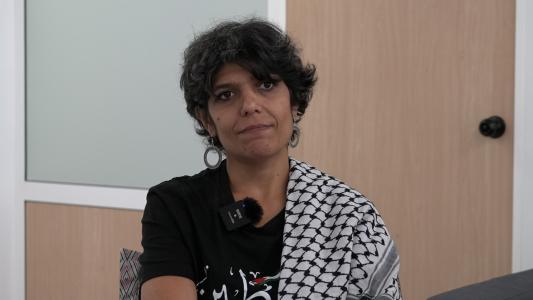
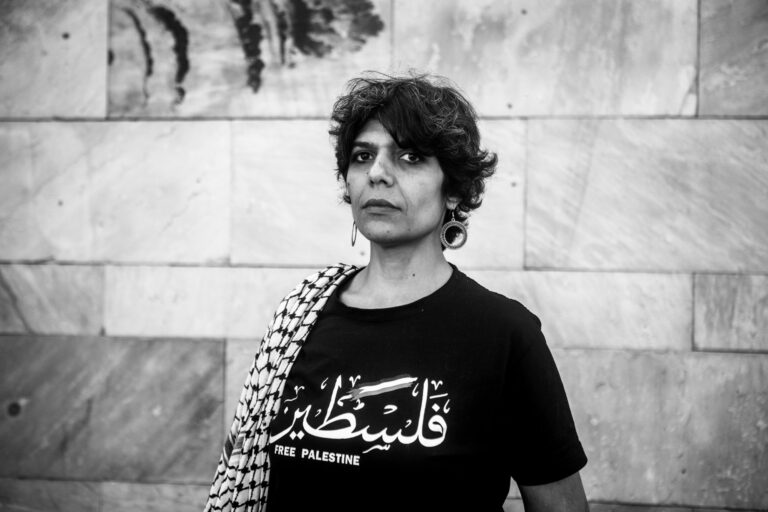
Yara Harake has spent more than a decade working for justice, freedom and human dignity. This Lebanese defender, now settled in Barcelona, works as a communication and media consultant, both nationally and internationally; the core of her work is the exploration that arises from the dichotomy between peace and conflict.
She knows what she is talking about: as a Lebanese woman she has had to live through conflict in her region; and throughout her younger years she worked with local communities, refugees, migrants and other vulnerable groups. She has carried out diversity inclusion projects and has helped dozens of people transform their realities. Highlights of her career include her work as a communications officer at the Syrian Female Journalists Network. She has also worked at Civicus Global Alliance, a human rights coalition. In addition to her human rights work in various organisations, Harake has a blog, where she shares her perspectives as a Lebanese woman, a migrant and an advocate for safe and creative spaces.
In September 2019 she arrived in Castellón de la Plana to study a master’s degree in International Studies in Peace, Conflict and Development. She had no intention of staying to live in Spain, but when she finished her studies, her country, Lebanon, was entering a spiral of economic crisis from which it has still not recovered.
“I was fine in my country; and until then there were opportunities, but then the economic crisis intensified and everything kept getting worse. People started losing money, some banks closed, protests followed one after another because people were demanding their rights… How are you going to stay in a country where you can’t imagine a future? I went back to Spain. Since then, the crisis in Lebanon has got worse: the arrival of Covid, the political crisis and now the situation in Gaza…,” explains Harake. That was how she decided to settle in Barcelona, where she already had some friends. “I chose Barcelona for the sea, because for me it is very important to be able to be close to the sea,” she says with a certain nostalgia. “If you grow up by the sea, as I did, it stays in your collective memory.” And she adds: “People label us as migrants, but they don’t see the layers of who we are; the people we were before this migration.”
She says she has been an ‘activist’, although she doesn’t like the word, for almost her whole life. “When the United States and other countries invaded Iraq in 2003, I was a teenager, and I remember attending many demonstrations. I can say that in my circle almost everyone is like that, an ‘activist’; that’s why I have never seen my involvement with human rights as something special. I have always fought and worked for collective well-being.”
Yara Harake studied biochemistry, but has never worked in the field. “I was never interested in working in a laboratory or for an international pharmaceutical company. On the contrary, I always liked listening to people’s stories and discovering the layers of their personality. That fascinates me, because we people can have lots of identities.” It was this eagerness to listen that led her to engage professionally in defending people’s rights and global justice. “Also the fact of having been born in one of the most harmed areas of the world… You grow up and realise how the system operates; how those who refuse to accept its tenets and dare to say ‘no’ get targeted.
The narratives of food
One of Yara Harake’s areas of work centres on food and the narratives that emerge from it. She says she loves cooking, and that this too is an act of resistance and political struggle. The activist has taken part in care processes for abused women and survivors of violence that centre on cooking and food.
“Cooking can act as an archive and as resistance. Why do Israelis destroy Palestinians’ olive trees in the occupied West Bank? Because the olive tree is a symbol of Palestine, and is directly related to the story and narratives of the Palestinian cause. Why does the State of Israel plant pine trees where there used to be olive groves? Precisely for that: to uproot the past and destroy the narratives. Talking about food and specific dishes is also a way of resisting,” she concludes.
Lebanon, a country at a crossroads
In recent months, Lebanon has been at the epicentre of the war that began on 7 October 2023 in Gaza. Attacks by the Israeli army have spread to southern Lebanon, the Beqaa region and some districts of the capital, Beirut, because of the Lebanese militia Hezbollah’s support for the Palestinian militia Hamas, which until that date controlled Gaza. The peak of recent hostilities between Israel and Lebanon came on 17 and 18 September 2024, when dozens of pagers and walkie-talkies exploded simultaneously in a coordinated attack carried out by Mossad. Since then, Israeli attacks in southern Lebanon have not stopped. Although a ceasefire came into effect on 27 November last year, hostilities continue to this day and the truce has been repeatedly violated, which has caused the displacement of both Lebanese and Israeli populations.
Before Lebanon was drawn into the war in the Gaza Strip, the country was already going through a difficult time due to a major financial crisis caused by the collapse of the exchange rate in 2019 (the value of the Lebanese pound then fell by up to 98%), which caused a large part of the population to lose their life savings; the explosion at the port of Beirut in 2020 (which left more than 200 dead and incalculable damage); and the outbreak of the COVID-19 pandemic. The liquidity crisis, linked to inflation, corruption among the political class and mismanagement, has forced the country to request humanitarian aid from foreign countries.
During these years, the economic instability of this country of fewer than six million inhabitants, yet located at a strategic point in the Middle East, has gone hand in hand with significant political instability. After more than two years with a caretaker Government led by Najib Mikati (since the legislative elections held in May 2022), the country has recently managed to form a new Executive. Just a few months ago, the new Lebanese president, Joseph Aoun, appointed Nawaf Salam as prime minister, who faces several important tasks, such as ending hostilities with Israel and reviving the country’s economy.
You don’t like to define yourself, or be defined, as an activist.
I don’t like the word ‘activist’ because I think activism is a way of being in the world as a conscious citizen. We ‘activists’ are not extraordinary people, or special, and we don’t have anything different. Activism is deciding that you have rights and that you have responsibilities towards those rights, both your own and other people’s. Being an activist is being present in everyday life.
In your professional career, what has been the hardest work?
Working with people with complex life stories is emotionally draining. For many years I was conducting interviews with people affected by war; with refugees, and so on. They were displaced people, coming from Syria, Palestine, Turkey, Jordan. I also got to know many people who arrived from Sudan, many of them domestic workers. Seeing the suffering of all those women, the racism they endured, the struggle to get their papers, the abuse they were subjected to at every level… That wore me down a lot; above all because in those situations you can be neither objective nor neutral. In fact, I have sometimes had to take breaks from this work and do something more routine, so that I could heal personally. I am interested in positive communication that focuses on people, but not only through their hardships, or the narrative of war. The issue of Palestine has always affected me deeply, because of the area I come from and as a matter of justice, for them and for our region. I have also been able to work on projects with people from Bolivia, Peru and Central America. Through that I have learned about struggles, which are often intersectional. Working on different causes has given me a broad view of the world. Those who take advantage of the system are always the same, in every part of the world.
You have had a lot of contact with Palestinians. How are you experiencing everything that is currently happening in Gaza?
It’s incredibly hard. I have friends in Gaza, in Jordan, where I lived for two years; in what is considered Israel; Palestinian friends who live in Lebanon… Palestine, in a way, is also my home; so all this horror affects me deeply. The horror has always been there, but we didn’t see it. Now, with social media, we see it every day; that’s also why what is happening has been normalised and why people have become desensitised. We are anaesthetised. But really, how I feel doesn’t matter; because we need to talk about Israel, about the United States, about the position of the European Union.
There have also been bombings in Lebanon.
I have family in southern Lebanon, which was bombed by Israel. The situation is lived with a great deal of horror and tension, because one day you are talking to your family and you don’t know what will happen the next day, whether they will survive that night or not. That is what is happening in Gaza, although the situations are not comparable. Gazans living here [in Catalonia] don’t lead a normal life, because they are constantly following what is happening there. That is a form of terrorism: when a country decides that it can simply attack another, that is terrorism. Israel’s attack on Lebanon is an act of terrorism, whatever they say.
You have worked on reconciliation processes. In the case of Palestine and Israel, is it possible?
What is peace? What matters is justice. Conflicts are commonplace and happen in every sphere, within communities themselves. It is something very human and very natural, and they are part of our everyday lives. In the case of Palestine, the Israelis have spent years insisting on a narrative that is not true: what God gives away land? The first challenge is to deconstruct a false narrative and acknowledge what has been done. I don’t have solutions, but I know that everything depends, in this case, on accepting that Israel is a colonial State present in a territory made up of different ethnic groups, most of them Arab. The first thing is to acknowledge that something wrong has been done; and then to begin a process of reparation and justice. I don’t believe in the two-State solution; Palestine is the only State. On the other hand, and going back to the issue of narrative, we need to be careful with language. When we talk about the ‘Near East’, what exactly do we mean? Or what does ‘Arab world’ mean? Cultures are diverse and approaching realities as blocs doesn’t help; we need to deconstruct the blocs and show the different layers of the issues. We are not exotic.
In a previous interview you said that conflicts are an opportunity for the positive transformation of society. In a world plagued by conflicts, is that possible?
The world has been warning us for some time that things are not going well. And to answer your question: it is not impossible, but it is harder now, because we don’t have enough tools to fight such a powerful system. What we can do is move forward little by little. We lack the imagination to think that things can be different. The vast majority of us think of an apocalyptic world, but we can change things if we start from the bottom up: education is the most important thing. Education understood as relationships in homes, in schools, in the neighbourhood, in the community. We have lost our connection with our surroundings. If we don’t say hello to our neighbours, how are we going to have empathy for the people of Gaza? I always say that I won’t let this world change me. People are not bad, nor do they have anything personal against others; it is the environment we live in, the speed at which things happen. When you start to imagine that you can change something, that your behaviour can influence others, everything changes. It’s difficult, but it’s possible.
We live surrounded by dystopias; there is little room for utopia and for the possibility of thinking that everything can get better. This is so because it benefits the system; but also because the idea of a global utopia that serves everyone does not exist. Around the world we share some basic values, but then the cultural values of each community may differ. In a pluriverse world it is difficult to find a solution that works for all of us, but that doesn’t mean we can’t think about them.