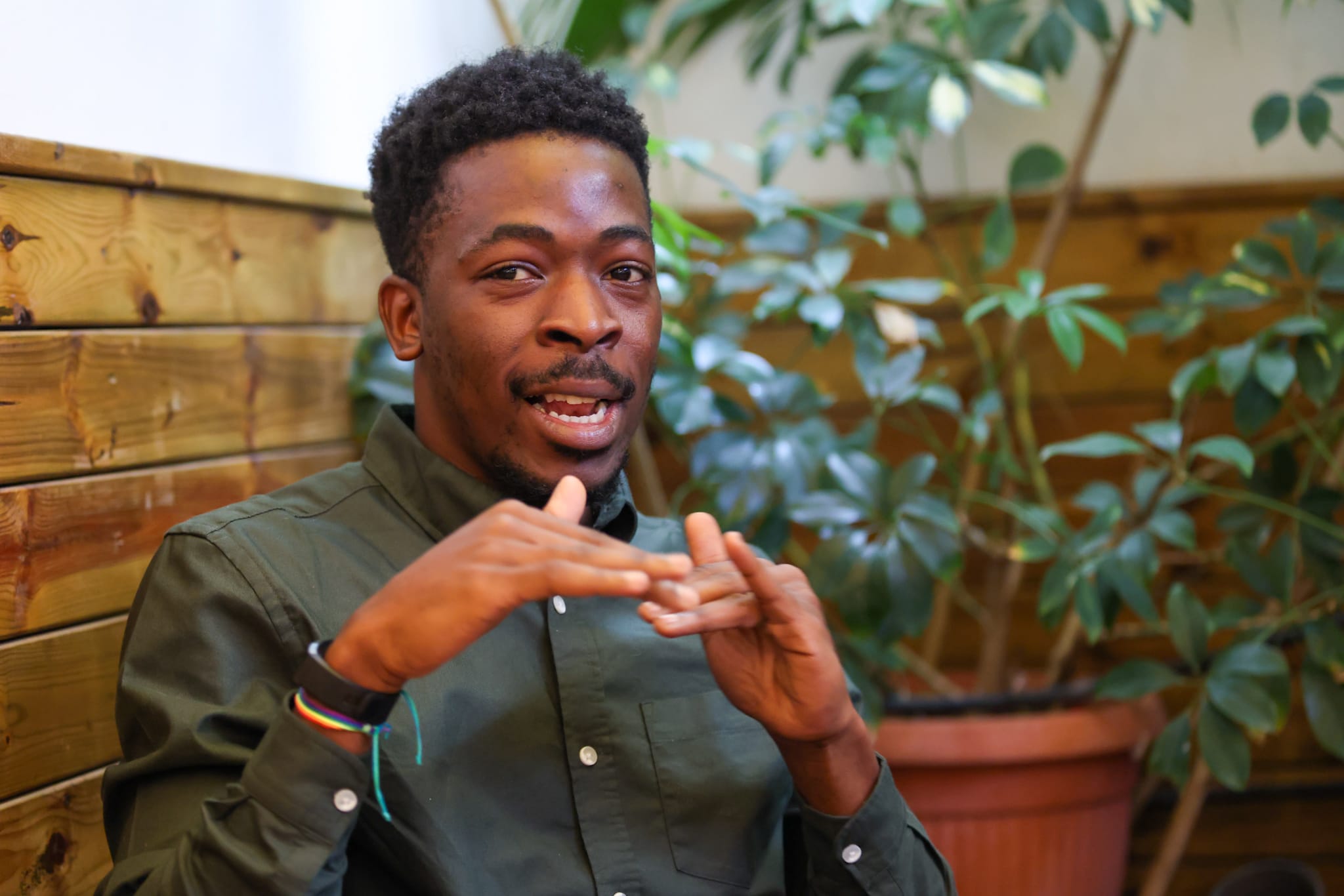
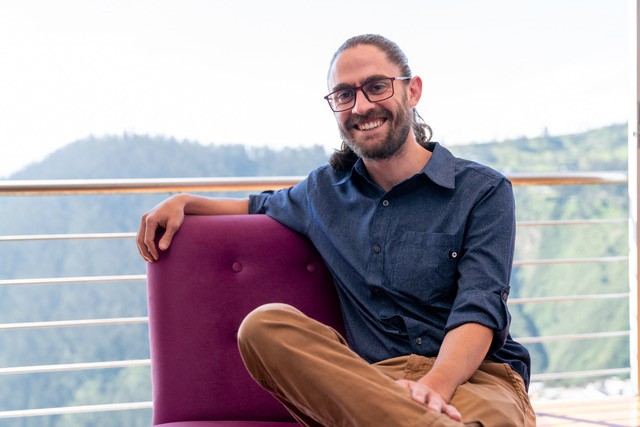
Jenkidar Shikhdmmar, Rojava’s representative in Spain, was born in 1986 in Kobani, a city in northern Syria that rose to fame in 2014 for the stoic resistance of its population against the siege by the Islamic State. Since 2019 he has lived in Catalonia, where he represents the Kurdish-Syrian movement and is studying for a PhD in Political Science at the University of Barcelona (UB). For this reason he wants to continue his life in Catalonia and has just co-founded the cultural organisation Berfin, which seeks to bring together the Kurdish population living in Catalonia.
As is the case for most Kurdish people, Jenkidar’s life has been marked by lack of opportunity, discrimination and conflict. He remembers a childhood in Kobani in which people emigrated to other countries to send money to their families or struggled to grow wheat and harvest pistachios and olives. From a family that has worked in carpentry for generations, with a grandfather, father and brothers who were all carpenters, Jenkidar was unable to pursue higher education in his youth, as he had to help his father in the family workshop.
“Kobani was very poor, we had no major investment, and there was a lot of pressure from the [ruling party] Baath. There were no water supply systems, and we used tanks. Many people did not go to university because they had to work to survive,” Jenkidar recalls. “Women in particular did not continue studying at university. If anything, it was a cultural issue typical of a conservative society, because to study you had to go to cities such as Aleppo, Damascus or Latakia, and many parents would not send their daughters so far away. So women had to get married,” he adds, and says that “this situation began to change from 2000 onwards, with the rise of the Kurdish movement for women’s rights and equality”.
Jenkidar’s life was upended by the civil war that broke out in Syria in 2011. Not wanting to serve in the Syrian Army, he fled to Lebanon, where he forged a completely different future from the one that awaited him in Syria: he studied Political Science and completed two master’s degrees while working as a carpenter and painter, in lift maintenance, even as a film extra, and collaborating with organisations such as Caritas and UNHCR. In 2019, he moved to Catalonia, where he continued his studies and became Rojava’s representative in Spain in 2021.
“I used to say I was the representative in Spain of the Autonomous Administration of North and East Syria (AANES), but lately, since the administration no longer exists because it has been integrated into the structures of Syria’s interim Government, I introduce myself as the representative of Rojava,” Jenkidar now regretfully says, a reflection of the new position of this people, who make up around 15% of Syria’s population and live mainly in the north-east.
The Kurdish people, without autonomy in the new Syria
The Kurdish people are considered the largest stateless nation in the world. They currently number around 45 million people who, after the break-up of the Ottoman Empire, were divided by the recognised borders of four countries: Iran, Iraq, Turkey and Syria. In all these States the Kurdish community was repressed, although, after decades of resistance and struggle for basic rights, the 21st century brought hope: the invasion of Iraq made possible an autonomy that today allows the Kurdish authorities to issue their own visas and have their own armed forces in Iraq. When civil war broke out in Syria, many people hoped to obtain a similar form of autonomy. However, in 2026 the United States (US) has withdrawn its support for Rojava, and the Kurds have set aside their aspirations for decentralisation. After almost fifteen years of war, the final aftertaste is bitter.
Like many other communities, the Kurdish community was repressed by the al-Assad dynasty in Syria. When the civil war began, the Kurdish forces regrouped in the north-eastern third of the country and, once they controlled their borders, set up an autonomous administration that followed the precepts of Abdullah Öcalan’s democratic confederalism. For more than a decade, the Kurdish forces had the support of the international community and concentrated on fighting the Islamic State while, at the same time, governing their territory under the AANES.
After the fall of Bashar al-Assad’s dictatorship in December 2024, the jihadist militia that led the lightning offensive seized transitional power in Syria and began demanding that the various militias that had operated during the conflict be integrated into the new Government. The Kurdish and Druze communities, taking into account their positions on the ground, did not accept this, and began negotiating an agreement to secure rights and decentralisation. However, after a year of negotiations, in 2026 the US withdrew its support for the Kurds, who, left with no options, have had to accept an integration agreement that is far from what they had hoped for.
In this way, the US has chosen to placate an essential ally in the region, Turkey, which is the main guarantor of the current Syrian leader Ahmad al-Sharaa. For it is Turkey that has insisted on burying Kurdish hopes since the very beginning of the war: had Rojava opposed the latest agreement, Ankara would have attacked or delegated an attack, and a new conflict would have engulfed the population.
The Kurdish community, which feels betrayed in Syria, is key to the current reconfiguration of the Middle East. A shifting board on which this community is looking towards Iran, where the US wants to topple the ayatollahs’ regime, which would have consequences in Iraq, where Iranian influence is predominant; in Turkey; and, who knows, perhaps even in Syria once again.
Your family lives in Kobani. What is the situation like there?
In Kobani specifically, the population has grown enormously; around 700,000 people live there, almost twice as many as before, because there are displaced people from other cities. Many people are sleeping in cars, living in unfinished houses without windows or doors. Some are waiting for the checkpoints to open so they can return to their homes, but others are afraid and do not want to go back to Aleppo or Raqqa. Trust between the peoples of Syria has been weakened. Significant work is needed to restore that trust. Right now, there is hate speech from Government officials, and insults from people on social media. They call us Kurds kafir (infidel).
Could we witness massacres like those suffered by the Alawite or Druze population in 2025?
Anything is possible. We have reached agreements with this Government that have not been honoured. We do not trust them. The latest agreement is the one of 29 January, which is insufficient for the price we have paid during the war. Since 2014, we have defended the world from the Islamic State, and we have thousands of martyrs. We thought that in the negotiations we would obtain more rights but, unfortunately, that has not been the case. In a way, we were forced to sign this agreement: we considered resisting, but we were cornered, with everyone against us. Now our priority is to keep the population of Rojava alive. And not only the Kurds, because Circassians, Arabs, Armenians and Turkmen also live in this region. But we do not want to fight any more; we do not want any more deaths. So we have reached an agreement.
The US no longer supports you…
The US is with Turkey, and they reached an agreement contrary to the interests of the Kurds. And, without the US, our situation is precarious. The international community backed Ahmad al-Sharaa instead of the egalitarian, feminist democracy that we propose. For Trump, Al-Sharaa has done a great job, which in reality has been massacring Alawites, Druze and Kurds. As I told you, we considered resisting, but the cost would have been very high.
What does the agreement between the AANES and the Syrian Government stipulate?
We will have cultural rights, our language, which is still not official. We will try to have the Kurdish language taught in all schools in Kurdish-majority areas. We will be integrated as a bloc into the army with three brigades, in Jazira, Hasakah and Qamishli-Amuda, and with a special brigade in Kobani. We are entitled to a deputy leadership position in the Ministry of Defence. We have proposed a person whom Turkey does not accept; it says he is a member of the Kurdistan Workers’ Party (PKK). Disputes still remain, however. For example, this transitional Government has a mindset that does not allow women to take part in the armed forces, which clashes with our commitment to women. For now, our main task is to end the suffering of displaced people, who have not been able to return to their homes. There are people who have been displaced from Afrin since 2018.
Given the ongoing demographic change and the sense of insecurity caused by the jihadist groups present in Afrin, do these displaced Kurdish families want to return there?
We are coordinating so that displaced people can return. They carried out a demographic change; they brought in Arabs from Ghouta, around Damascus, from Homs, from Idlib. Other people are occupying houses that belong to Kurdish people and they are afraid. There is no trust. As leaders of Rojava, we must give people the opportunity to return. If they do not want to, we will offer them land elsewhere so they can have a decent life. But the policy of demographic change is not new in Syria. It has been in force for 50 years, with the Arab belt in Serekaniye, Qamishli and Derik. In addition, many Kurds who do not have citizenship —they are stateless— and who had no right to study or work are not counted in the statistics.
But now their citizenship will be restored.
Yes, I hope that [the authorities] do not follow the Baathist mindset and accept that human beings have rights. For now, they say they will give us basic rights. So we have to work in the political arena to obtain more rights. There are no battles, and now it is time to do politics. We want to keep resisting through politics. For now, since not all Syrians are Arabs, we want to remove the word Arab from Syria’s name.
The Kurdish PKK guerrilla has begun a new process of dialogue with the Turkish State in which it has announced its dissolution. The process is continuing, even though Turkey is the one that has buried Rojava’s autonomy project.
We make our decisions, and the PKK makes its own. Abdullah Öcalan took this decision for many reasons, but he understood that nothing more could be achieved with weapons. So he thinks it is better to fight through political means. In addition, there is a regional shift in which they want to put an end to the Shia axis in the Middle East. Israel attacked Hamas in Gaza and Hezbollah in Lebanon, and now it is Iran’s turn.
Do you think an independent Kurdistan in Iran is feasible?
It is a deep debate within our community. The Kurdish population, from its left-wing ideology, says it does not want a country, but to live with rights; but if you ask, deep down it wants a country of its own. The thing is, everyone knows that it is very difficult to achieve a State of our own. The same is true in Iran. Six Kurdish parties in Iran have announced a coalition and I believe that, in the coming months, the ayatollahs’ regime will fall.
After a decade of hope in Rojava, is it the moment for Iranian Kurdistan?
Our problem is Turkey, and they (the Turks) are also sticking their noses into Iran.
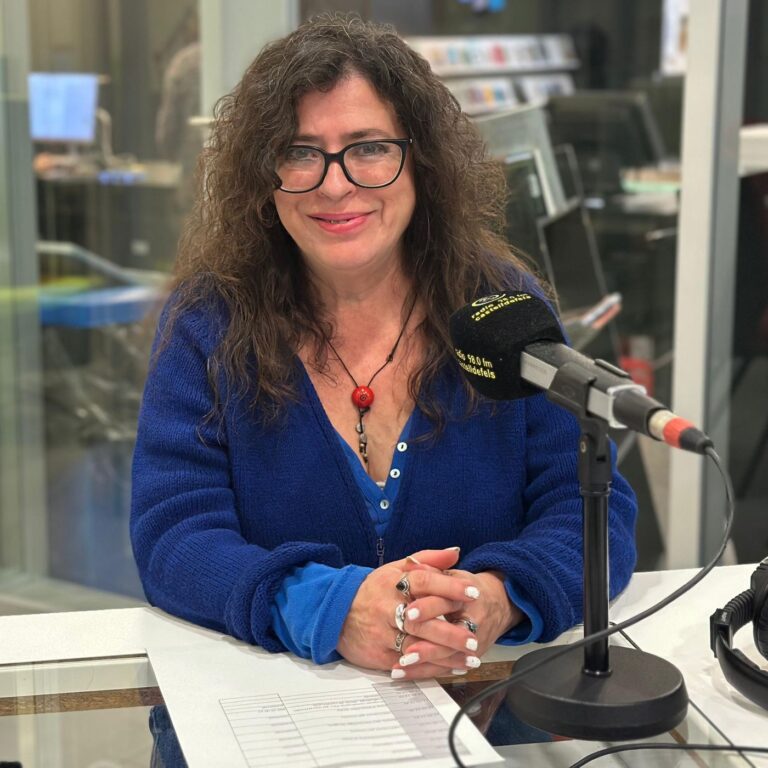 Radio Castelldefels · 21/04/2026Drets Humans: entrevista amb l’activista kurd Jenkidar ShikhdmmarRead ↗
 rtvvilafranca.cat · 21/04/2026Vilafranca acull dues persones que participen en la gira Ciutats Defensores dels Drets HumansRead ↗
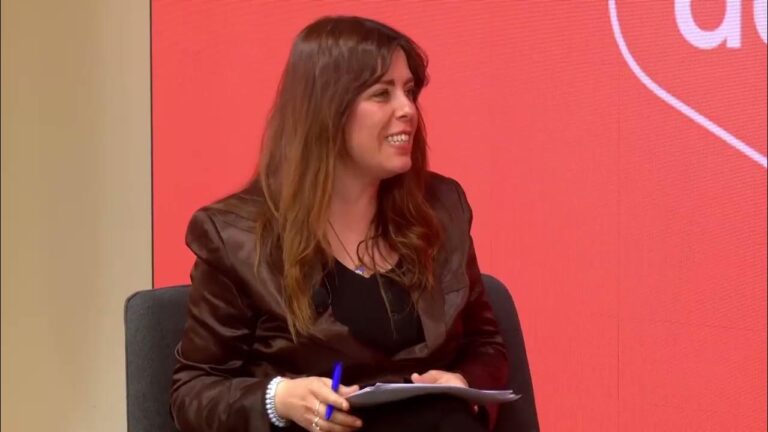 Valles Visio · 15/04/2026Especial Drets Humans: entrevista a Jenkidar ShikhdmmarRead ↗