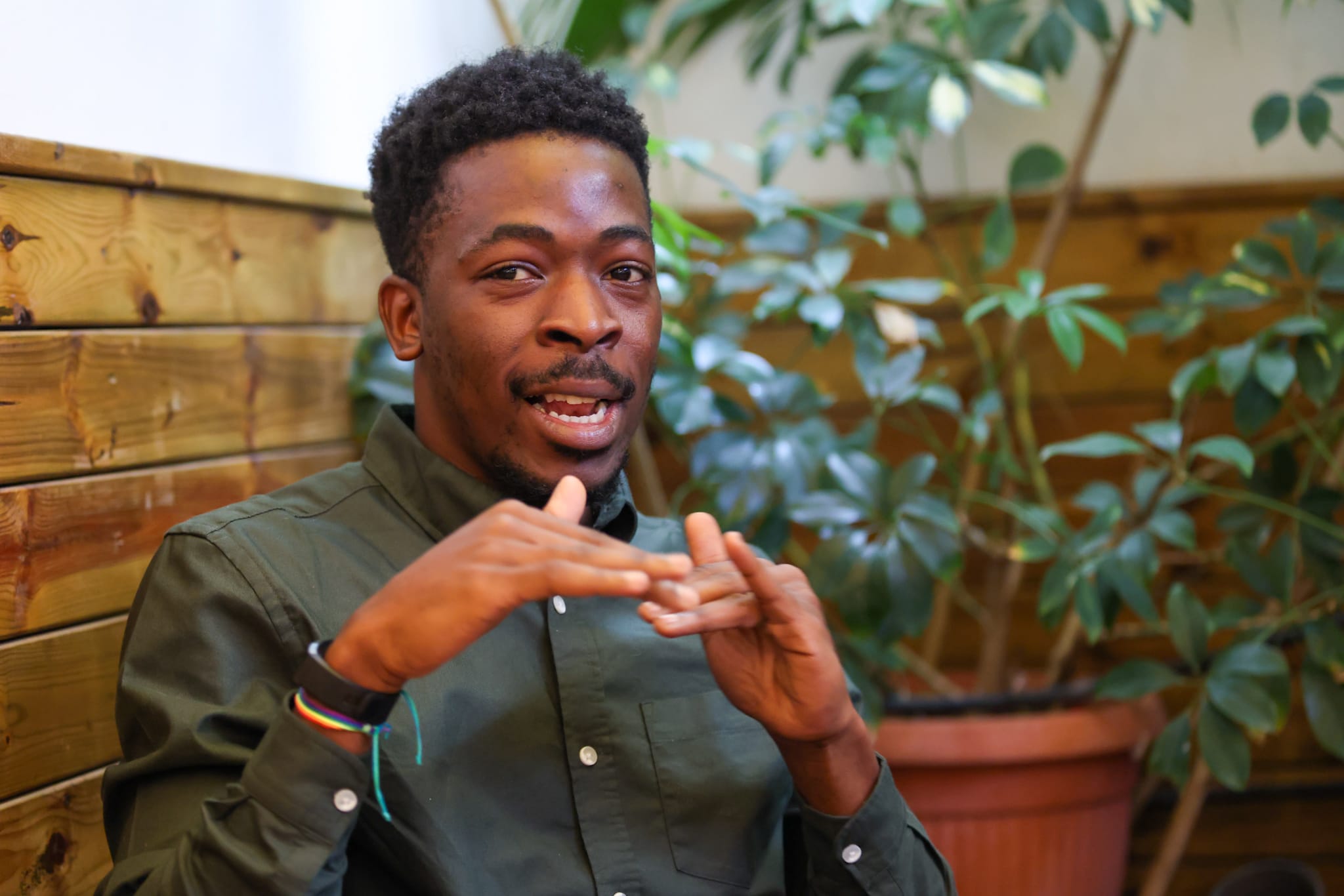
Athens-born Iasonas Apostolopoulos studied civil engineering, but after visiting the island of Lesbos in 2015 he knew he would never work as an engineer again. That year, more than a million people arrived in Greece, mainly from Syria, Iraq and Afghanistan. Faced with that humanitarian tragedy, dozens of young people from Greece, but also from other parts of the world, settled on the islands for weeks to provide assistance to the migrants arriving there. Iasonas Apostolopoulos was one of them; and those weeks on Lesbos changed his life completely.
Ten years have passed since he began his humanitarian work on Lesbos, and the activist now works as a coordinator for the Italian humanitarian organisation Mediterranea Saving Humans, where he leads search and rescue operations in the central Mediterranean aboard the rescue ship Mare Jonio.
In addition to his work aboard the Mare Jonio, Iasonas also takes part in political events, talks and debates on migration and reception. Unfortunately, this has brought him insults and death threats on social media. His fierce criticism of the Greek Coast Guard and its responsibility for dozens of deaths in the Mediterranean has for years put him in the crosshairs of the Greek far right and right, who often brand him a “traitor to the homeland”.
The Greek Coast Guard under scrutiny
The constant criticism and public denunciation to which Iasonas Apostolopoulos—but also other Greek activists and alternative media—subject the Hellenic Coast Guard are not without foundation. On several occasions its responsibility has been demonstrated in pushbacks (forced returns on the high seas, not provided for under international law) or in its dereliction of duty regarding the obligation under international maritime law to carry out rescues on the high seas.
Currently, 17 Greek coast guard officers are under investigation and face possible criminal charges over the Pylos shipwreck, in which some 650 people drowned in June 2023. It was the deadliest shipwreck recorded in the Mediterranean Sea in recent years and, according to the testimonies of the survivors (104 people), it was not an accident: the capsizing of the vessel was caused by an abrupt manoeuvre by the Coast Guard while it was trying to tow it towards international waters; in other words, during a pushback manoeuvre.
Thanks to years of effort by Greek human rights organisations, and also to investigations by Forensic Architecture, The Press Project, Amnesty International (AI), Legal Centre Lesvos and Human Rights Watch (HRW), among others, a group of coast guard officers has been brought to court. The captain of the patrol boat present at the time of the shipwreck is accused of causing the vessel to capsize and of failing to assist the migrants; and the rest of the crew, of complicity. All of them are accused of failing to fulfil their rescue obligations: once the vessel had sunk, they took between three and four hours to get people out of the water.
Moreover, the irregularities committed in the hours before and after the shipwreck raise suspicions that the lack of assistance was deliberate. Although two years have passed since the tragedy, the Coast Guard has not provided the communication records from those hours; nor are there any transcripts of the moment of the capsizing, or any audiovisual record, despite being obliged to keep them.
The central Mediterranean, the largest cemetery in the world
One of the things that most strikes Iasonas Apostolopoulos is how a sea that welcomes hundreds of thousands of tourists every year is also the largest mass grave in the world. It is estimated that between 2015 and 2025 some 30,000 people lost their lives trying to reach European shores.
The lack of safe routes and the attitude of both the EU and countries such as Italy, Malta, Spain and Cyprus have contributed to this harrowing figure. As the Greek activist points out:
“Today, the only way for a human being to apply for asylum in Europe is to pay a smuggler and risk their life at sea. There is no other option. In 2025 there is no safe or legal way for a human being to exercise this internationally guaranteed right: the right to asylum.”
Safe entry routes for people from North Africa or from countries such as Pakistan, Syria, Bangladesh or Afghanistan are closed; as a result, the options for migrating are few and unsafe. On these crossings, which can last for days and are made in extreme conditions (overcrowded boats, with almost no food or water), these people have to face violence not only from criminal gangs but also from the coast guards of the different countries, which for years have been carrying out a policy of forced returns not provided for under international law.
According to UNHCR data, since January 2025 some 23,000 people have arrived in Greece and some 33,000 in Italy. Figures for the dead and missing on these routes tend to be imprecise, as it is often difficult to know for certain how many people board each vessel.
In 2015 your life changed with the so-called “refugee crisis”.
Exactly. I had studied civil engineering at the National Technical University of Athens and had a master’s degree in environmental engineering, but in 2015 I decided to move to Lesbos to help the people arriving there. There we worked side by side with Open Arms, who were among the first to arrive on the island.
I went for two weeks to hand out clothes, food and water and ended up staying for nine months. On 28 October 2015 I witnessed one of the worst tragedies of my life: I saw 300 people sinking in front of us, about two miles off the coast. We couldn’t do anything because at that moment there was no rescue boat available. More than 70 people died in front of us.
Seeing that whole beach full of bodies affected me deeply. That same night we organised an assembly and decided that we could not limit ourselves to handing out basic necessities: we had to form a rescue team. We brought the first rescue boat to the island because the first team there was very kind, but didn’t have one. They only had two jet skis.
There is a before and after Lesbos in my life. What we experienced there was so intense that I left everything behind. Since then, I have been part of other rescue groups operating in the central Mediterranean. Over the last nine years, after Lesbos, I have worked on rescue ships, mainly in Italy.
You are currently the search and rescue coordinator for Mediterranea Saving Humans.
Yes. And I am also actively involved in Greece as a human rights activist, mainly through various solidarity networks. We try to raise visibility and awareness of the problem of pushbacks at the Greek borders and the criminalisation of people in transit, especially those who steer the boats.
A few weeks ago the Greek government passed an emergency amendment suspending asylum procedures for people arriving from North Africa. The situation in Greece is complicated. A couple of years ago we had the deadliest shipwreck in recent history, the Pylos shipwreck, in which more than 600 people drowned. We now know that it was the Greek Coast Guard that sank the boat while trying to tow it with a rope towards Italy or Malta. The vessel was in international waters, but they wanted to push it out of Greece and more than 600 people died.
It was horrible. But now 17 coast guard officers are under investigation for their responsibility in that shipwreck. We have fought hard for this; I myself was a defence witness in the trial against the seven people who were steering the fishing boat and whom they wanted to imprison as smugglers. And yes, the fact that 17 coast guard officers are under investigation for that shipwreck is great news; I would even go so far as to say it is incredible.
Until now, we [human rights organisations] have suffered enormous criminalisation; we have been attacked by the media and by the political class. I have been harassed on social media, even by some ministers; they have called me a smuggler, a traitor and a slanderer. They have said that I am against the Greek Coast Guard because I support Turkey. And now that the coast guard officers are accused of negligent homicide, the media have gone silent.
That is precisely what we in the organisations are trying to do: change the narrative around arrivals, shift the public discourse and make the situation visible. Many people in Greece don’t know how the Coast Guard acts at sea. And that is where the organisations and some alternative media come in.
Changing the narrative on migration is also part of our work: in addition to carrying out rescues, we seek to make the situation visible; and that is why we organise advocacy activities. If we don’t communicate it, our work, which takes place on the high seas, goes unseen. It is difficult to bring journalists with us, so we know that the information has to come from us. We have to report on human rights violations, the terrible conditions in which these people live in Libya, the active role of the European Union in pushbacks, etc.
On the other hand, in Europe the political spectrum is shifting towards the right and the far right. There is a widespread xenophobic discourse among the political class. And yes, we certainly have to blame the racists who organise against migrants on the streets; but we also have to point the finger at the elites, because this hatred is passed down from the top. They invest in xenophobia because they have nothing else to promise people.
We are living in a time of crisis that extends to different areas: there are several ongoing wars, inflation, rising prices… We can’t even afford a home because of Airbnb. The cost of living is exorbitant and people are suffering. So, when there is nothing else to promise the population, the easiest thing is to blame the weakest in our societies: migrants. It is easy to find a scapegoat and direct all that energy and hatred against the poorest.
And how can or should this hate speech be fought?
By changing the narrative and breaking down the myths we hear about migration. In my talks I speak about this: do we know how many people actually arrive each year? Because if you listen to the media, you would think millions of people are arriving; but that’s not the case. Only around 200,000 people arrive by sea each year. It’s an incredibly small, ridiculous figure.
The rhetoric that we can’t take them in because there are too many of them is a lie. How were we able to take in 4 million Ukrainians in two months? That was fantastic; why can’t we do the same with others?
Another important point is to stop talking about “illegal immigrants”. Talking about legal or illegal people implies that regular travel is an option, when it isn’t. Today, the only way for a human being to apply for asylum in Europe is to pay a smuggler and risk their life at sea. There is no other option. In 2025 there is no safe or legal way for a human being to exercise this internationally guaranteed right: the right to asylum.
And how many people in Greece know this?
Very few.
How has the situation in the central Mediterranean changed over the last 10 years?
Repression has got worse. Much more money and resources are now invested in blocking the arrival of migrants in Europe; and a great deal of effort is also going into restricting civilian search and rescue activities.
On the other hand, we organisations have a civilian fleet of more than 20 ships spread across Europe, which means there is a large solidarity movement.
And you have faced a lot of criminalisation.
Yes. We have faced all kinds of repression: from the arrest of captains, as in the case of Carola Rackete; we have also been accused of human trafficking; our ships have been held in ports for bureaucratic reasons; they have been confiscated, etc. Under Salvini, Italy closed its ports; under Meloni, they now send us to more distant ports, such as Venice, Ravenna or Ancona, which are days away. We lose money and fuel.
However, the most serious thing of all is the dehumanisation of migrants, who are portrayed as a threat to Western countries, as enemies, as invaders. That is why I insist: we need to show people that the enemy is not the refugee, but racism and violence against the weak, which is poisoning every sphere of our society.
Because, for now, refugees are the main targets; but sooner or later, all this hatred will be turned against other less privileged groups, wherever they are from.
The idea that some lives matter more than others is the basis of fascism, which is the greatest threat to our society. Racism and fascism created two world wars; the Holocaust, colonialism and all these wars we are witnessing now. It wasn’t migrants.
What saddens or angers you most about the situation?
That the sea that welcomes millions of tourists every year has become the deadliest sea on the planet. It is a huge cemetery. Over the last ten years, more than 30,000 people have lost their lives in the water.
And these deaths are not the result of an accident or a natural disaster: they are the result of a European policy designed so that asylum seekers have no legal and safe routes. It is the EU that pushes them into the hands of human trafficking networks.
Then there is the issue of assistance: they are not rescued when they need help. The policy of non-assistance is common: we constantly call the Italian, Maltese and Greek coast guards; we tell them that there are people dying, in danger… They ignore the distress calls.
Witnessing death is one thing; and it is very hard, it is very hard to recover bodies from the sea, but it is harder to realise that behind these deaths there is a political decision, that they could have been prevented. They deliberately let people die so that others won’t come; and that is shameful. It is a disgrace not only for Europe, but for all of humanity.