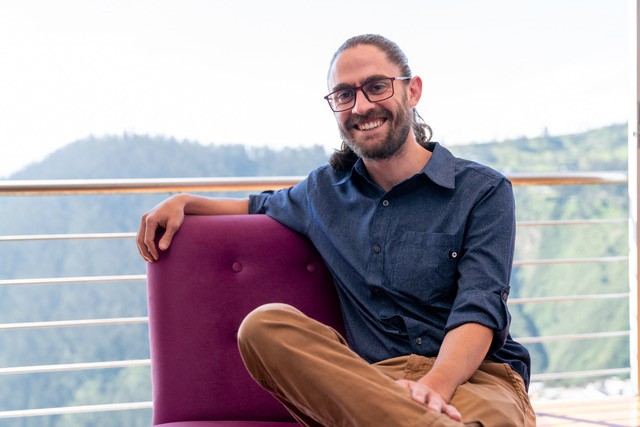
The story of Bruno Álvarez and his work with migrants began in Athens, on a volunteering trip. In the Greek capital, he worked for a couple of weeks at the port of Piraeus while waiting for his company to call him to offer him a permanent contract: Bruno was a flight attendant at the time.
That trip to Athens was followed by another, which he made after hearing about the situation migrants were facing in Belgrade, so without thinking twice he set off for Serbia to help distribute winter clothing. “At that time, the Serbian government had banned humanitarian assistance in the barracks, but Médecins Sans Frontières (MSF), for example, had carried on operating to assist people. Hot Food Idomeni was in charge of distributing food. And that is the context in which No Name Kitchen was born.” On 3 February 2017 the Kitchen handed out food for the first time to people in transit. The goal was clear: to feed as many as possible of all those who needed it.
Bruno got a call from the airline he worked for, and he went back, but his head and his heart had stayed in Belgrade. “I left my job and came back to devote myself to this. And I’m still doing it to this day,” he explains.
No Name Kitchen, an organisation on the move
No Name Kitchen was born in Belgrade in 2017 when a group of volunteers began cooking for migrants who were passing through the Balkans and had become stranded in Serbia after Hungary closed its borders.
Today the organisation focuses on a range of areas of work, from medical assistance and the distribution of essential goods (food, medicine or clothing) to legal support and protection. It recently launched a new line of work in Bulgaria, Inland Search and Rescue, which aims to locate and support people who are lost or stranded in forests or remote areas of that country. “We intervene directly or coordinate with other emergency actors,” explains Bruno Álvarez.
Another of the areas in which No Name Kitchen works is collecting and archiving testimonies, so that the accounts of migration survivors and their stories of human rights violations by the various competent authorities in each country do not go unpunished. Because for the Kitchen, as the organisation is popularly known, “humanitarian aid must be complemented by political action in order to bring about change”.
To that end, in order to monitor violence at the borders, No Name Kitchen co-founded the Border Violence Monitoring Network, with the aim of publishing reports on pushbacks, border violence and other types of human rights violations suffered by people on the move during their journeys. Out of this initiative came several editions of the book Black Book of Pushbacks, which gathers the testimonies of people who have suffered pushbacks at the borders. No Name Kitchen is no longer part of this network, but it has launched the Bloody Borders initiative, whose purpose is to continue monitoring, by collecting testimonies, the violence suffered by migrants at the borders; but also rights violations in detention camps and any type of violence exercised administratively, psychologically, physically or psychologically against migrants.
At present, No Name Kitchen operates in various territories on European soil, and has projects in Zeleznik (border between Serbia and Croatia); Harmanli (border between Bulgaria and Turkey); Sjenica (border between Serbia and Montenegro); Bihac (border between Bosnia and Herzegovina and Croatia); Ventimiglia (border between Italy and France), Ceuta (border between Spain and Morocco); Trieste (border between Italy and Slovenia); and Oulx (border between Italy and France). The latter is a pilot project that is just getting off the ground.
Between 35 and 45 volunteers from every corner of the planet work at the Kitchen. “Volunteering with the organisation lasts from one month —the minimum— to three, which is the maximum. We’re constantly on the move and there are always people coming and going; many of the volunteers come back again. That’s why we say that No Name Kitchen works as a kind of activism factory,” explains Bruno Álvarez.
Thanks to the work of recent years, No Name Kitchen is now a well-positioned organisation, with a network of significant institutional support, including in Brussels. Its work at the borders collecting testimonies, providing food aid and first aid (through its Health on the Move programme, which includes the distribution of hygiene kits and basic services, as well as arranging visits to medical specialists); and distributing humanitarian aid in the form of hot meals and warm clothing, has given it an important position in the sector.
It is an organisation that operates outside the institutional sphere, and, as Bruno Álvarez explains, “the Kitchen operates wherever it is needed, we are constantly on the move”. That is why its medium- and long-term goals are not defined, because the organisation works according to the needs of the people who migrate.
The Western Balkans route
Since its creation, No Name Kitchen has always operated on the Western Balkans route (Albania, Bosnia and Herzegovina, Kosovo, North Macedonia, Serbia, Montenegro), a key transit area and corridor on the migration route to the European Union. Countries such as Bulgaria, which borders Turkey, or Croatia can also be included in the route. Although this route saw its peak in 2015, when arrivals in European territory reached an all-time high, in 2019 there was a resurgence in the use of these borders.
Over these years, what have been the main difficulties No Name Kitchen has faced in operating? Many of the countries you work in have carried out very serious criminalisation campaigns.
They’ve tried to provoke us on a number of occasions. For example, at first, as we weren’t registered as an organisation, they couldn’t say anything to us. Later we had other kinds of problems: raids, confiscations, ID checks on volunteers, problems with local people holding radical and racist views, deportations of volunteers, and so on. We’ve faced many obstacles of this kind. Right now the police have had some of our laptops and mobile phones confiscated for months and we don’t know when they’ll give them back.
How are you facing the upcoming changes to be implemented at European level regarding migration [referring to the new EU Pact on Migration and Asylum, adopted in May 2024], and what are the Kitchen’s medium- to long-term goals?
Since it was born, the Kitchen has moved and adapted to the needs of people on the move; it’s a very dynamic organisation. We go wherever people go and adapt to what they need. We replicate our projects in different territories. The way we work is simple: if we see there’s a need, we go there, rent a house and stay for months or years, or however long is necessary. If we see that the flow of migrants is dropping because the route has changed, we leave too.
How is No Name Kitchen funded?
That’s a miracle. On the one hand, we sell merchandise online; we also receive money from foundations and attend fairs where we talk about our work. When the volunteers return home, they organise fundraising events and talks; we raise some money from that too. We also receive micro-donations.
Since 2017, when has police violence against people on the move at the borders been at its worst?
I think things are a bit better now than a few years ago, because the number of people in transit has fallen. Police violence at the borders continues, but now we need to look at the mafias. Before, migrants paid the mafias to reach the Balkan countries, and there they organised among themselves to cross together. Now that has changed and it is the human trafficking networks that control these crossings; they even extort the families of those who migrate so that they keep paying. Violence is still present at the borders, in different forms.
Have you seen an increase in the use of Artificial Intelligence at borders to control migration flows?
Just by looking at how Frontex’s budget has evolved, you can get an idea of how much is being invested in borders. Over the last ten years there has been an enormous change; and with the European Union’s new Pact on Migration and Asylum these controls will increase, there’s no doubt about it. When we started, there was hardly any talk of AI at borders.
And which would you say is the most dangerous route right now?
We’re not in the Mediterranean, but for me, getting into a pirogue in Senegal bound for the Canary Islands… It seems incredibly dangerous to me. You risk your life and you have a lot to lose. It’s true that there are deaths at the Balkan borders too, mainly because of the harsh weather in winter, but it’s not comparable to the deaths at sea.
What would you change about the way migration is covered in the press? People seem to have become desensitised to the stories of those who migrate. Too much data?
For us, the challenge lies in reaching the section of people who pay no attention at all to this situation, for whatever reason: because they change the channel when it comes on TV, because their algorithm doesn’t show them what’s happening… The challenge is for the stories to reach those people. Another issue to bear in mind is to see how, why and where far-right discourses against migration are gaining ground; that’s another challenge. To halt these discourses it’s important to do advocacy work: go to primary and secondary schools, tell the stories… And if even one person listens, that would already be a success. We have to do this from within organisations, but it would also be interesting for people who have lived through a migration process first-hand to do it. But for that, they can’t be working 10 hours a day in a slaughterhouse: these people need to be freed up, given a salary so they can devote themselves to it. And we’re not achieving that; there’s a lot of work still to be done.
One of the Kitchen’s areas of work, besides distributing essential goods and providing assistance at the borders, is collecting testimonies, which is essential so that perhaps in the future those responsible for the systematic violation of the human rights of people who migrate can be identified.
Exactly. At the time we founded the Border Violence Monitoring Network and brought out a book, the Black Book of pushbacks, funded by The Left. We collected the testimonies with a legal focus; so that if, at some point, a judge in Germany wants to investigate a case, they can do so. The Kitchen has something very good going for it, which is that it builds trust with people; in the official camps, the ones run by institutions, there are no reference people to whom migrants can tell their stories. On the one hand there’s neglect on the part of the administrations, and on the other, it’s the young men and women themselves who don’t want to tell their stories in that context. They see us as friends; we spend a lot of time with them; that’s why we have access to their stories. We do try to be very careful, though, and we approach people on the move in the most human way we can, because many of them have very serious trauma. For some stories we have more details, for others fewer; but our duty is to document them all, in case one day justice can be sought somewhere for what is being done to these people. Putting it in writing and making it known is fundamental.