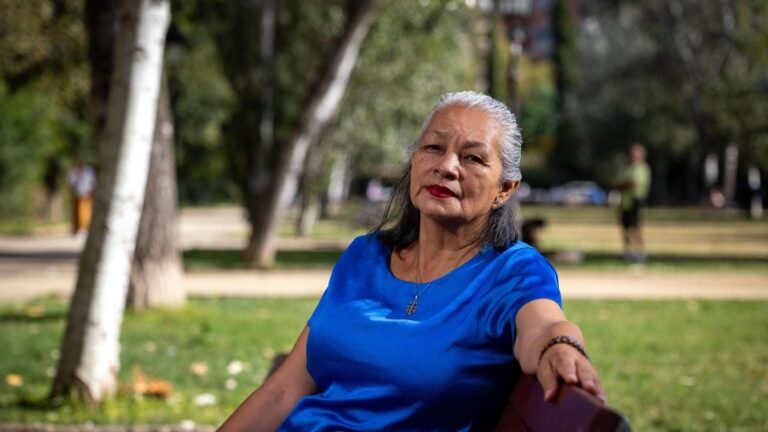
María de Lourdes Ruiz Bravo (Guadalajara, Jalisco region, 1963), known as “Mamá Lulú”, the sixth of eight siblings, looks back fondly on her childhood. “There were lots of us and we went without, but we were close,” she says. “Our special days were Sundays, when the whole family spent time together and we ate arbolitos, broccoli or cauliflower,” she adds. María de Lourdes Ruiz Bravo (Guadalajara, Jalisco region, 1963), known as “Mamá Lulú”, the sixth of eight siblings, looks back fondly on her childhood. “There were lots of us and we went without, but we were close,” she says. “Our special days were Sundays, when the whole family spent time together and we ate arbolitos, broccoli or cauliflower,” she adds.
Her childhood soon gave way to a series of traumatic experiences that have marked her life to this day. At 17, Mamá Lulú had to leave home because her brothers-in-law tried to abuse her. So as not to cause problems for her parents and sisters, “because those men were violent”, she left home and ended up with a “bad man” who abused her for 27 years: he came home drunk, had relationships with other women, and was violent. One day she said “enough” and separated her life from that man’s, whom she never married but with whom she had six children.
To provide for her children, Mamá Lulú worked for a telephone company and at a school. Just when life seemed to have granted her peace and stability, the most traumatic period of her life began: in 2015 her son José Marcos disappeared. “Since they wouldn’t give me time off school, I went out searching on Saturdays and Sundays. I spent my time looking for any clue,” she recalls. Five years later, life dealt her another blow: her daughter María de Lourdes also disappeared.
It was then that she was dismissed from the school where she worked and, in 2021, she joined a group of people with missing relatives and co-founded the collective Luz de Esperanza. After several years of struggle, irreconcilable differences arose and she left. But she did not stop, and turned to the newly created Fundación Entre Cielo y Tierra. The collective devoted itself to covering the region with pictures of the disappeared in Guadalajara, in Jalisco, the region with the highest number of missing people in Mexico: more than 15,000.
To tell the story of this struggle, with the help of her psychologist Belinda Aceves, she has just published the book Hasta encontrarles. Crónica de una esperanza en Jalisco: Lulú, madre buscadora, with which she hopes to comfort those going through this traumatic experience. “The first message of the book is for people going through this to know that they are not alone, that they can turn to a collective,” she explains, adding: “People need to be more empathetic, to understand that our children didn’t raise their hands to be taken. Once I was told that all the disappeared had left because they had decided to, and that’s a lie. Nobody wants to live through this, and we as mothers don’t want to be dead while still alive.”
Mamá Lulú is not afraid; she says she can no longer feel fear. “The family fell apart. It’s as if someone had a contagious disease. Everyone pulled away so as not to get involved with me,” she laments, describing the effects her struggle has had on her immediate family. Even so, Mamá Lulú does not give up, and never will, in her search for the disappeared in Mexico.
Mexico: thirty people disappear every day
The phenomenon of enforced disappearance has occurred in Latin America above all since the 1960s, when dictatorships or militarised governments began to repress any form of dissent, and disappearances became common practice. According to the UN, between 1980 and 2020 six Latin American countries were on the list of the ten with the most disappearances.
In Mexico, thirty people disappear every day. More than 128,000 people are estimated to have disappeared between 1952 and May 2025, although 90% of the reported cases date from after 2006. Despite the laws that have been passed, the situation is not improving: in 2024, according to Amnesty International, 13,588 people disappeared; while Red Lupa, a platform that monitors the actions of the State, points out that cases rose by 7.3% in 2023, by 6.3% in 2024 and by 12% in the first five months of 2025.
“The phenomenon of enforced disappearance is unusual in Mexico. Unlike what happens in other countries around the world and in the Americas, where people demand that States search for the disappeared, in Mexico it is families who carry out this task, owing to the inaction or omission of the authorities,” Amnesty International states in a report from May 2025. “Another particular feature of this problem in Mexico is that, although a high percentage of the disappeared are men, those leading the search for them are mostly women, organised in various collectives that today number more than 200,” it adds.
The tragedy of disappearances affects everyone, but above all women: mothers, sisters, daughters and wives; they are the main searchers. These women devote their time and money, suffer stigmatisation from society and are left unprotected by laws that are not implemented. Their work is stoic, and that is why the cartels murder them. In total, according to Amnesty International, the figure stands at 29. But the trend is worrying: while there were 16 between 2019 and 2024, in the following 18 months, up to May 2025, there were 13.
This lack of protection stems from the failure to implement the laws that protect people in Mexico. The 2025 report Disappearances in Mexico are still not a priority, produced by Red Lupa for the Instituto Mexicano de Derechos Humanos y Democracia, analyses the role of the State and the shortcomings of support programmes. It identifies a number of problems, including: poor information on the total number of disappeared people; a lack of resources to identify human remains; shortcomings in staff training; the abandonment of long-standing cases; the absence of information to guide victims; impunity resulting from the “minimal” levels of convictions; and the lack of reparations.
If not even your family stands by you, neither will the people of Guadalajara.
Lots of people see me at a demonstration, putting up posters or at the Prosecutor’s Office, but they tell me they were taken for a reason, that I wasn’t able to look after my children. In other words, there are lots of people who don’t help me, who blame me.
Do you think these people behave like this out of fear?
One day we were putting up posters and a woman came up and started saying offensive things to me: that my children were mixed up with criminals. I told her: “Madam, don’t judge. I wouldn’t wish on you even a minute of what I’m going through.” She left insulting me, swearing at me, but you won’t believe what happened: 20 days later the woman was in tears because one of her sons had been kidnapped. She came to ask me for help, but she didn’t have the strength or the dignity to say “I made a mistake, forgive me, I need you to help me”.
On the street you come across the people who could be behind your children’s disappearance.
I went to visit the narquitos at the little shops where they sell drugs. My children used to scold me and tell me not to do it, that they would hurt me. But they had no reason to hurt me: I was looking for my son. Then what happened to my daughter happened, and I also went to the place where they took her, a little drug-dealing shop. They abducted her from her home, and her eight-year-old daughter told me they had taken her to see her, that she knew where they were holding her. We went there and they asked me for my daughter’s name. They had a notebook keeping track of the people they planned to kidnap, and they told me my daughter had been taken for being somewhere she shouldn’t have been. They are very well organised, better than the Prosecutor’s Office.
Do you think your daughter María de Lourdes was taken because of your struggle as a searcher?
No, an accountant visited my daughter and asked her a favour: to receive his mail while he sorted out the paperwork for his new address. My daughter agreed, but she never asked the accountant what it was that was arriving. That man kept the accounts for someone in the cartel, who began to notice money being diverted and not arriving. That’s why they took my daughter from her home.
Your son José Marcos disappeared on 22 July 2015. Why was he kidnapped?
My son was sociable. Well, he is, not was, because he is still with me. He had charisma, he would give you the shirt off his back. He worked in a tyre workshop, and the cartel wanted him to sell their merchandise. Since he refused, they planted a woman there who sold the drugs. When my son realised, he threw the girl out and what was bound to happen happened: they took my son, his two assistants and the girl they had put there to sell the drugs. Three of them turned up dead, but not my son. The girl was punished: they beat her with planks. It doesn’t suit them [the cartel] for anyone to know who they are.
The investigation into José Marcos’s case was shelved for six years. What’s more, DNA evidence went missing. How do you view the role of the authorities?
The authorities go hand in hand with the cartel. Since they work together, they don’t want investigations to continue. That’s why my son’s case disappeared from the system; his DNA sample wasn’t there. They made a disappeared person disappear three times over.
You mean your case disappeared from the justice system three times?
Correct.
Your daughter María de Lourdes disappeared on 13 August 2020. Did the authorities act just as negligently?
A year and eight months later they went to search the place where she was taken. What happened? Well, there was no trace, the house had already been stripped. The Prosecutor’s Office never did anything; it said everything had been investigated and there was nowhere to look for her.7
Since López Obrador, the left has governed Mexico. Now the country is led by Claudia Sheinbaum. Do you think any politician could change this situation?
The cartel controls the Government: it imposes the people in power. We need a war: the good guys against the narcos, the Government and the Army. The cartel and the politicians are one and the same group, they go hand in hand, which is why we don’t have rulers but narco-rulers. Andrés Manuel [López Obrador], when he was president, used to say “let the wars end, hugs not bullets”, and the narcos grew stronger. To finish them off, all that’s left is war.
Tragedy has led you to become a human rights defender. Can you explain in practical terms how you search for the disappeared?
When they laid me off and I was left without a job, I started searching for the disappeared. We go out into the countryside with the divining rod (a tool that is pushed into the ground and indicates whether there are calcium remains), which tells us if there is a positive. We work with picks and shovels. People who come from elsewhere are given shelter and a roof over their heads, so that they can search for their loved ones.
Why were you dismissed?
The headteacher said they would come and wreak havoc on us, so it was better for me to leave. He dismissed me after nine years of working there and I didn’t even receive any compensation, because I signed a voluntary resignation without even knowing what I was signing. I worked at the Colegio Copérnico. I did everything: I helped out in the nursery; I also made the food for the children, painted the furniture, the courts, the playground.
There are more than 200 collectives of families of the disappeared in Mexico. Do you coordinate with them?
Yes, and each one searches on its own hillside. We have found people both alive and dead. We have found many clandestine graves because, now, it is we the families who do the searching. The Government does nothing, even though it is its responsibility.
How has Guadalajara changed over the last 50 years?
When I was 15 or 16, it was peaceful, you could walk around the streets. There were no kidnappings, and the narcos fought among themselves. The situation has got worse over the last 10–12 years. There used to be the rondas, patrols that came by at different times, but they were removed. Why? So that there would be disappearances. Now the police hide; you call 911 about a robbery and the patrols never arrive, or they arrive three or four hours later just to say they have done their job. Everything began to fall apart when Enrique Alfaro was governor, who, by the way, is in Spain. All the criminals went to Europe: Alfaro, Peña Nieto, Calderón. They made sure they left Mexico in a terrible state.
You are up against a cartel and authorities that are, in some cases, corrupt. 29 women searchers have been murdered. Aren’t you afraid?
My fear was taken away the moment they took my son. I’m not afraid. That’s why I keep searching. And I want to find not just two people, but everyone who is missing. The figures are enormous. More than 20,000 disappeared in Jalisco alone, as far as we know; because many people don’t report out of fear. The Government lowers the figures: my children weren’t in the books of the disappeared, they weren’t counted, and there are many more like them. Many are afraid; I’m not.