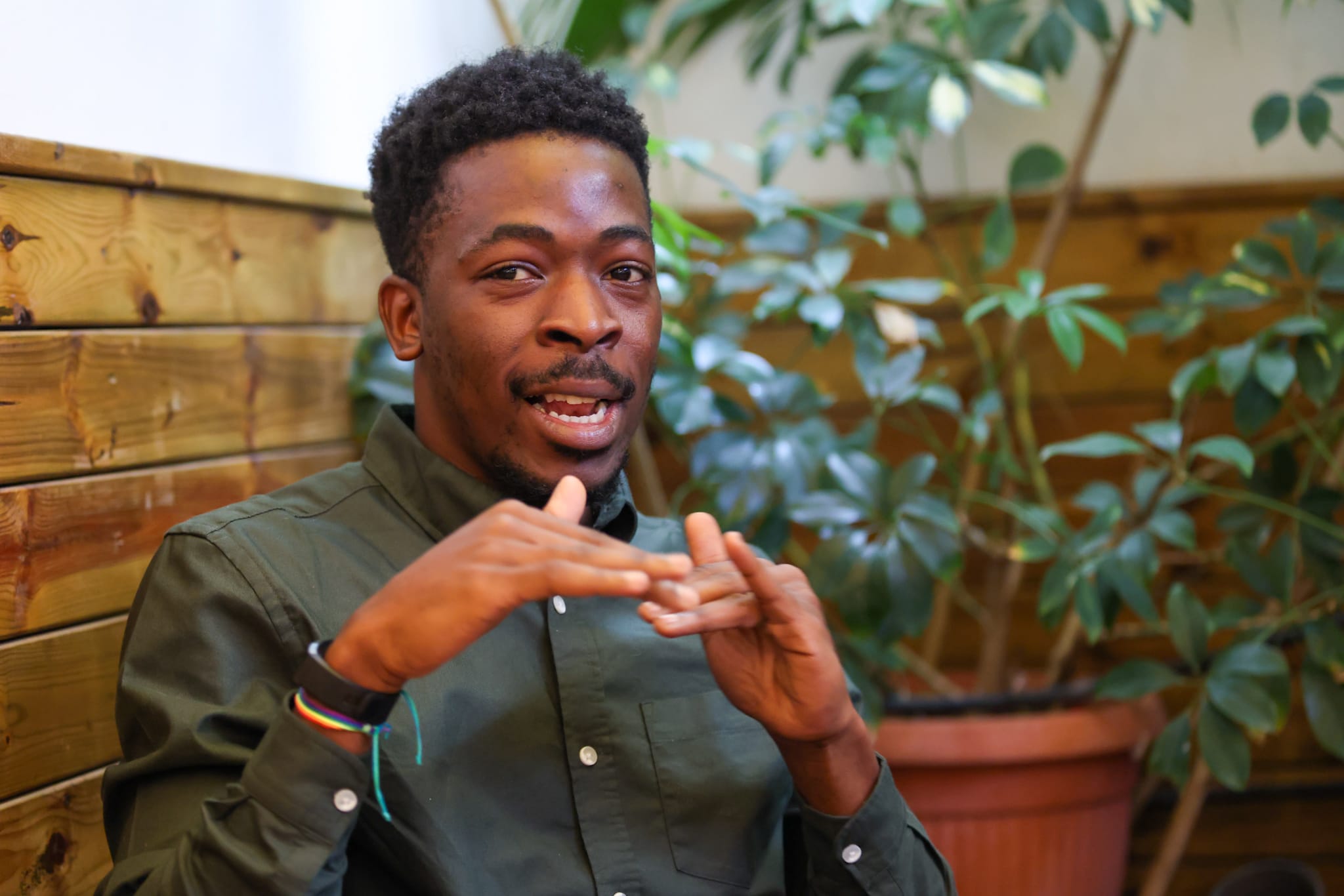
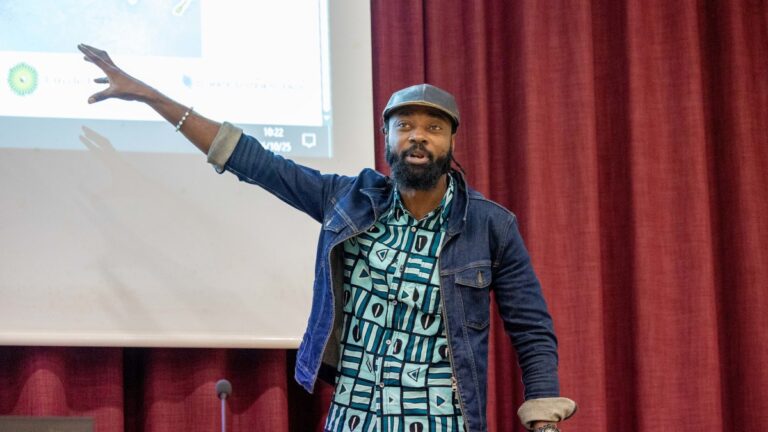
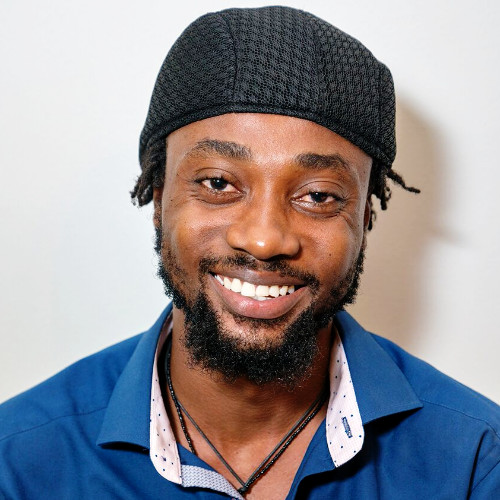
Richmond Kennedy Quarcoo, executive director and co-founder of Plastic Punch, an organisation fighting to reduce the use of plastic, was born in Accra, the capital of Ghana. The son of a family with a farming tradition, with a mother who was a teacher and a father who was an educator and politician, Richmond first wanted to be a doctor, although he later realised it was not the profession for him. Undecided, and shaped by his passion for the sea and the influence of his uncle, he ended up becoming a merchant navy officer, and focused his thesis on the impact of plastic pollutants. “Afterwards I sailed for a while on supply vessels and cargo ships. When I returned to Ghana, we founded Plastic Punch,” he recalls.
“There were seven of us, all professionals and all very concerned about the environment. We attended a sea turtle monitoring session in a community about 45 minutes from Accra. Of the six turtles we saw, five were dead. We couldn’t scientifically diagnose the cause of death, but it was from living among plastics,” Richmond explains. “So we decided to act. It all started as an initiative with a first beach clean-up, and then we carried out prevention measures. We soon realised that we needed to establish ourselves as an NGO,” he adds.
Plastic is a global problem: pollution affects certain countries more but, in the long term, in this interconnected world, all countries will suffer the consequences. For example, in the ocean there are accumulations of rubbish the size of a continent. And sea currents keep feeding them. What will happen? “Because of ocean currents, our rubbish will end up joining together. If people don’t act in the Congo, their rubbish will travel all the way to join it too (an accumulation of waste). We are one ocean, one planet. We are interconnected, and we cannot escape,” says Richmond, speaking of a world also shaped by the evident effects of climate change. “There are visible effects, such as rising sea levels or fluctuating rainfall. Last year, in Ghana, they had to spill water from a hydroelectric dam because it was raining so much, and many communities were affected: some farms were flooded,” he explains by way of example.
The future of the oceans: more plastic than fish
There are more than 150 million tonnes of plastic in the oceans, and between 4.7 and 12 million tonnes more are added every year. By weight, according to the European Parliament, by 2050 the oceans will contain more plastic than fish. A global tragedy that is reflected most harshly in certain regions of the world.
The Mediterranean and Yellow Seas (the latter located in the northern part of the East China Sea) have the highest concentrations of microplastics in the world, while places such as the North Pacific Gyre collect larger plastics which, through the process of fragmentation, will end up becoming micro- and nanoplastics. Microplastics are not easy to see, unlike the continents of rubbish or the idyllic spots spoiled by sea currents that constantly carry visible waste. But even if our eyes deceive us, it is all plastic.
“In 2017, the total amount of plastics produced amounted to 8,300 million metric tonnes (Mt), of which 6,800 Mt were plastic resins, 500 Mt were additives and 1,000 Mt were polyester, polyamide and acrylic fibres. Approximately 76% (6,300 Mt) had already become waste. Incinerated waste accounted for 12%. Another 9% had been recycled. Only 10% of that percentage was recycled more than once. The remaining 79% ended up in landfills or in the environment, which represents 60% of all plastics produced up to 2017,” notes the World Wide Fund for Nature (WWF) in its report Impacts of Plastic Pollution in the Oceans on Marine Species, Biodiversity and Ecosystems. “Plastic pollution cannot be considered in isolation. Rather, it adds yet another impact to the string of existing human-induced pressures, such as global warming and heat stress, ocean acidification, eutrophication, deoxygenation, overfishing, maritime and underwater noise, habitat destruction and fragmentation, and chemical pollution,” the activist believes.
While in Europe the optimisation of recycling and restrictive regulations are helping to solve problems arising from the overuse of plastic products, especially so-called “single-use” ones, most countries in the world have not undertaken the necessary reforms; moreover, they lack the means to recycle their own waste. In these places, rubbish that is neither burned nor recycled ends up in the environment or in the ocean. Ghana is home to one of the world’s electronic waste graveyards. Waste is in plain sight for everyone: on the streets, on the beaches and, of course, in the sea. The State is not reacting, and this paralysis will have irreversible consequences for biodiversity, for marine life and its species; for human health, through the consumption of contaminated fish; and for native communities, who are watching their traditional economic activities wither: according to the European Parliament report Plastic in the Ocean: the facts, effects and new EU rules, losses in the tourism and fishing sectors amount to between 259 and 695 million euros worldwide.
What are Plastic Punch’s main projects and how do you implement them?
First, we clean the beaches where turtles lay their eggs, so that they have a safe place to nest. However, we know that cleaning the beach is not the solution: more rubbish will arrive later. That is why what we propose is plastic reduction. With this action we seek to answer two questions: what pollutes and who pollutes? We collect data that we use to inform the direction of our policy recommendations. We also research and develop alternative product packaging solutions; and we seek to ban problematic plastics; that is, ones such as single-use plastics, those that cannot be recycled and have no value after their first use. In addition, we carry out awareness-raising work in communities through art, music and film, and we provide training in ocean sciences in Africa. We are in Ghana and Nigeria, and we are expanding to Kenya and Cameroon. We need more scientists to research and collect data.
Is the situation in Ghana improving, or is society not responding?
You can’t really blame the people. The fault lies with inefficient waste management systems. The clean areas are clean because they have efficient waste management.
And why are those areas clean?
For different reasons. Before, local authorities awarded the contract to whoever they wanted; now it is the central Government that awards it. In some places, the waste management provider does the job; in others, it doesn’t, but it still takes the money. So there are problems of corruption, monitoring and evaluation. And we have another obvious problem: waste management systems are insufficient. We also have to consider the rubbish that is neither used nor produced locally: rubbish that arrives with the oceans: lots of body waste, shoes, toys and electronic waste. We are still trying to understand, with satellite data, where this rubbish comes from. We don’t know, but we have an internal problem: we don’t have a solid waste management system.
Ghana is one of the world’s graveyards for technological waste. And for clothing too. Much of it comes from Europe and the West. Who do you blame for this situation?
The trade agreements are with our governments, so the main responsibility lies with them. If this kind of trade were not allowed, this problem would not exist. On the other hand, there is no national agenda or technological capacity to recycle. So I wouldn’t blame others. Countries such as Rwanda and Kenya have taken action. We need to opt for reduction and for other available alternative practices and solutions, instead of resorting to the circular economy of waste, because there is a value chain around recycling. That is why we say prevention before management.
Reducing single-use plastic products seems the most viable option.
We have started a project in which we got supermarkets to put a price on single-use plastics, bags, as has been done in many countries, and it showed a reduction in consumption. We have good examples in East Africa: Rwanda, Kenya and Tanzania do not provide single-use plastics. We are doing the same. We want to make this [through a tax] mandatory. We work with the Environmental Protection Agency, and the Government and the president have made strong statements committing to look into it.
The Mediterranean Sea and the Yellow Sea have the highest concentrations of microplastics. Why are microplastics more dangerous than other types?
All plastic is dangerous. But perhaps, because we can’t see them, microplastics are more so. In the end, they get into our bloodstream; they reach the water we drink, the food we eat and the materials we come into contact with. Plastic itself is the problem. The materials it is made of, the additives that are added, are of fossil origin, and they should not come into contact with humans; they are toxic. However, it has become the norm, and that is why it is dangerous. In Ghana, we find microplastics in fish and in the soil. Fifteen years ago we did things right. You didn’t see people throwing rubbish in the street, and we had the communal labour days, when the whole community would get up on a Saturday and start working on whatever was needed. But look at our beaches now.
What is the beach like today compared with the one from your childhood?
It’s horrible, horrible. I can’t go to the beaches I enjoyed in my youth. We are working to recover some of them. As well as pollution, we are also suffering from rising sea levels. If you want to go to a clean beach in Ghana, you have to drive a long way east or west.
It is estimated that plastics will triple worldwide between 2040 and 2060. Despite the laws and treaties, are we on the right track?
The opportunities lie in reduction and in alternative packaging solutions. If recycling had worked, more than 70% of our plastics would be recycled, but we don’t even reach 10%. There is a systemic failure, and it is time we took on our collective responsibilities while trying to get our governments to move towards reduction. We can all make an effort: from the child at school adapting to a lifestyle, to the entrepreneur who doesn’t force us to use single-use plastics. That way, we will be able to leave a better world to the next generation. For now, the world we will leave behind is worse than the one we had a few years ago.
Fishing is one of Ghana’s economic drivers. How is it being affected by the increase in pollution?
The fishing communities we serve catch more plastic than fish. It’s very sad. This was supposed to happen around 2050, but it’s already happening. It’s truly regrettable, and that’s why we are trying to push for a ban on some of these single-use plastics. It is the Government that has to act and ban or penalise their use. Fishermen’s livelihoods are being affected. Catches are low. Moreover, it is not a lucrative industry, as it has to compete with Chinese fishing vessels and illegal fishing. So it faces problems that go beyond rubbish.
 Diari de Tarragona · 6/10/2025Desde Ghana hasta Galicia: cómo los residuos plásticos recorren los océanos y amenazan vidasRead ↗
 Planeta Futuro / El País · 4/10/2025Richmond Kennedy Quarcoo, activista ambiental: “La próxima generación nos merecemos algo mejor que ser un vertedero”Read ↗