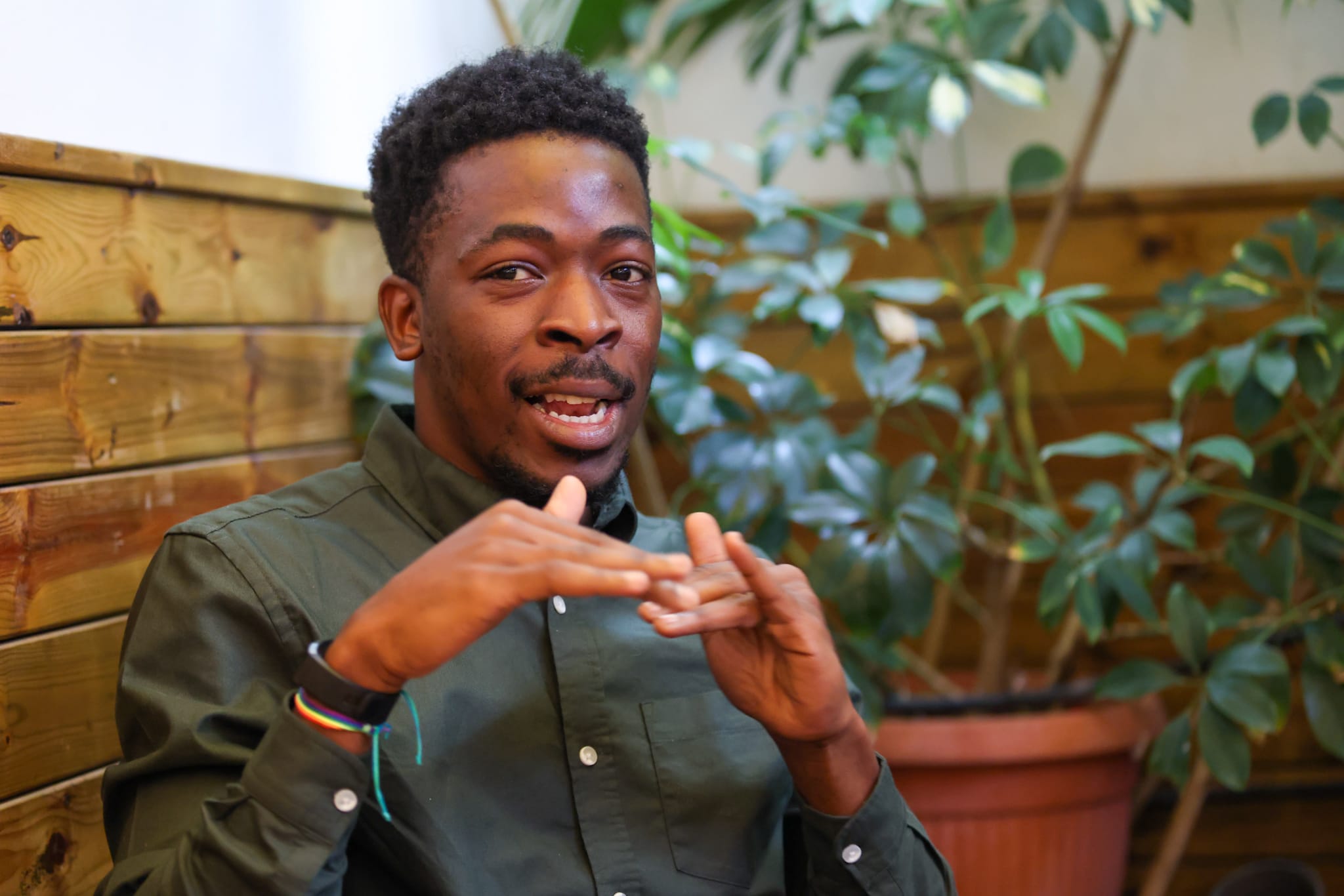
Roland Mimi Ngoy has been living in Tarragona for six years, but his commitment to his country of origin, the Democratic Republic of the Congo (DRC), has never waned. A graduate in development economics from the Catholic University of Congo and a technician in marketing and advertising, this political activist is one of the founders of the Union des Jeunes pour la Réussite de l’Avenir et de Dignité RDC (Union of Young People for the Success of the Future and the Dignity of the Democratic Republic of the Congo). As he himself explains, from a very young age, while still at school, he was involved in various initiatives, both sporting and cultural.
“My mother, my sisters and I left my father’s house when I was 5; we were thrown out, so we went to live with my grandparents. I studied with the Marists and for many years I was a delegate, a student representative. In 2012 I was elected president of the Marist students and in 2013 the opportunity came up to go to Brazil for World Youth Day. There I learned a lot about organising and associations. It was very inspiring.” That trip to Brazil would give him the impetus he needed to create, in 2014, the Union des Jeunes pour la Réussite de l’Avenir et de Dignité RDC. It was during his university years that he took his activism onto the ground: he began organising talks, meetings, gatherings with other young people and so on, with the aim of denouncing the situation the country was in.
“At that time, Joseph Kabila was president of the country; he wanted to change the Constitution and cancel the call for elections, so I launched a campaign entitled Good Citizenship. We went round different places, such as churches, markets and schools, to explain what it means to be a good citizen, because it was important to claim our rights and demand that the country’s Constitution be respected.” It was also during this period that his activism began to cause him problems with the authorities; difficulties he managed to dodge thanks to his good fortune in living in the house of his grandfather, who had been a general under Mobutu, the former president of the DRC. “When they realised where I lived, they left me alone,” he explains.
In 2015 marches began to demand that elections be called; at that point the difficulties in carrying out his activism became more serious. “One day the president’s people chased me all the way home. Nothing happened, but they warned my grandmother to be careful. My mother, who was already in Spain, was very worried about the situation, so, as I was still studying, we arranged a student visa so that I could leave the country.” And so it was: in 2018, Roland Mimi Ngoy secured a place at a higher vocational training institute and settled in Tarragona.
In this city he has worked as a volunteer with the Red Cross, the Associació Quilòmetre Zero and the Xarxa Antiracista.
Democratic Republic of the Congo and Rwanda: tensions over coltan and copper
In 1994 one of the first televised genocides took place: the one committed in Rwanda against the Tutsis, in which some 800,000 people (70% of the Tutsi population) were murdered in barely three months (between 7 April and 15 July 1994). After the genocide, a significant number of the perpetrators of the massacres, mostly Hutus, fled to the neighbouring country: the DRC. There, these Hutus founded the Democratic Forces for the Liberation of Rwanda (FDLR). Supposedly to fight this militia, in 2012 the M23 (Mouvement du 23-Mars) appeared, another militia group which (although Rwanda denies it) has the support of the Rwandan regime.
In January this year, the M23 conquered the main cities in the Kivu region and since then the attacks between the Congolese army and the Rwandan militia have only increased, causing a mass displacement of the civilian population and an alarming situation: since the beginning of 2025, it is estimated that some 7,000 members of civil society, that is, non-combatants, have died as a result of the intensifying hostilities between the two factions. According to UNHCR, the United Nations refugee agency, at the end of 2024 there were almost seven million people internally displaced by the violence, more than 5 million of them in the eastern provinces of North Kivu, South Kivu and Ituri. There are also almost one million refugees who have fled the DRC and sought asylum in other countries on the African continent. Several humanitarian organisations, as well as the European Parliament, have warned that sexual violence against women has been and is being used as a weapon of war.
The struggle between the Congolese army and the M23 is aimed at controlling the exploitation of raw materials, above all coltan and copper. To this end, for years the M23 has profited from smuggling Congolese minerals into Rwanda; a country which, in principle, has no reserves of these minerals, but which since January 2025 has managed to earn twice as much money from exports to China as its neighbour, the DRC (which is where the mines are actually located).
An uncertain agreement and many interests
Barely a few weeks ago, the Congolese government and the M23 signed a peace agreement and committed to working towards a cessation of hostilities. In the coming months, the DRC will have to dissolve the *FDLR (and repatriate its fighters to Rwanda) and the M23 will have to withdraw from Congolese soil.
The agreement was brokered by the United States; and as a reward for its mediation and for the military protection it will offer the DRC, that country will receive a series of mineral exploitation concessions. Félix Tshisekedi, the Congolese president, has already committed to this. It is a lucrative deal for the United States, as it will allow it to begin competing with the Chinese government for the exploitation of raw materials —above all minerals, essential for carrying out the energy transition— on the African continent. As the journalist specialising in the African continent Jaume Portell Canella recently wrote: “The entry of Western capital into the Congolese mining sector has been one of the unfinished challenges for both the EU and the United States in recent years. Faced with China’s leadership in refining key minerals for the energy transition, the West wants to recover lost ground. It is a dispute being played out on DRC soil, where China has been ahead for years.”
You arrived in Tarragona in 2018, after years of activism in your country; here you have continued this activity and have also become involved in the third sector.
In 2020 I found out that the Associació Quilòmetre Zero was looking for social mentors for minors. I spent a year there mentoring a boy from Senegal. That was when the director of Quilòmetre Zero began to take an interest in the activism I was doing on social media, which focused on everything that was happening in the DRC. She told me there was hardly any information in Spanish on the subject and that it might be interesting if I started giving talks and the like to explain the situation. It was hard at first, because I had hardly any contacts, but little by little I carved out a space for myself and began to make contacts with political parties and other organisations. In 2024 I started a project entitled “Eye on the Congo”, with the idea of providing visibility and information about what is happening in my country. I sent the information to various organisations and parties and they responded positively, so I began giving talks in different places around Catalonia.
What is the focus of these talks?
I defend social and political rights. I defend access to school and quality education. In the DRC there is a president who talks about free education, but not about its quality. Congolese schools lack internet in the classrooms and furniture for the pupils. How are you going to fit 100 pupils where there is room for 35? That is not right. I also fight for the right to water, to electrification of the country and to public transport. And all of this is what I demand through my social media. However, in the talks I give here I speak about the genocide. I don’t want to talk about the lack of roads, because I understand that isn’t a problem for Spain; that is why in the talks I speak about the minerals and the genocide that is taking place in the struggle to control them, because that really is a matter of international law, of economics, of globalisation. The mining basins of my country are being emptied to make phones and cars that are then sold in every corner of the world. To do this, women are raped, children are killed, people are displaced.
Stories from the African continent tend to be told by white people and from a white perspective. What do you think of what is published in the media here about Africa?
Most of the information published in Spain is superficial and partial; everything could be developed further; above all, more context should be given and those responsible, and the support they receive, should be pointed out. The psychosocial consequences of all this violence suffered by the population should be discussed, for example. Another problem I have noticed is that communication influencers are called on to talk about certain subjects when they hardly know anything about them. These people are not looking to develop information; they just want to be listened to or read; besides, information without context is useless. Information needs to be developed so that people understand exactly where the problem comes from, how it began, how it developed and what the obstacles are, in this case to peace. Because yes, we want peace, but we also want justice. The victims deserve it, and so do all the Congolese people.
Those responsible are not talked about.
For people to understand a conflict, a situation, whatever it may be, you have to tell them the stories in full: from the origin, through the testimonies, and explaining the consequences. If we only rely on the testimonies of the victims, we will create a narrative of pity, but the problem will not have been explained, and so people will not mobilise. 28
What is the situation in the DRC right now? [This interview was conducted a few days before the signing of the peace agreement between the Congolese Government and the M23 militias, backed by Rwanda].
There is the whole conflict with the M23; and internally, the country is very tense and there is very strong polarisation. On 27 June a peace agreement will be signed with Rwanda which mentions regional economic integration, a ceasefire and the cessation of hostilities, the pooling of the armed forces, and so on. But the fact is that the people are divided. Those who support the president agree with the agreements we will sign; however, the opposition and a large part of the citizenry, myself included, have doubts about this deal, because Rwanda will walk away in peace and will continue exploiting Congolese minerals, only from now on it will do so officially, because that is what regional economic integration means. We will sign an agreement, but the one invading the country and killing is Rwanda; the one stealing our resources is Rwanda. Why is a peace agreement being signed without justice being done, without condemning what Rwanda has done? On the other hand, the rebel soldiers who have raped our mothers and killed our people will return, under conditions we do not yet know, to join the country’s armed forces, something we do not want.
What have been the main obstacles you have encountered in Catalonia?
I was going to say the language, but that wouldn’t be true, because I learned it in three months. On the other hand, I haven’t had to face problems of racism, but I have had to fight in the legal and administrative sphere over the issue of residency. Without residency, I can’t carry out my activities with complete freedom, I can’t travel. At present I am not in a regular administrative situation, and that limits me a great deal, above all when it comes to funding my activism and what we are doing in the DRC.
What political goals do you have professionally?
In December 2020 I decided to go into politics, because I realised that nothing can change unless progress is made politically. I joined a party there, but it was funded by Kabila, so when I realised that I left; and in 2023 I created my own party: Dignité Congo, of which I am the president. I will stand as a candidate in the elections to the National Assembly [the Congress] in 2028; then, in 10 years or more, I would like to run for the presidency. At the same time, here I am trying to get all my papers in order so that I can keep carrying out my activities and working, because I can’t live in a country where I can’t work. It is a matter of dignity. In my country I am the president of a political party, and here I have to stay hidden at home. If I don’t get all my papers here, I will have to go back to the DRC.
 Xarxanet.org · 29/10/2025Roland Mimi Ngoy: “Som la població qui patim les conseqüències de l’explotació de les terres”Read ↗
 Diario Red · 30/01/2025Roland Mimi Ngoy: “Al capitalismo le interesa la continuidad del conflicto en la República Democrática del Congo por sus minerales”Read ↗