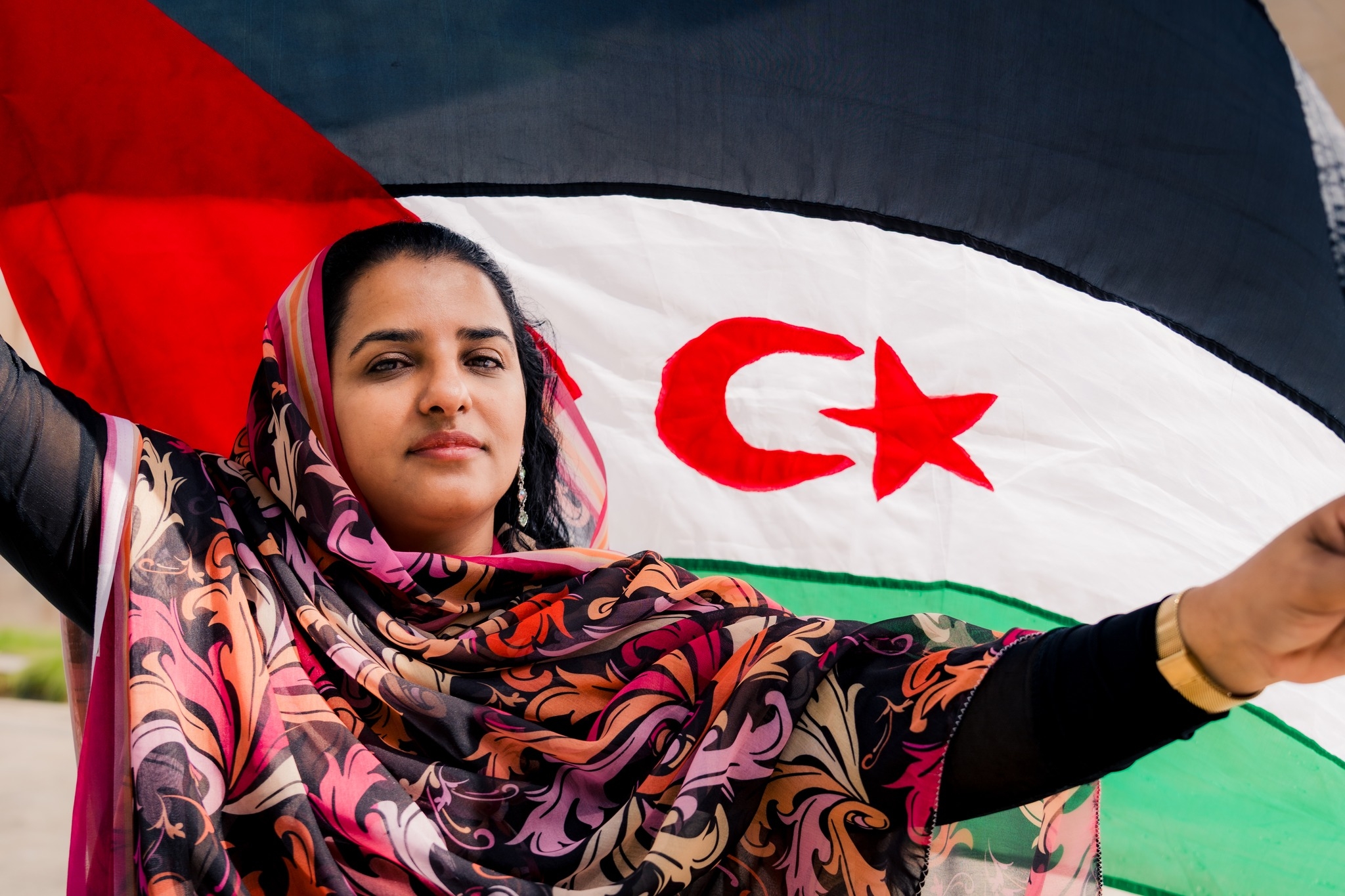
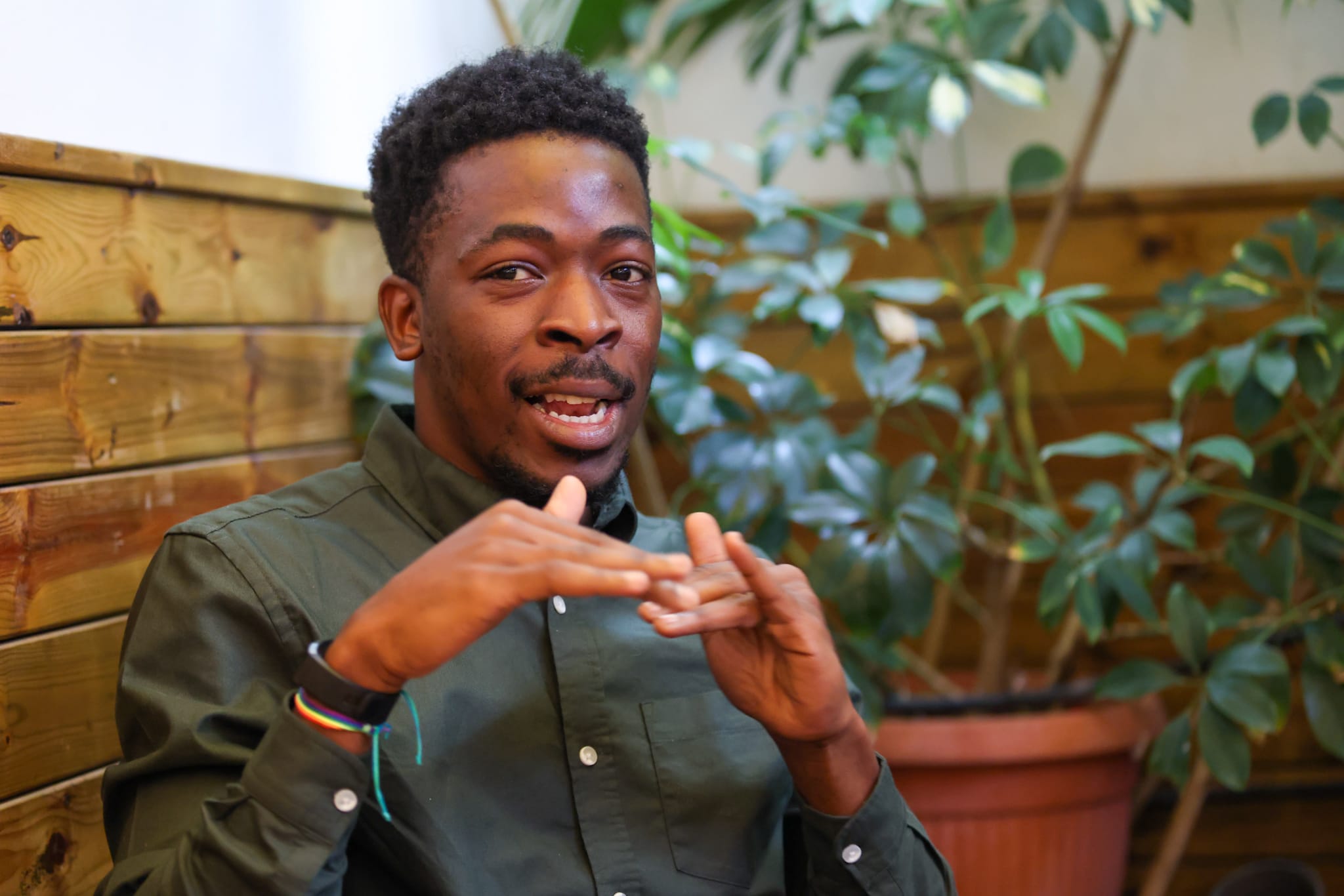
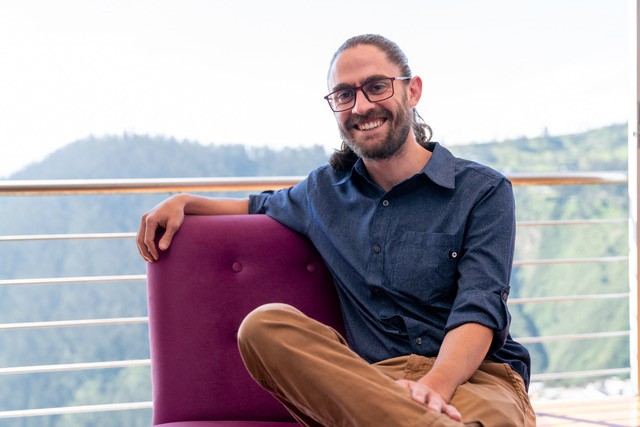
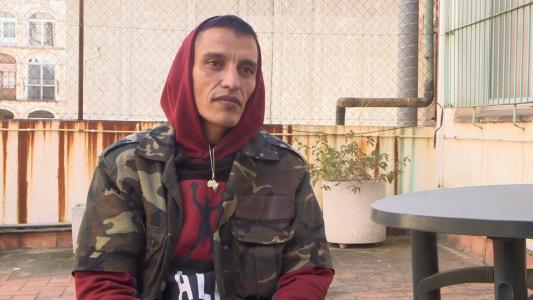
Yslem Mohamed Salem Nafaa is a Sahrawi rapper born in the Tindouf camps, in Algeria. He currently lives in Alborea (Albacete). He came to Spain, as many Sahrawi boys and girls do, thanks to the Vacaciones en Paz summer programme. Settled in Galicia during his teenage years and taken in by a Galician family, he studied social education, but he has never set aside his true vocation: hip hop.
Yslem says that things have changed a great deal in the Sahrawi camps since he was a child: “(…) all I knew were the dunes and the haimas, going to school, helping my mother and waiting for humanitarian aid. I didn’t even know what a shop was, or the sea. Not even a trainer,” he explains. Perhaps that is why the experience of his first Vacaciones en Paz, in Italy, made such an impact on him. “Everything amazed me: the grass, the houses, the bricks, the water coming out of the tap, the fountains.” After those holidays in peace in Italy, he had others in different parts of Spain, such as Castilla-La Mancha and the Basque Country. As his twin sister was in Galicia and he had respiratory problems, his sister’s host family decided to take him in, so he settled in Mos (Pontevedra), with the consent of his Sahrawi family. It was there and then that he began to get into the culture of graffiti and rap and to rhyme his first verses. Yslem is one of the first Sahrawis in the genre in his territory. He says, however, that his interest in music goes back to his childhood: “(…) in the camps, at school, I was always part of the choir. I loved singing. My grandfather and my great-grandfather were poets, and that influenced me too,” he recounts.
His first contact with rap was through the Cuban aid workers who brought cassettes of American hip hop to the camps. He didn’t understand a thing, but he liked it. “The last year I lived in the camps, black-and-white television arrived. We picked up a couple of channels; one of them was Algerian, and in the afternoons they played Arabic music from different countries. That’s where I discovered Algerian rap, thanks to a group called MBS.” Once in Spain, in O Porriño, near Mos, where he later lived, he had the chance to get to know this culture that attracted him so much more closely, partly thanks to the Intercontracultura Festival, which brought together graffiti artists from all over the world. “That festival hooked me,” he recalls. He began to write up the lyrics he had. In 2007 he released his first album: Qüestió de fe; and he has carried on ever since.
Yslem’s lyrics speak of resistance, struggle and self-determination. They speak of the need to break down the wall of silence and the wall of indifference that cause conflicts to fall into oblivion. He also speaks, without holding back, about the responsibility of the Spanish State in the Western Sahara question; and he is highly critical of Spanish political parties, whom he accuses of living under blackmail from the Moroccan kingdom.
To speak of the history of Western Sahara is to speak of the history of an injustice and of a people, the Sahrawi people, who have been fighting for the right to self-determination for years. With its capital in El Aaiún, Western Sahara was occupied by Spain until 1975: it was considered the 53rd province of the Spanish state. With Franco’s death, the demands of the Sahrawi people, which had begun in the early 1970s, gained strength. In this context, Spain undertook to organise and hold a self-determination referendum. It was then that Morocco, led at the time by Hassan II, and Mauritania seized the opportunity to claim part of the Sahrawi territory as their own, citing historical reasons. At the end of October 1975 the first attacks by the Kingdom of Morocco took place, and on 6 November the Green March began: more than 300,000 Moroccans entered Sahrawi territory and occupied it, which led to a mass exodus from the coast to the interior, the desert. Only Algeria opened its doors to these people fleeing the violence.
The responsibility of the Spanish government in all this is beyond doubt. In fact, there are documents about what really happened during the Green March that have still not been declassified. In 2017, however, the CIA declassified some that would call into question the stance of King Emeritus Juan Carlos I: apparently, the Spanish monarchy facilitated the entry of Moroccan troops into Sahrawi territory. Far from reaching an agreement with the Sahrawi people in mind, on 14 November 1975 Spain, Mauritania and Morocco signed the Madrid Accords, which provided for a referendum on the self-determination of the Sahrawi people. It never took place. On 27 February 1976 Spain withdrew definitively from Western Sahara; and on that same day the Polisario Front (Popular Front for the Liberation of Saguia el-Hamra and Río de Oro) proclaimed the SADR (Sahrawi Arab Democratic Republic). In 1979 Mauritania surrendered and stopped claiming part of Western Sahara, but Morocco took advantage of this to annex another part of the territory. In 1991 a peace agreement was signed and the UN established MINURSO (United Nations Mission for the Referendum in Western Sahara) with the commitment to hold a self-determination referendum. It has never been held. Since then, the Polisario Front and the Kingdom of Morocco have lived through an unofficial but uninterrupted war, with periods of greater or lesser intensity.
As for its political status, Western Sahara is a permanent member of the African Union, but at the United Nations, France, a permanent member of the Security Council with veto power, systematically vetoes all resolutions in favour of the Sahrawi people because it considers Morocco, its former colony, a priority partner and its main ally in the region. After more than forty years, the conflict remains deadlocked.
In early 2022, Pedro Sánchez’s government (PSOE) made an unexpected U-turn on the Western Sahara question and publicly backed the regime of Mohammed VI, which since 2007 has had on the table a proposal for autonomy for the territory that the Sahrawi people do not accept. Until then, Spain had favoured a political solution accepted by both parties and within the framework of United Nations negotiations. The change of stance could be due, in part, to a crisis between Morocco and Spain after the latter country took in the leader of the Polisario Front to be treated for Covid during the pandemic. This led to a diplomatic crisis between the Alawite kingdom and Spain, which ended when the Spanish government publicly backed the regime of Mohammed VI. This change of stance also had consequences for diplomatic and cooperation relations between Spain and Algeria, which were badly damaged.
What is it like to grow up in the Tindouf camps, in such an abnormal situation?
I lived in the camps as a child. I was happy because I was innocent; there was a shortage of everything and we all had the same. The men were at war and the women looked after us. We didn’t know whether our fathers and uncles would come back. Everything was strange, but we accepted it: it was what we had to live with. We found it odd to see foreigners visiting us. I compare it with my life now and, certainly, that childhood was a bit strange. My friends and I dreamed of seeing the sea and our parents’ homes; we wondered what Western Sahara was like. I also remember living in wait for humanitarian aid.
What was your greatest fear as a child?
Losing relatives, or friends’ relatives, and ending up separated. There were many people in the diaspora. Now my whole generation lives separated from their families, but we can’t go back to the camps because there are no opportunities. Most of us have an education; that is something the Polisario did very well: providing education as an option for the future. We have a very well-trained generation, but the sadness we suffer is that we can’t develop ourselves there. I would stay here [at the time of the interview Yslem is in the camps, in Tindouf], but what would I do? I have no future here, and the only thing I could do is go and fight in the war. We are still stuck, and the Polisario’s effort to educate an entire generation has been of no use. Here there are young engineers, lawyers, artists… who can do nothing but wait for time to pass. That is very sad. And it frightens me. I see it with my nephews and nieces: what is the point of educating them if they can’t then develop here? They will have to live separated from their family, as happened to me. In twenty years I have hardly seen my parents. The other option is to end up in the army, and who knows what will happen to them.
What hooked you about rap?
Rap is the music of the voiceless, and it talks, or used to talk, about what is wrong in society. It goes further. Now everything has changed a bit, but the essence of rap hasn’t. It is a combative genre.
You use it to talk about the Sahrawi cause. You also run workshops and training sessions in the camps. Is music a tool for changing things?
Art, and therefore music, is the best weapon for turning everything around and raising awareness among the population and politicians, or even defeating aggressive policies. It is also true that we currently live in an era in which everything moves very fast and change is constant. Technological advances and digitalisation overwhelm us, and the new generations are quite saturated with knowledge. At the same time, however, I have the feeling that we are facing a population that is asleep: people are too distracted and don’t pay attention to what matters. We see it in Gaza: babies are being killed before the eyes of the whole world and nobody does anything: people prefer to live in their TikTok. In this context, I sometimes think that not even music or culture can stir consciences any more.
You talk about indifference to what is happening in the world.
Exactly. If we rise up, not just the Sahrawi people but everyone, we will be able to bring down the wall of indifference. We have been taught not to care about anything. And I’m not talking about the Gazans who are being bombed, about the Sahrawis or about the migrant who dies at sea; I’m talking about the neighbour next door. They evict him before our very eyes and we don’t even move. They keep us entertained so that we don’t notice things and don’t care about anything. Music and art could indeed break down this wall of indifference.
Given the responsibility of the Spanish State in the Western Sahara question, do you think the Spanish population is aware of the Sahrawi cause?
We Sahrawis have nothing to reproach the Spanish population for. The Spanish State, however, bears an enormous responsibility for what has happened to us Sahrawis. We must recognise, nevertheless, the great work of Spanish citizens and their solidarity. Organisations, Vacaciones en Paz, sending aid and professionals coming over, hosting children… They are the ones who have built the foundations of what we are now. The absence of every Spanish government in Western Sahara has been made up for by the will of its citizens. In Spain you still remember us. Our greatest enemy, together with Morocco, is the Spanish State. They promised us everything while negotiating in parallel with Morocco, which blackmails Spain over migration, drug trafficking and terrorism. These are three issues that are constantly played with. And Spain, obviously, is afraid.
During your adolescence you grew up in Galicia, where there is also a Moroccan population. What was your relationship like with Moroccan boys and girls?
Before coming to Spain, I lived in the refugee camps, where the only thing you heard was that Morocco was the devil, evil: the absolute enemy. When you are seven or eight years old, that narrative is powerful and you imagine the enemy as a monster. In Spain, I studied social education and had the opportunity to work very closely with Moroccan communities. I realised then that they were far more victims of their own country than we were, for a simple reason: they don’t even know where Western Sahara is on the map. Morocco is one of the countries with the highest illiteracy rates on the whole African continent, and this situation is encouraged by the Moroccan State itself, because it benefits enormously from it. Having an ignorant country is always positive for those in power. The Moroccan population bears no responsibility for what is happening to the Sahrawi people.
Where does fear come into all this?
A large part of the Moroccan population is afraid of the monarchy and has no interest in getting involved in political problems. Talking about or referring to Western Sahara means trouble for them. It doesn’t matter that they are in Spain: every Moroccan has family who still live in Morocco: an uncle, an aunt, a nephew, and so on. It is dangerous, but I believe there is hope, because there are many young Moroccan men and women who are waking up and waking others up. There are Moroccan activists fighting for the people to rise up, but it will be very hard because it is a scourge that has long been entrenched among the citizens.
You are giving this interview from the Sahrawi camps in Tindouf. How do you see the children there today?
We are in a situation of war and there is a very significant information blackout, which means hardly anyone knows about it, but the Sahrawi army continues to fight against the Moroccan one. There is also a diplomatic and social war, so we continue to denounce the abuses. Did you know that Morocco has just been appointed president of the United Nations Human Rights Council for 2024? The boys and girls follow in our footsteps and they are the ones who suffer the worst of this whole conflict. They know perfectly well that the place where they live is not their land and that we are fighting to get it back. They are the ones who bear the brunt.
Are you optimistic or pessimistic about Western Sahara?
I have no right to be pessimistic, because I live on hope. If we lose it [hope], we lose everything; we will have nothing to hold on to. And we Sahrawis remain as convinced as ever: Western Sahara will be free. A Sahrawi will never be Moroccan.
 Xarxanet.org · 13/05/2024Yslem: “El rap em permet parlar de la causa sahrauí sense embuts”Read ↗
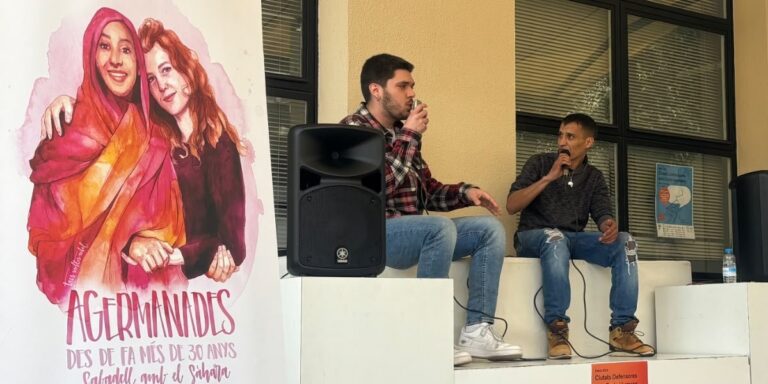 iSabadell.cat · 15/04/2024Yslem, de criar-se en un camp de refugiats a fer raps contra les injustíciesRead ↗
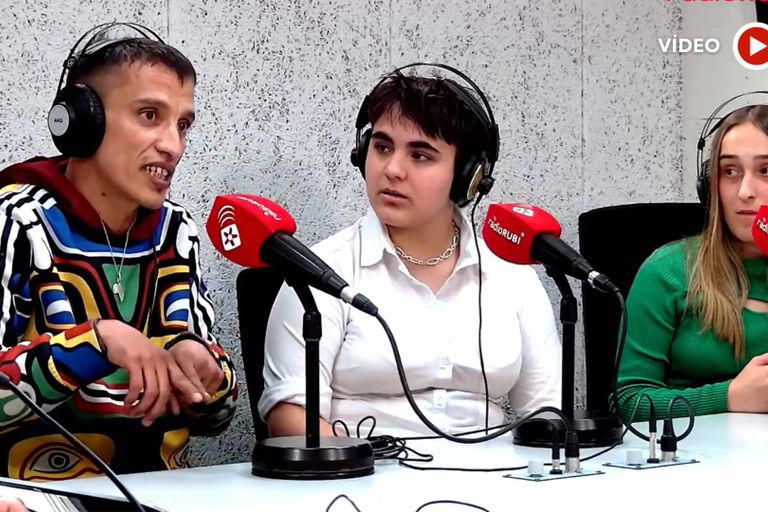 Ràdio Rubí · 12/04/2024El cantant sahrauí Yslem visita Rubí amb les Ciutats Defensores dels Drets HumansRead ↗