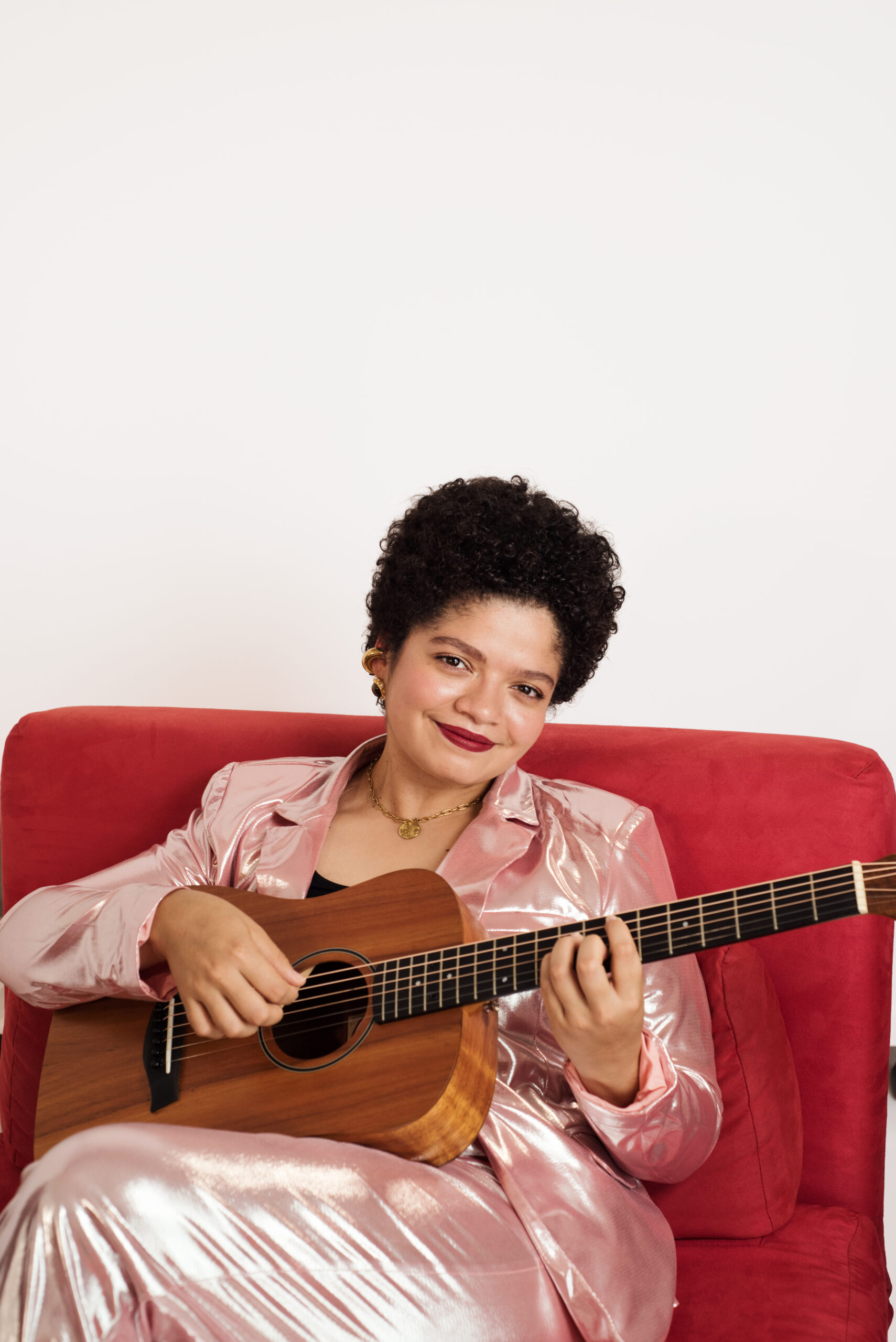
The beginning of Desirée Bela Lobedde’s anti-racist activism (Barcelona, 1978) is closely linked to the birth of her two daughters. It was through them that this Catalan activist realised she did not want her little girls to go through what she had gone through. She stopped straightening her hair and started a blog and a YouTube channel. At the time, she was working in public administration, but little by little she began to gain recognition on social media. “It all happened by chance. In 2008 I had just had my second daughter, and someone very close to me mentioned the idea of writing a blog, which was very fashionable in those years. I started writing about my personal concerns and about my daughters. In August 2010 I decided to stop straightening my hair and make the transition to my natural hair. That was when I opened the YouTube channel,” she explains. She labelled herself a ‘beauty blogger’ and shared reviews of the products she used on her own hair and her daughters’, explained how to wear a turban, which hairstyles could be done with afro hair, and so on. From time to time, this content was accompanied by reflections on what it means to be a Black woman, in terms of identity or racism, among other things. Views of her videos kept growing, and Desirée Bela Lobedde began to reflect more deeply on Africanness and Afro-descendance. All of this went far beyond a simple beauty blog, and it was at that point that she dropped the ‘beauty blogger’ label and began calling herself an ‘aesthetic activist’.
All this happened more than a decade ago, and in these years Desirée Bela Lobedde has become one of the most visible faces of the anti-racist struggle in our region. In addition to giving talks and publishing books, the activist offers anti-racism training, both to individuals and to companies, and contributes to various media outlets. In September 2022 she left her job in public administration to devote herself exclusively to the training she offers.
Desirée Bela Lobedde’s discourse revolves around the need to be actively anti-racist and the importance of not staying on the surface of discourses. She believes that white people do not attach importance to racism because it has no impact on their daily lives. She articulates an anti-racist discourse that goes far beyond anecdote or personal experience and addresses issues such as the need for denunciation and reparation, among others.
Because of her activism and her anti-racist and critical discourse, Desirée Bela Lobedde has been harassed, insulted and threatened on social media. A few years ago she had to close her accounts because of racist comments and threats. She reported it, but the public prosecutor’s office considered that, since the authors had deleted the comments, the case was not relevant. It was also considered that, since the authors were not public figures, there was no need to investigate. But the comments were on her YouTube channel and thousands of people read them. “The journalist Moha Gerehou was even put up for auction, and in that case there were convictions. And that is precisely the point: we need to create case law so that people understand that making these comments has consequences; to put an end to impunity. It is not freedom of expression, it is hate speech,” she explains. In 2019 she closed her Twitter (now X) account for good.
Although white people tend not to consider themselves racist, the fact is that both discrimination at various levels and attacks on minoritised groups continue. According to SOS Racisme, “racism remains the leading cause of hate crimes, both in Catalonia and in Spain as a whole. Although the number of reported racist crimes has increased in recent years, even today between 80% and 90% remain invisible.” The organisation also points to the institutions for their lack of both capacity and will to identify “the structural causes and racist motivations underlying many of these criminal practices. Likewise, institutions remain responsible for the failure to uphold the rights of the ‘victims’ of racism –whom they often end up revictimising– and for the lack of effective mechanisms to repair the harm (…) Racist discourse and institutional practices and policies go hand in hand and feed back into each other, the former being at the same time cause and consequence of the latter.”
Racism when looking for a flat or trying to get a job, other forms of discrimination, as well as the rise in hate crimes and hate speech against racialised people, continue to be part of everyday life in our region. According to the Ministry of the Interior, hate crime incidents increased by 33.1% in 2023 compared with 2022. Most of these crimes are related to racism and xenophobia. Police identity checks based on racial profiling, a widespread practice in our region, deserve a special mention. “Racial profiling is a normalised criterion in police identity-check practice, in which people are asked for their documents on the basis of their race or ethnicity and not because they have committed an administrative offence or a criminal act and/or because there are reasonable grounds for suspicion,” explains the report ‘Vigilància 0.2: Una anàlisi de dades sobre les identificacions per perfil ètnic-racial‘, produced by SOS Racisme in 2021. The study’s conclusions are clear: foreigners are three times more likely to be stopped and identified by the police: “for every Spanish person identified, 3.48 foreigners are identified.” This practice criminalises racialised people and exposes them to risky situations, as well as being deeply unjust and illegal.
Besides your aesthetic activism, you have published several books on anti-racism and the need to be actively anti-racist. Not being racist is useless, you have to be actively anti-racist, you always say. Where are we in Catalonia? Are we actively anti-racist?
Most people are not. Most people stick to the ‘I’m not racist’ discourse, and around that there is a very simplistic, very limited and limiting belief. In this country, not being racist is associated with moral questions and with the narrative: ‘I’m not racist because I’m a good person.’ Seen through this lens, many people believe that inaction and neutrality are desirable; but when we talk about issues related to social justice, inaction perpetuates existing inequality. So it is not enough not to consider yourself racist. This also shows that people do not understand that racism is a structural issue, not an individual one. You are not racist, but racist things happen around you: what are you going to do? If you stick to the idea that you are not racist, then you will do nothing and you will allow what is happening to keep happening. When you are actively anti-racist, if you believe you do not have racist behaviours, you first examine yourself humbly, because nobody is a being of light. And once you have been self-critical, you can criticise the behaviour of others and everything that happens around you, and take action.
Are you worried about the rise of the far right and its discourse?
My rights as a Black woman have never been guaranteed, so for me there is not much difference. Obviously, if far-right discourse spreads a lot, we will reach unsustainable points. But whether the right governs, or the centre-right, the centre-left or even the left, racial issues never appear in electoral programmes. In other words, it does not make much difference to me. What is happening now? Well, there are groups of white people, women, LGBTQ groups who considered their rights to be secured and who thought there would be no going back, and now they are seeing that there is. How did we get to this point? Because all these right-wing and far-right parties have taken xenophobic and racist discourse to the extreme; but since until now that discourse did not affect us, we had not stopped it. Now they are going a little further and targeting the rights of women and the LGBTQ community, or cultural and educational rights. As a Black woman, nothing surprises me at all.
In one of your YouTube videos, and also in various talks you have given, you say that you denounce how little attention, if any at all, is paid to racism.
The problem is that people do not understand that racism is a structural issue that goes beyond discourse or hate crimes; that goes beyond what right-wing and far-right parties say. People think there is no need to educate themselves in anti-racism and that they know a lot about everything. I have even come across white people who came to tell me I was wrong, and in a very violent way. They did so from a white supremacism that legitimises. The first thing to do is to become aware that we are facing an educational issue. We women see this more clearly thanks to feminism, which has taught us that we live in a patriarchal society and has pointed out misogynistic behaviour, including our own. Anti-racism does exactly the same, but it focuses on another axis of oppression. People who train in anti-racism go through this process.
You run anti-racism courses for individuals and for companies. What do you find there?
Yes. I also give talks, and I know there are people who are shaken when they realise what I am saying. As a population, you need someone with experience and knowledge to guide you and point out [racist behaviour] to you, because [racism] is part of your experience and is so normalised that it is hard to see. Everyone needs anti-racist training, even if they think they don’t. When you put on anti-racist glasses, you see everything more clearly.
One of the mistakes we journalists make is interviewing non-white people from a paternalistic standpoint, always asking about personal experiences and denying you your identity, or limiting it.
A few months ago, in the membership group of the training I offer, we read Hermanito, by Ibrahima Balde and Amets Arzallus. I was doing some research and reading the interviews, and I was stunned. On some occasions Ibrahima Balde was introduced as an ‘immigrant’, whereas Amets Arzallus was introduced by his profession. That is reducing the other. Is there nobody who checks this?
To bring about a structural reform of everything we are discussing… What is needed? More role models, more representation, more visibility?
There are role models. The problem is that representation can be a double-edged sword. I am one of those who think that the self-proclaimed progressive parties are not doing enough because there are no actively anti-racist policies. It is not about appointing racialised people to head projects or departments. What do we do, give you a medal?
Have you ever felt like a token?
Yes, at all kinds of events. Institutional ones too. Sometimes I have been asked about personal experiences and denied the political and professional agency I have. Neither I nor any racialised person should find themselves in this situation. It is like sitting a woman in front of an entirely male audience and asking her to describe a sexist assault. Let us reflect on why we fall time and again into the pornography of the suffering of Black bodies. To raise your awareness, those of us who go to give talks do not need to explain how badly we have suffered. That is what films, documentaries and books are for. If we keep doing it, we will never be able to raise the level of the conversation.
Photo credits: Laurent Leger Adame