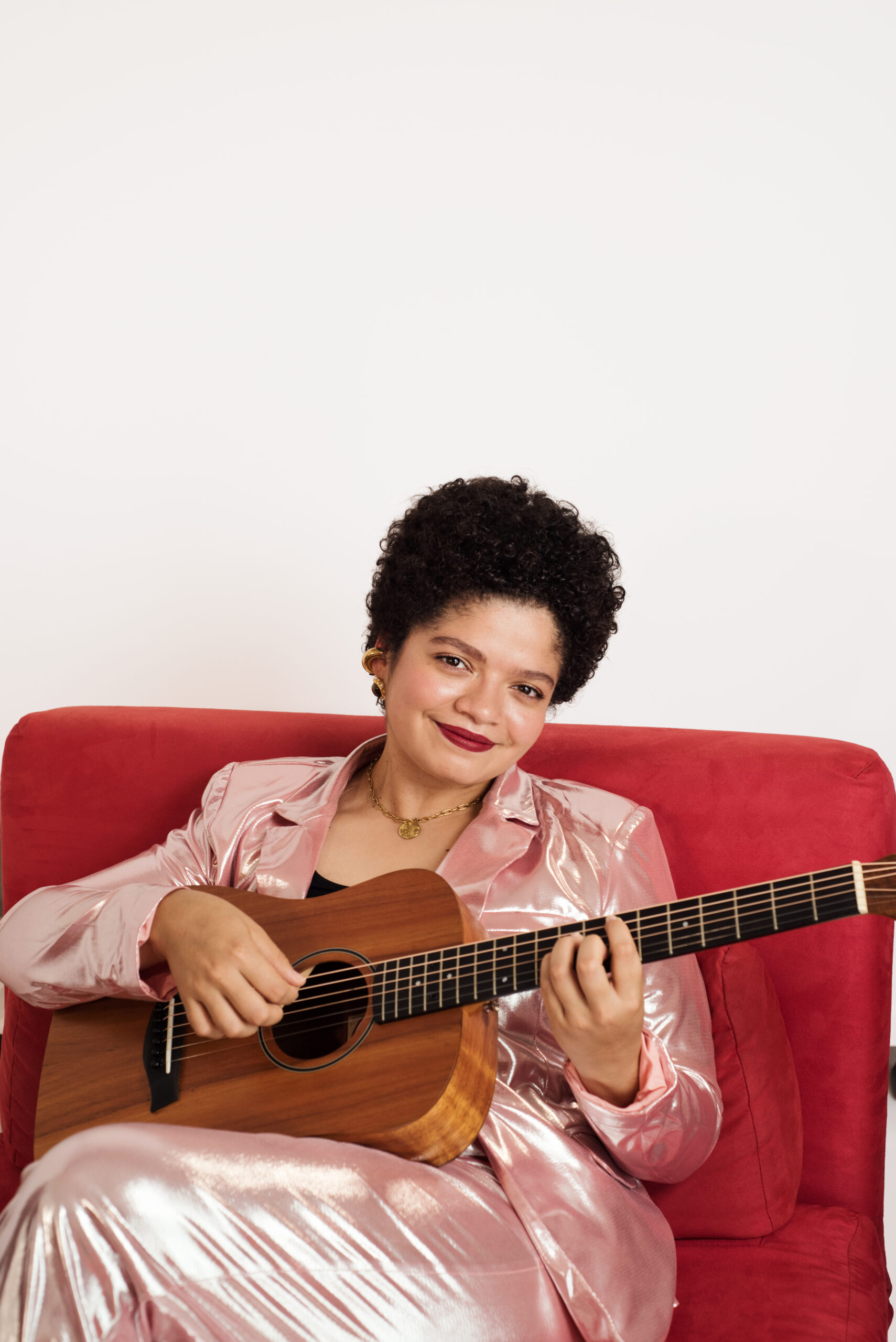
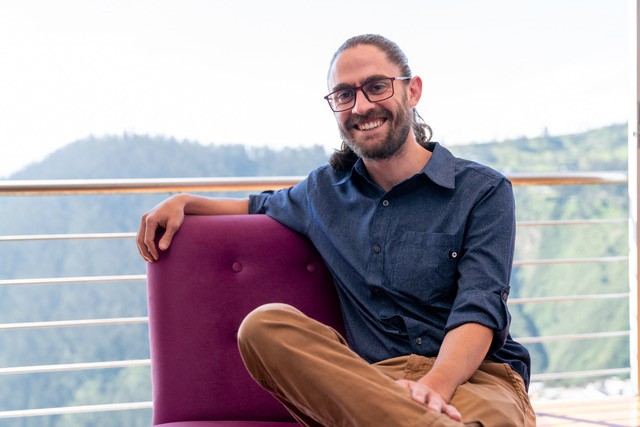
Millaray Jara Collio, known as MC Millaray, which means “golden flower” in Mapudungun, is an 18-year-old Mapuche rapper who has surprised Chile with her precocity and determination: she keeps a photo of herself going up on stage at the age of three; at five she began rapping in public alongside her father; and at seven she released her first album, unregistered, which she uploaded to YouTube. “It was one of the means I had back then to show my music. That album has seven songs and is entitled ‘Pequeña Femenina’. It talked about music, about hip-hop itself.” MC Millaray is clear about her influences: the Mapuche group Wechekeche Ñi Trawun, Chilean folklore, Andean and Mapuche music, and rap.
“Another of my influences is Anita Tijoux: I like her lyrics because they are clearly combative,” acknowledges MC Millaray, who collaborated with Tijoux on the song ‘Rebelión de Octubre’, dedicated to the 2019 Estallido Social. “I listen to specific songs by certain artists, not all their music,” explains this rapper, who prefers a hard-hitting beat, “heavier, with kick and snare”, and collaborations with artists who have a story to tell.
First alongside her father and then solo, MC Millaray has evolved towards combativeness, and her music takes us into a world of marginalisation and social protest in which she demands the rights denied to the Mapuche people. “I never lacked anything, but I saw needs among the people and felt an urgent need to make them visible,” she explains. Her social protest is made of her experiences, shaped by her ethnicity and by the marginal neighbourhood of Santiago where she grew up. “I like rap with political content. I don’t like singing what other young people sing about, going out partying, because I don’t do that; I don’t like rapping about things I don’t live,” she stresses, and admits that, because of her activist stance, at the age of 13 she received threats that forced her to temporarily close her social media accounts.
“The [Mapuche] communities have been living with repression and militarisation for many years. Once, after a talk, some lamngen (brother or sister, in Mapudungun) were beaten up, and I thought that one of them could have been me: if I had gone out to speak earlier, they would have beaten me too. I was exposing myself a lot, I was very young and I didn’t want those hate messages, those specific threats; so I decided to leave social media and continue speaking out through music, which is what I am most passionate about.” In the wake of the 2019 Uprising, her voice made her a loudspeaker and a leading figure of Mapuche rap in Chile. As a result, the Al-Jazeera channel devoted a documentary to her and The New York Times considered her, in 2023, an artist with international reach. It was in 2023 that she went on her first international tour, during which her albums ‘Mi ser mapuche’, ‘Quebrar la mano del destino’ and ‘Txükü’ resonated powerfully and reminded audiences what it means to be Mapuche in Chile.
Five years since the Social Uprising
October 2024 marks the fifth anniversary of Chile’s Estallido Social. The rise in the price of metro tickets was the last straw for the Chilean people, who took to the streets of the main cities in protest to demand a change of Government and a reform of the Constitution. Finally, after months of social upheaval, interrupted by the outbreak of the coronavirus crisis, a process began to reform the Constitution, inherited from the dictatorship of Augusto Pinochet, and in the December 2021 elections the renewal-minded left led by Gabriel Boric won.
Years later, this hopeful process has collapsed. The constitutional reform has been rejected in a referendum on two occasions: the first document was drafted by groups from the Chilean left and included advances for indigenous and marginalised peoples; and the second text, dominated by right-wing ideology, barely altered the capitalist precepts introduced by the Chicago School and denied rights to minorities. A fiasco for hopes of transformation which, moreover, has been compounded by the questionable term of President Gabriel Boric: the lack of a majority in Parliament forces him to negotiate reforms with the right, which limits the scope of his progressive measures. Today, the protagonists of the Uprising are watching, paralysed, the more than likely return of the right, with Evelyn Matthei the strongest contender.
The Mapuche people: years of grievances and resistance
In this process of social change that began in 2019, the Mapuche people played a crucial role: one of the iconic images of the Estallido is that of Plaza Dignidad, in Santiago, packed with people and with an enormous Mapuche flag flying above all the others. That period of openness made the Mapuche community feel somewhat integrated, at least those settled in Santiago. However, the majority’s subsequent rejection resurfaced: first, society said “no” to the first constitutional proposal, which, among other reforms, allowed greater autonomy for the Mapuche community; then President Boric extended the State of Emergency in Wallmapu; and finally, there were hardly any public shows of support in May 2024 when Héctor Llaitul, spokesperson and leader of the Coordinadora Arauco Malleco (CAM), the organisation that has spearheaded political violence since its founding in 1998, was sentenced to 23 years in prison.
During his statements before the Temuco Criminal Court, where he was tried, Llaitul justified the struggle of the Mapuche people. He emphasised that the forestry model has wiped out biodiversity and recalled that his people have been resisting the usurpation of their land ever since the Spanish arrived. The recovery of these ancestral lands is a crucial cause: the State continues to grant licences to extractive companies to plant eucalyptus for timber or build hydroelectric plants, while the Mapuche are barely ceded any productive land; land that the State, through the Corporación Nacional de Desarrollo Indígena (CONADI), also negotiates with landowners, who prefer not to give it up or ask a high price for it. This lack of will, reports the media outlet ‘Ciper’, has meant that between 1997 and 2015 the hectares owned by forestry companies rose from 2 to 3 million, while over the same period individual Mapuche obtained barely 209,000.
To secure their rights, in a militarised region, different organisations favour different paths to a solution: political, social or armed. There are politicians and social organisations that have spent decades trying to engage in dialogue with the Chilean Government, while several armed organisations believe the State will not change its stance and engage in political violence. The CAM is the most prominent, and its actions are mainly acts of sabotage against the forestry companies that extract natural resources.
The Mapuche people make up around 10% of Chile’s population and live in the central and southern regions of the country and in part of Argentina. Due to migration from the countryside to the city, as well as repression and a lack of opportunities, Mapuche men and women have been leaving their territories and today they are a minority in Wallmapu. Moreover, due to the advance of the State, which sends settlers and facilitates the establishment of extractive companies, communities are fracturing and there are cases of confrontation among the Mapuche themselves: some defend extractive activities as a solution to the lack of opportunities, while others, by contrast, believe that this development destroys an ancestral territory bound up with their own spirituality.
Facing obstacles to studying their language, Mapudungun, and without the right to self-determination, this people suffers assimilation by the Chilean State, which in the 21st century does not deny Mapuche identity, provided it is stripped of its spiritual relationship with the land.
You were part of the social organisation Network for the Defence of Mapuche Children. What left the deepest mark on you during that period as a defender?
I was a spokesperson for about three and a half years and I met children who have suffered systematic violence all their lives. I wanted to be part of that group and I wrote the song ‘No habrá silencio’ for the network. Going to commemorate the murder of a lamngen [brother, sister] had a big impact on me. I was shaken by a protest where I was going to speak about underage children who had been violently abused, and a guanaco arrived, which is a micro that fires water with chemicals that burn the body, and it started to soak us. I never got to give my speech and we went down the Alameda, from Plaza Dignidad, while they followed us. They shot a lamngen and, to this day, there has been no justice. The lamngen was lying on the ground bleeding to death and they wouldn’t let us get near her; they wouldn’t let the ambulance through either. She died. After they took the lamngen to hospital, they continued repressing us: some were beaten and others were taken away [arrested]. There is so much violence and injustice that it is hard to stay on your feet. There is also a lot of prejudice. Until the social awakening, we were a people who were looked down on, we were accused of carrying out attacks, instead of people seeing the Chilean State’s set-ups: they murdered our lamngen Camilo Catrillanca and the police said the Mapuche fired shots and that the bullet ricocheted off a tractor.
What do they teach at school about the relationship between the Chilean State and the Mapuche people?
Nowadays, since I finished my last year of secondary school last year, they say that the Mapuche are a people from the south of Chile and part of Argentina who drink and waste the land. They believe that they occupied that territory for the common good, that they taught us to work the land. But we have always looked after our land, and it is the transnational companies that overexploit it.
In Wallmapu, Mapuche men and women are not the majority; there are more settlers, due to migration. How does this situation affect their relationship with Mother Earth?
It affects us spiritually. We are connected to the territory and it is sad that we cannot hold our ceremonies: we cannot get up at seven in the morning to go and bathe in the river and pray for a good life or good health. On the spiritual level, we work with energy, we feed off its strength, and that is why we need nature. In the countryside, you harvest the wheat, grind it, make toasted flour and eat pancito in the morning, and it is a beautiful and rewarding process. When I went around my grandmother’s land, we picked apples and went looking for blackberries to make jam; there were pine nuts. So going back [to Wallmapu] is a necessity, because I have loved ones there: my great-grandmother, who inspired me and taught me to feel proud of who we are.
What are the main problems facing the Mapuche community in Chile and in Wallmapu?
The constant usurpation of our territories, because nowadays our territories have become tourist spots where visitors do not respect our land. We don’t want to be part of tourism; we want to be part of a change towards the respect our land deserves. In addition, the forestry companies are filling the territory with pine and eucalyptus. When I was seven, the river flowed with a force it doesn’t have today, and that is because of the forestry plantations around it. This territory [referring to Wallmapu] is sacred to us, as are the rivers, because that is where our ancestors rest, who suffered a genocide.
You grew up in La Pincoya. What have you learned from this marginal neighbourhood of Santiago?
It was a neighbourhood that, although marginal, was very close-knit. There were seven grass pitches, pure grass, where horses would sometimes wander. It was something like being in the countryside. And there was a sense of community. For example, when a neighbour fell ill, we held bingos, an event that is like a party where comedians and dancers are invited, bingo is played and food is sold; you pay an entrance fee, on top of what you consume, and the money goes to the person in need. I tell that story in one of my songs. Perhaps neighbourhoods are more dangerous and violent nowadays, but that is because there are more unmet needs.
In your songs you constantly talk about police violence, but also about classism. How is it reflected in Chile?
Classism is seen constantly. Free education in Chile is not of good quality, and it is the only tool the poor have to change their situation. Healthcare isn’t good either: people are constantly dying while waiting for a stretcher. I experienced it with my great-grandmother, who had a kind of appendicitis and they sent her home saying it was a stomach ache. She died; she bled to death. That wouldn’t happen if the hospitals weren’t overwhelmed, if we had more resources. Because she didn’t go to the doctor just once, she went two or three times. It could have been avoided. That is why I say we live under a classism that consumes us and that constantly violates our rights.
To change this and other problems, the Estallido Social took place five years ago. What do you remember of that time, which inspired and left its mark on so many young people?
We had a feeling of hope, a moment when we felt supported as Mapuche. It was inspiring to see young people rouse a whole country, even though afterwards the youth were let down by the Chilean people. In the end, I think (people) chose badly, that they didn’t take the time to learn about and study the new Constitution, and older people, who are neglected, were swayed by what the television was saying, which was against the new Constitution. The result was disappointing, although it was also a beautiful moment of unity. After all that, we went back to the same old thing.
In your songs you call for the release of Mapuche political prisoners. Some organisations support armed struggle, while others call for dialogue with the Chilean State. You rap; you fight with your music. Are all forms of resistance valid?
Of course. I don’t justify violence, but we can never forgive or forget those who trample on us. We cannot forget the genocide our Mapuche nation suffered, nor accept the unjust deaths of our brothers who fight to defend Mapuche territory. So all forms of struggle are valid as long as the territories are respected and the Mapuche are not divided into good and bad. The oppression (by the security forces) is constant, and we cannot go on facing bullets with stones; it isn’t fair. When justice is truly respected, perhaps changes will happen, but nothing will change while our lamngen continue to be murdered. And the struggle is against the Chilean State, but also against the forestry companies and the transnationals, and against the racism our people suffer.