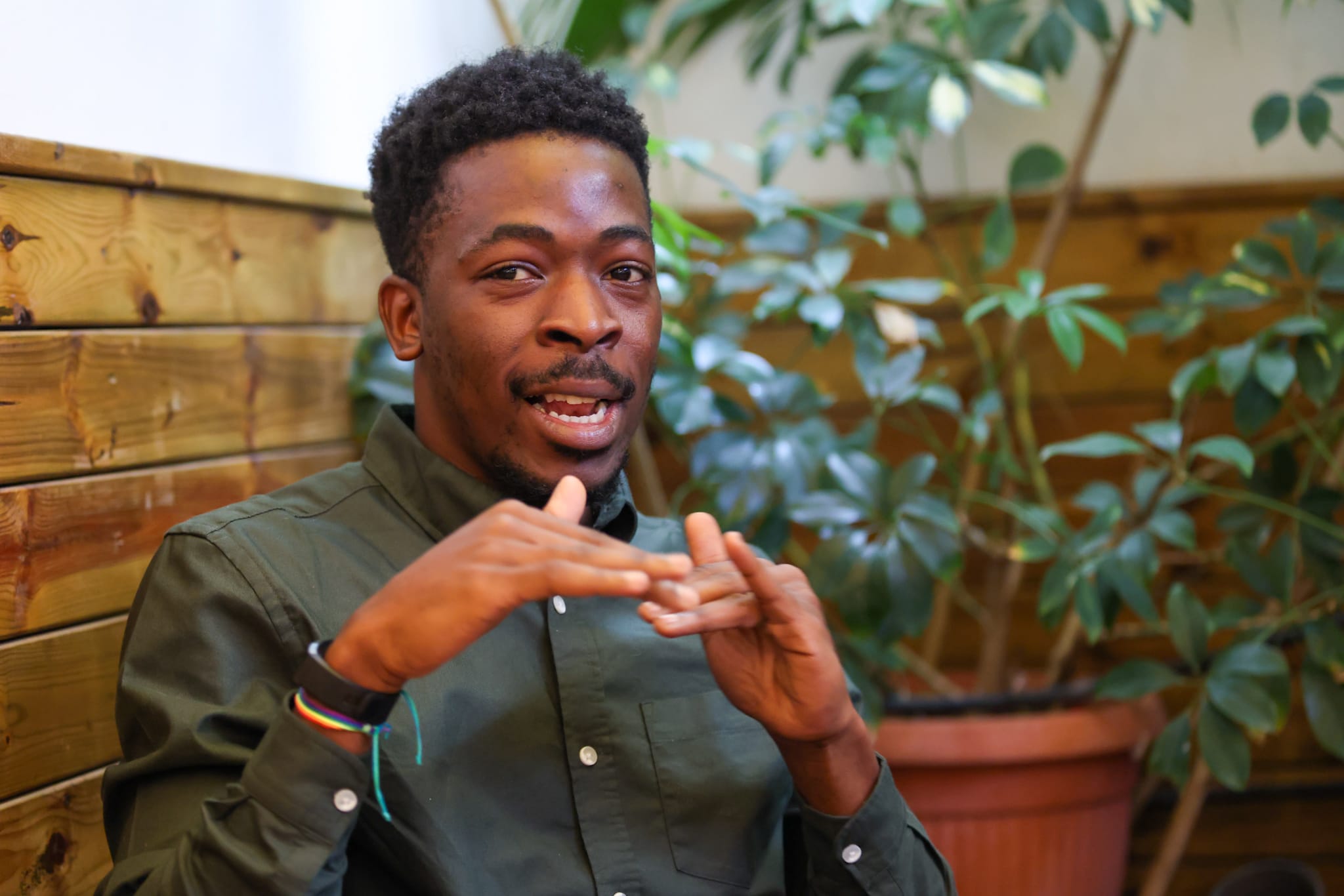
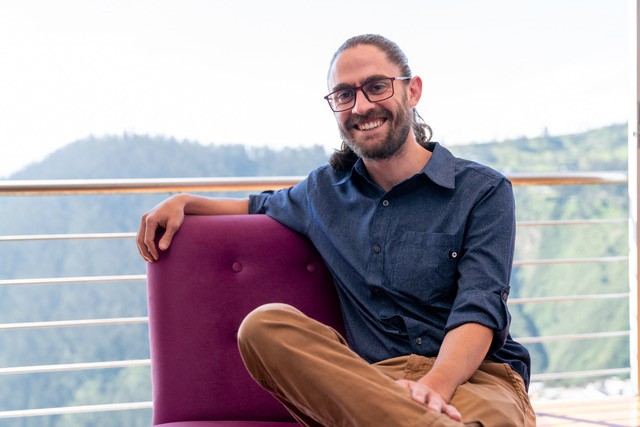
Natali González Arce was born in 1983 in Cali. A clinical and social neuropsychologist and a feminist, she was Under-Secretary for Human Rights and Peacebuilding at Cali City Council between 2020 and 2022. Natali is an activist with the Observatory for Conflict Management and Peacebuilding (COBSEPAZ), founder of PSICOPAZ, an organisation focused on mental health and conflict, and part of the regional leadership in Cali of Comunes, the political party that succeeded the FARC. Before that, from her youth, she was a clandestine agent of the political and social apparatus of the Revolutionary Armed Forces of Colombia–People’s Army (FARC-EP), the historic guerrilla group that signed a peace agreement with the Colombian Government in 2016.
The only daughter of an upholsterer father and a mother devoted to ancestral wisdom and mysticism, Natali grew up in Cali, a city in south-western Colombia which she describes as “a meeting point for the mixing of Indigenous and Afro-descendant communities”. In a lower-middle-class environment, she developed a deep political awareness and, at the age of 15, in a context marked by the conflict, she began her involvement with social organisations and social justice. A year later, she was already vice-president of a community board in a Cali neighbourhood.
“On one occasion, I had breakfast with [former president] Uribe Vélez. They brought us community leaders together. At the time I didn’t know whether I was right-wing or left-wing, but at that breakfast I could see how that political class organised itself, how it blamed security problems on the young people I worked with and who, over time, would be murdered,” she recalls of a period that left its mark on her conscience with the murder of the comedian Jaime Garzón in 1999.
It was at that moment that Natali understood which side she would be on in the conflict in Colombia. She chose the radical left as a way of defending life and joined the communist youth, later becoming part of the FARC’s clandestine Bolivarian movement and a member of the PC3, or Clandestine Colombian Communist Party. Her activities were persecuted by the authorities, so she had to lead a double life. “While I was living my clandestine life, I studied for my degree in Psychology and specialised in neuropsychology and in psychosocial support in contexts of war or insecurity,” she explains.
As she was not a guerrilla fighter, the peace process achieved in 2016 does not cover her case. However, the signing brought a crucial change in her life: she was able to leave clandestinity behind and put an end to her parallel lives. Now her public identity is clear, concise and transparent. Hers is a personality that breaks down the stigmas still attached to former members of the guerrilla and shows that, despite the difficulties, it is indeed possible to integrate into the system one wants to transform. That said, she warns, it is not easy, especially if you are a woman.
“Nothing we are talking about can be understood outside of privilege. I didn’t experience gender-based violence, but women’s participation in politics has to be seen in terms of privilege,” Natali insists, and recalls: “Participation has historically been monopolised by the interests of patriarchy, which says that if we have a certain leadership or rank, it is because we are the commanders’ girlfriends. But that is not the case: those of us women who joined the organisations were neither blinded nor deceived; we did it out of conviction. In Cali, many of us women were part of organisations of the Bolivarian movement in which we were not merely included, but were the ones leading.”
Colombia, when peace is marked by violence
In 2016, the then president Juan Manuel Santos and the Revolutionary Armed Forces of Colombia–People’s Army (FARC) signed a peace agreement that ended the armed conflict that had begun in 1964 and has left around 120,000 victims. This peace, full of imperfections, dissidence and reprisals, turns ten years old in 2026. And although the FARC has dissolved and most of its members have begun a process of reintegration into society, violence continues to shape people’s lives in Colombia. In regions such as Cauca and Guaviare, the situation has even worsened, now marked by armed groups fighting over the vacuum left by the FARC.
These armed groups are mainly made up of FARC dissident forces, paramilitaries linked to the State, members of the National Liberation Army guerrilla group and criminal groups allied with drug trafficking. Depending on the region of Colombia, one faction has a greater or lesser presence, although in every case they want to seize the territory in order to control illicit activities such as the cultivation of and trafficking in cocaine or the extraction of mineral resources such as gold. In many parts of the country, since the State does not exist, they are the ones who act as the real authority, sometimes creating a swarm of fragile alliances that can quickly escalate into extreme violence. And those who suffer most from this violence are the inhabitants of these territories and human rights defenders.
Thus, according to data from the Institute for Development and Peace Studies (INDEPAZ), in 2025 alone “187 people who exercised some form of social leadership or human rights defence work in Colombia were murdered. This figure represents an increase of 14 murders compared with 2024 and matches the levels of violence reached in 2022, a year marked by the presidential elections.” Although it does not reach the levels of the worst years of the post-conflict period, from 2018 to 2020, under the presidency of Iván Duque, skirmishes still persist, mainly affecting the population living in rural areas, where the authority of the State is so diluted that it practically does not exist. A reflection of this lack of protection is that not even political representatives are free; this February Aida Quilcué, a senator and defender from Cauca, was kidnapped for a few hours. That is why people flee. In 2025 alone, INDEPAZ put the number of people displaced by the conflict at more than 100,000. In the midst of the 2026 electoral process, few people believe that the new Colombian president will change this dynamic, entrenched for decades in Colombia.
Although in a close referendum society said ‘no’ to the peace agreement, in 2016 former president Juan Manuel Santos and the FARC went ahead and signed it. What problems persist?
We prefer to say that the agreement was signed, because the model of peace we have is imperfect. Signing the agreement did not bring peace, which does not depend solely on laying down arms, but requires material, political and social conditions. Even if you lay down your arms, if the structural problems persist, there will be another kind of conflict. And now you can find conflict in every single point of the agreement. The main conflict is over land, over economic and community development in rural areas. The second problem is political participation, which means that all of us can participate properly, but there are persistent threats, especially in rural areas. Another problem is that of the emerging groups, which for us are not dissidents but organised armed groups strategically located along the drug corridors. They have no ideology, and their actions are very useful to the Army, the former paramilitaries and the drug cartels. It is very easy to use the FARC’s name.
Leaders of the dissident group Estado Mayor Central were senior FARC commanders. They do not seem to be mere drug traffickers. Most of the guerrilla chose to reintegrate. Why didn’t these members want to?
That confrontation was due to the interests of some commanders. In war there are combat actions and economic actions. When the possibility arose of no longer having access to economic resources, which also came from drug trafficking, some did not want that. Also, because of that situation, there was a desire to get out [and dissolve the guerrilla]. But let it be clear that the FARC was not defeated militarily; rather, it was an exercise in recognising that the dynamics were not responding to the people’s problems. So what distinguishes an organised armed group from a revolutionary political group? That one fights for the people. We [the FARC] made military mistakes, but they did not systematically benefit the Government, and what we see is that the actions of these dissident groups only benefit uribismo, the right, paramilitarism. Under Álvaro Uribe, a génocidaire who has killed 6,104 ‘false positives’, there were attacks, bombs. They were self-inflicted attacks. Now it is happening with the dissidents. It is the same modus operandi. The security strategy in Latin America and in Colombia is based on the internal enemy. It is part of the right’s game; a right which, by the way, is traqueta (mafia-like), because Uribe is a drug trafficker. They are a political cartel. That is why, even though Gustavo Petro’s Government is progressive, these dissident groups carry out military actions whose only effect is to delegitimise themselves. And it is all about territorial control.
This confrontation is suffered by villagers, men and women who already spent decades caught between the State and the FARC. How does the conflict affect these people?
They are not villagers. They are peasant farmers, men and women, and they are still in the middle of the conflict. For them, life has not changed in these 10 years: they are still caught in drug-trafficking violence. In fact, they report that their living conditions have deteriorated. Why? Because when we were the State there, there were decent living conditions for people. There were rules, education, and not only military matters. We were not an entity separate from the population. So the perception is that these people are currently worse off, and not only in social terms: in these corridors there is a great deal of flora and fauna that was respected by the FARC and is now being devastated.
In this decade, almost 500 reintegrated guerrilla fighters or peace signatories have been murdered. How is the process being experienced?
We want it to be recognised that peace signatories are currently human rights defenders. They defend communities. We are denouncing the slow-drip massacre. There is an intention to annihilate our legacy, our ideology; there is a whole strategy to demoralise us. It is part of the strategy of genocide, until we are no longer a force that worries the Government. When we were in the negotiation process, the people from the [dissolved guerrilla group] M-19 warned us about the painful process that awaited us. We didn’t listen to them. Because it is not only the tangible part, which is in the agreement; there are strategies they will implement that push you aside, that break you, and you have to be prepared. With us, they sowed doubts among the rank and file, they went off on holiday, drinking whisky, to create resentment… A project I collaborate on with PSICOPAZ deals precisely with this: with the emotions that run through the reconciliation process.
Is it easy to be a representative of Comunes, or are you former FARC members stigmatised in Colombia?
There is a lot of stigmatisation. Stigma is experienced in everyday life and, especially, in political participation and economic access. Many people don’t say they were part of the FARC because they are afraid of losing their jobs, their lives. Not me. I was lucky, or it was privilege. Moreover, the left doesn’t help us either. President Gustavo Petro doesn’t help. He has been an excellent president for Colombians. We have never had a better one. But for FARC people he has not been so excellent. And it is not that he lacks the will; rather, there is a fear of being associated with us. I love Iván Cepeda, who recently had a set-up staged against him with FARC members to damage his image. Right now, the last thing the presidential candidates want is to appear in a photo with the stigma, which is any one of us.
What influence can Donald Trump have in Colombia?
The Monroe Doctrine was the United States’ strategy of imperialist expansion in the Americas. They treat us as if our resources were there for their economic development. There has always been a colonialist intention, but unlike other Latin American nations, in Colombia they didn’t need to stage a coup: politicians have betrayed the interests of the people ever since Santander betrayed Bolívar. Since then, the US has never abandoned Colombia and, unlike Cuba or Venezuela, it has not needed to intervene to take control.
 rtvvilafranca.cat · 21/04/2026Vilafranca acull dues persones que participen en la gira Ciutats Defensores dels Drets HumansRead ↗
 VOTV · 15/04/2026L’activista Natali González reflexiona sobre la construcció col·lectiva de la PauRead ↗