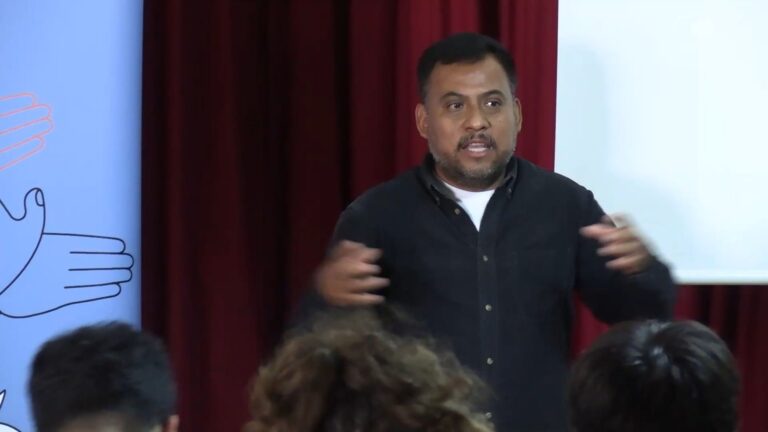
Rubén Moreno was born in 1977 in Chiapas, Mexico, and has been working for more than 20 years at the Fray Bartolomé de Las Casas Human Rights Centre (Frayba). Currently in the International Advocacy area, which in his words is “a bridge between the local and the global”, he documents, investigates and denounces human rights violations in Chiapas in order to bequeath a faithful account of historical memory that honours the victims and their families.
Rubén comes from the municipality of Nicolás Ruiz, which the elders know as San Diego de la Reforma, a religious name that was changed to another more in keeping with the identity-based, revolutionary narrative of modern Mexico. It is a territory complemented by generous farmland that provides pulses, maize and squash, and which for decades its inhabitants have tried to protect from organised groups colluding with the State.
Rubén’s family always encouraged him to study, but in that troubled environment he first had to learn to resist. As a young man, between 1994 and 1998, he lived through the struggle to reclaim the land that was led by Zapatismo but emulated by anonymous people from towns such as Nicolás Ruiz. “In 1994, the town decided to change its relationship with the State. They weren’t Zapatistas, but, in an assembly, the town agreed to reclaim its own lands,” Rubén recalls. “We suffered killings and imprisonment. In ’96, the Army murdered three inhabitants of our town. By then that struggle was no longer just about land, but also about impunity and historical memory. In ’98, when the lands had been reclaimed, a minority of 23 families with ties to the State wanted to put an end to our autonomy; they made up the claim that the town was under siege so that the State would intervene, which it did on 3 June ’98. I was there. They took many comrades and one woman prisoner. That was when we understood that we had to organise. I was 22,” recalls the man who accompanied his town’s political prisoners throughout that process.
It was then that many inhabitants began training in human rights to counter the illegal actions of the State and other armed groups. “Suddenly, we were no longer documenting just one town, there were many,” recalls Rubén, who, after completing a law degree in 2006, began working at Frayba. “From here we can contribute what we have learned from the struggle to our peoples, so that other peoples organise and defend human rights,” says Rubén of a leading organisation that was established in 1989, linked to Catholic diocesan action for peace, justice and dignity. Since then, it has documented and litigated human rights violations in Chiapas such as extrajudicial executions, torture, disappearances and the denial of Indigenous peoples’ right to their territory in what he defines as the “unresolved armed conflict in Chiapas”.
Chiapas, the constant struggle for territorial control
Chiapas, covering 73,311 square kilometres, is a state in southern Mexico bordering Guatemala. A crossroads that is one of the epicentres of the migrant route crossing Central America, it is also a bastion of the anti-capitalist, community-based movement led by the Zapatista Army of National Liberation (EZLN), as well as of other communal and assembly-based groups with no affiliation other than their own community or the locality in which they live.
Chiapas is a militarised zone, with more than a hundred armed forces barracks and an ongoing dispute over territorial control. Between 1994 and 1999, the confrontation left people disappeared and dead, most of them as a result of violence by counter-insurgent paramilitary groups allied with the State, then led by the Institutional Revolutionary Party (PRI). These were the conflict’s years of lead. Although the inhabitants were able to hold on to their territories, the violence continued on another scale, with new forms of counter-insurgency resembling a war of attrition directed by the State, which relies on armed and criminal groups with complex alliances prone to erupting into episodes of extreme violence.
These alliances involve business people, politicians and armed groups seeking to create a sense of insecurity and ungovernability in order to justify the military presence in Chiapas. It is a way of doing politics that has not changed under the progressive governments of the Morena party: first with Andrés Manuel López Obrador and now with Claudia Sheinbaum.
This state or para-state violence thus carries a high cost, paid by the communities living in Chiapas. According to data collected by the State Commission for the Search for Disappeared Persons in Chiapas, 1,045 people disappeared between 2020 and 2023, of whom 397 had still not been found in 2023. It is a historical problem across the whole country, where more than 128,000 people are estimated to have disappeared between 1952 and 2025, 90% of them after 2006. Far from being resolved, this tragedy is getting worse, at least in Chiapas, where, according to data from the National Registry of Disappeared and Missing Persons, disappearances rose by 358% between 2019 and 2022, reaching 244 in 2022. In addition, between 2010 and 2022 Frayba documented 16,755 displaced people, with a worrying increase in violence during the pandemic, especially on the border with Guatemala and in the Northern Corridor.
It is precisely this violence that traps the inhabitants of the territories reclaimed between 1994 and 1999: near the Pan-American Highway, in La Trinitaria, Comitán de Domínguez and Teopisca; on the road running parallel to the border with Guatemala, in Chicomuselo, Siltepec and Motozintla; and in other regions where megaprojects such as the Maya Train or infrastructure works affect the natural environment and people’s lives, and which also draw in criminal groups that impose the law of violence.
In Peru, last year a law was passed to grant amnesty for crimes committed during the conflict with the Shining Path. What is the situation like in Mexico?
Pressure from civil society has forced the State to acknowledge its responsibility for serious human rights violations. Cases have been brought before the Inter-American Commission on Human Rights (IACHR), which has found that Mexico has violated human rights and must comply with the mechanisms for memory, non-repetition and comprehensive reparation of the harm done. But what we have seen is that the State thinks everything can be solved with money, by paying compensation, and that is not the case. From the very beginning, denialism prevails, because the State denies having taken part in the human rights violations. Moreover, they have not investigated or have not changed their narratives, rejecting the testimonies of the families who lived through it. There have been initiatives at the federal level to draft a memory law, but they have remained nothing more than good intentions. We will keep fighting and we will not forget what happened in Chiapas. We do not want it to happen again anywhere else.
So you are the ones building historical memory.
Our space is a site of memory where we safeguard historical archives. We are the ones who have to safeguard them, because the State is not paying attention and tries to cover things up, since it knows that the perpetrators also come from within its own ranks. We will hold a gathering in June to mark 30 years since the disappearance of Minerva Guadalupe Pérez Torres, a young woman who disappeared in Tila at the hands of the paramilitary group Desarrollo, Paz y Justicia. Her only crime was that her parents opened up the community and the doors of their home to many people displaced by paramilitary violence. Thirty years have passed and we do not know where her body is.
How many victims of disappearance are there in Chiapas?
In the northern zone of Chiapas alone, in the context of the armed uprising, we at Frayba have recorded 122 cases. Thirty-seven are disappearances and 85 are extrajudicial executions, most of them committed by paramilitaries. Of these 122 cases, we have submitted the eight best-documented to the IACHR. Two are disappearances and six are executions. These 122 cases took place between 1994 and 2000, but the violence has continued since: in the current context of widespread violence, we have also recorded disappearances, killings and forced displacement.
Twenty-eight years have passed since these cases. What did the IACHR rule?
These cases are still in litigation, but we have no further information to submit. We want the IACHR to issue recommendations and acknowledge that the Mexican State violated human rights in the context of the internal armed conflict. As happened, among others, with the cases of Ejido La Grandeza and Antonio González Méndez.
At present, Frayba is warning of an increase in attacks on the territories reclaimed by the Zapatistas, especially in the Central Corridor.
There are many transit routes for trafficking people and weapons that are marked by organised crime violence. Now there is violence on the road being built to San Cristóbal and to the border, in Chicomuselo, a town that has also been highly organised but has come under heavy attack. Why? Because there is mining there for barite, which is used in hydrocarbon extraction. There used to be a Canadian company. It is no longer there, but extraction continues. And nobody says anything. These groups act with impunity, and officials allow it. The Army, Police and National Guard camps are very close by. This Government says that everything is fine, that there is no torture and there are no disappeared people. Former president López Obrador said on several occasions that Frayba was making things up, that he had other data. But that is not true: we are on the ground, we have direct testimony from the people.
Why does the Government not want to acknowledge the delicate situation?
It is very complicated. It is not me saying it, it is the peoples who have been denouncing it: here we have narco-governments. Not only narco-governments, but also a whole range of corrupt governments. And who would dare say anything, because to protect your life, you keep quiet in many territories.
Between 2020 and 2022, according to Frayba’s data, the number of disappearances in Chiapas increased by 385%. Why?
The rise in violence on the border came during the pandemic. Organised crime showed itself in that period and has not slowed down. There are many reports of disappearances, and many people have been displaced. Sometimes there are families who do not want to report because they are afraid, because they end up criminalised and they distrust the authorities. In addition, in Chiapas we had never seen bags with human remains or a body by the side of the road, something that started to appear during the pandemic.
Are you afraid?
We have to work carefully and use appropriate language. Before, we were not afraid. Now we are. We have stepped up our protection measures. The State is not guaranteeing the safety of the population; it lets armed groups act violently and cause the displacement, disappearance and execution of people. But fear will not paralyse us. The cases we have before the IACHR were documented in the mountains, crossing rivers, crossing boundaries, in the midst of violence. It is part of our work and we must keep doing it.
You belong to the Tseltal people. How do you assess the situation of Indigenous communities in Chiapas?
I am Tseltal by affiliation; I recognise that I come from an Indigenous people. Before ’94, discrimination and violence were blatant. Since then, the Government has been very careful to disguise and not reveal what it is doing, which is carrying out an extermination, the displacement of people. Our Zapatista comrades have said it clearly: there are laws, but no protection. The clear example is the San Andrés Accords to protect Indigenous cultures, which have turned 30 but which the Government never implemented. In addition, the Government runs support programmes for communities which, for the most part, seek to divide and dismantle community organisations. Of course, this also affects Indigenous communities.