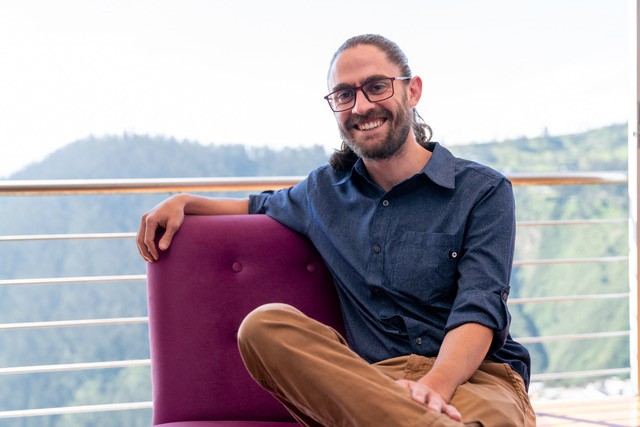
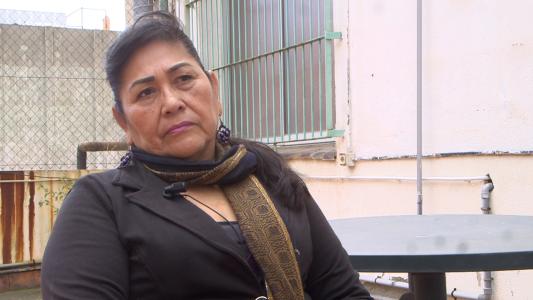
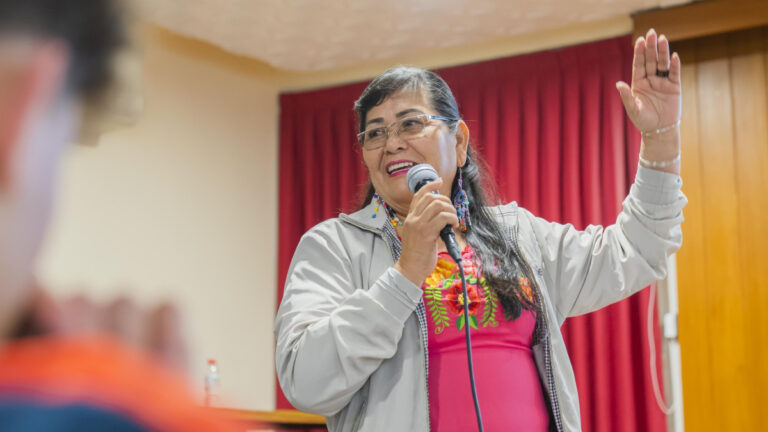
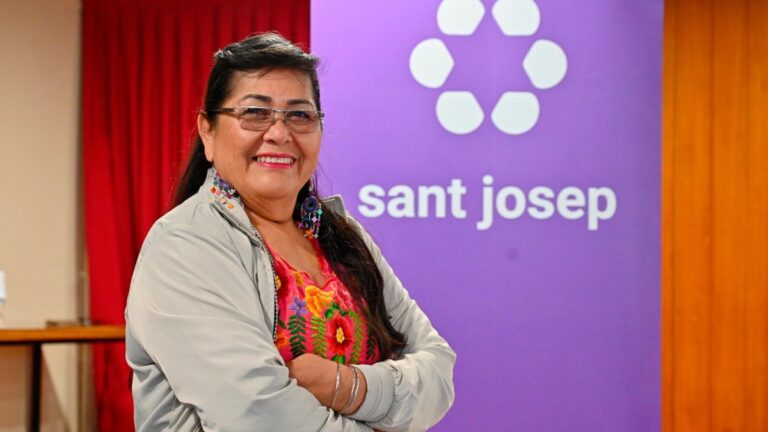
Sara López’s activism in defence of territory, land, water, life and Indigenous communities dates back to her adolescence, when she took part in the training workshops run by the Jesuits. Trained in liberation theology, the activist has devoted her whole life to standing up against the injustices to which the original peoples of Mexico are subjected year after year. Since the mid-1990s she has been a member of the Regional Indigenous and Popular Council of Xpujil and of the National Indigenous Council (CNI).
In her career as an activist and human rights defender, her work stands out in Nicaragua, training communities with coffee pickers, her accompaniment of displaced Indigenous communities and her struggle in the National Network of Civil Resistance against High Electricity Tariffs, for which she was arrested and imprisoned in 2009. On that occasion, Sara López spent eleven months in prison; but thanks to popular pressure demanding her release and a hunger strike she carried out for fifteen days, she was freed. She currently focuses her struggle on opposing the construction of the so-called Maya Train, a pharaonic megaproject that has become the emblem of López Obrador’s government and is having a strong impact on the region and on the communities that inhabit it.
One of the struggles in which Sara López is currently immersed is the one focused on the so-called Maya Train, a railway project launched by López Obrador’s government that crosses the states of Tabasco, Chiapas, Campeche, Yucatán and Quintana Roo. This megaproject, which involves the construction of more than 1,500 kilometres of railway track, entails a profound territorial reorganisation and has a profound impact in every sphere: environmental, social, cultural and economic. Although the Mexican government has stated that the project aims to improve connectivity between communities, improve their quality of life and boost the region economically, its inhabitants do not share that view: the megaproject brings more deforestation (so far 3,444,000 trees have been felled along the route), more pollution, the cultural alienation of the territory’s inhabitants and more poverty, as well as the conversion of the culture of the territories —in this case Maya culture— into a commercial product. The organisations opposed to the project maintain that behind it lies only the commercial and economic interest of the Mexican government and that it is a tourism development project geared towards that end. Activists opposed to this railway route state that: “Hotel chains, travel agencies and theme parks have commodified their culture, clothing, rituals and sacred sites in exchange for economic profit”, and they fear that the Maya Train will sweep away their way of life, their culture and their languages. In Mexico, moreover, some reports have also been published questioning the social and financial viability of the project, pointing to alleged corruption, and the irregularities that occurred in the consultation with the territory’s original communities in 2019 have already come to light: information was withheld from the population and more than two million inhabitants of the Yucatán Peninsula were left out of the consultation. “With regard to informed consent, due to the lack of a definitive route for the Maya Train Project, the lack of definition of the location of the development hubs along the train route, and the fact that, in 2019, it did not prepare any assessments or studies in the social sphere that anticipated the possible social effects and risks that the development of the railway and the development hubs would cause, FONATUR did not provide the Indigenous people with the information necessary for them to accept the project with full knowledge of the facts, and therefore did not demonstrate that consent for the project was obtained on the basic condition of being informed”, reads the report Social Effects of the Maya Train Project Performance Audit: 2019-3-21W3N-07-1385-2020 1385-DE, by the Superior Audit Office of the Federation. Although the project was launched in 2018, works did not begin until 2020. Last December 2023, López Obrador inaugurated the first three sections of the route. According to the National Fund for Tourism Development (FONATUR), which is in charge of the megaproject, by 2053 the train will carry some 100,000 users a day, around three million passengers a month.
Another of the problems the region faces is the proliferation of African palm plantations and the increase in GM crops, which threaten the traditional farming methods of local communities and biosphere areas with unique ecosystems. In fact, the Yucatán Peninsula has the largest percentage of protected areas in the country. African palm and GM crops encourage deforestation and illegal logging, the pollution of rivers and groundwater and changes in the behaviour of native animal species, among other effects.
Finally, we must not forget the impact of mass tourism on the region, one of the most popular destinations in the country. The touristification and massive overexploitation of the area in recent years has led, in addition to serious environmental impacts, to the displacement of communities and the migration of the local population to tourist cities such as Tulum, Playa del Carmen or Cancún to earn a living. This is having a significant impact on Indigenous identities, traditions and original culture, and is turning spaces of high spiritual value for the original communities into holiday settings.
You have been an activist for more than forty years, defending Maya territory and culture.
Yes, since I was 14. I got started through the workshops run by the Jesuits, which had nothing to do with religion. They focused on analysing reality, political faith, etc. It motivated me a lot and I went on training along those lines. I married at 15 and soon had two children. I was working in the field of liberation theology. During those years the Regional Indigenous and Popular Council of Xpujil emerged. It coincided, in the mid-nineties, with a very severe drought. The wetlands dried up and the situation became so tense that we organised some demonstrations. That was when the persecution against me began.
You had to flee.
Yes, so that they would not arrest me; but activism is part of my life. I am so passionate that I love the struggle, what we do. I can no longer be without it. I know I need time for myself and for my health, but I also know that I have to do my bit.
In 2009 you were arrested for fighting against high electricity tariffs.
I had had an arrest warrant against me since 1995 in Xpujil; then I went to Veracruz, but because of financial problems I had to return to Candelaria, which is where I come from. I knew they could arrest me anywhere, because the warrant was nationwide. When I returned to Candelaria and got involved in the struggle again, that was when they arrested me, when I joined the civil resistance movement against high electricity tariffs, because the tariffs were not fair. We took a stand and decided not to pay. The impact was strong and the government saw its interests threatened, so they invented the crime of deprivation of liberty and arrested five people. One of them was me. I went through so many things in prison… I would grow weak, but I always managed to be reborn. The good thing is that people mobilised and began to exert political pressure, regionally, nationally and internationally. And it worked. And I came out of it all stronger.
Did you ever think of stepping away from defending the territory and from activism?
The government thought that by keeping me imprisoned for eleven months it would pull me away from our demands, and that is not how it went. It never imagined that this would be the definitive push for me to continue my struggle. My activities, however, have affected my personal life. At times I have lowered the intensity of the struggle, but I have always come back to it. What I have always feared is that the government would touch one of my five children. Since I was in prison, they did lower the intensity of their activism. But they have always supported me. I have never involved them in my affairs, even though they too have been harassed by those in power.
You live in a territory in constant conflict over the defence of human rights and the right to exist. Mass touristification, the proliferation of African palm monoculture and GM crops, among other problems.
In the case of Candelaria we have a very big problem with African palm cultivation, because it damages the land and the other crops. The problem with this crop is that it consumes a lot of water and the plantations are near the rivers, which can become polluted, as well as drying up. The fish die because of the waste, too. In the resistance we held several information sessions on the dangers of African palm cultivation, and when the government was preparing another round of planting, the people did not allow it. It was an immense achievement. Another problem we have, in another part of the region, in Campeche, is deforestation, driven by the Mennonites, and the planting of sorghum and GM soya. They are enormous plantations that are sprayed from light aircraft. It is something frightening. They also draw water from the wells to flood hectares so they can sow rice. It is a constant struggle.
And now the construction and launch of the so-called Maya Train. How are you dealing with the current situation?
With the arrival of the so-called Maya Train, violence, robberies and murders have increased. The prices of the basic food basket and of rents have risen as never before. This is a project that predates López Obrador taking office, but he is the one who has launched it. López Obrador, seeing that millions of Mexicans voted for him, seized the opportunity. He gave grants and resources to young and older people, among other forms of support. He was shrewd and knew how to do it: he knew that people need financial help; so he won everyone over and pushed the project through on us. That was in 2019. We did not have time to prepare, and the people of the territory, for the most part, supported the project. Now, with everything that is happening, people have realised and are beginning to wake up.
The European left has a good image of López Obrador, but when viewed from the perspective of the country’s human rights defenders or journalists, it seems that during these years in government there have also been some steps backwards in certain areas.
He [López Obrador] comes from the social struggle in Tabasco, but when he was mayor of Mexico City [2000-2005] he did not do much either: he basically limited himself to launching welfare programmes, which is the same thing he has done these years at national level. For many voters, he has been a disappointment. We did not vote for him, but we thought that with him we might be able to reach some kind of dialogue. He left [the presidency] and we never managed to get a negotiating table with him, something we had achieved with both the PRI [Institutional Revolutionary Party] and the PAN [National Action Party].
There are elections in the country shortly, and two women are standing.
I am convinced that Claudia Sheinbaum [Morena] will win, but it does not matter: the one running the presidency from behind the scenes will be López Obrador, I have no doubt.
 El Cugatenc · 20/05/2024Sara López: “La construcció del Tren Maia ha fet pujar la criminalitat i els preus dels aliments en les comunitats indígenes”Read ↗
 Xarxanet.org · 29/04/2024Sara López: “Tot el que està passant a Mèxic és un ecocidi”Read ↗
 l'informatiu · 26/04/2024Sara López a L’Informatiu de Santa Perpètua (núm. 726)Read ↗
 Diari Més · 17/04/2024Sara López: «A Europa els activistes no són tan criminalitzats, a Mèxic correm un alt risc»Read ↗
 Diari de Tarragona · 10/04/2024Sara López (activista mexicana) «Contar nuestra realidad en Reus crea una red más allá de las fronteras»Read ↗