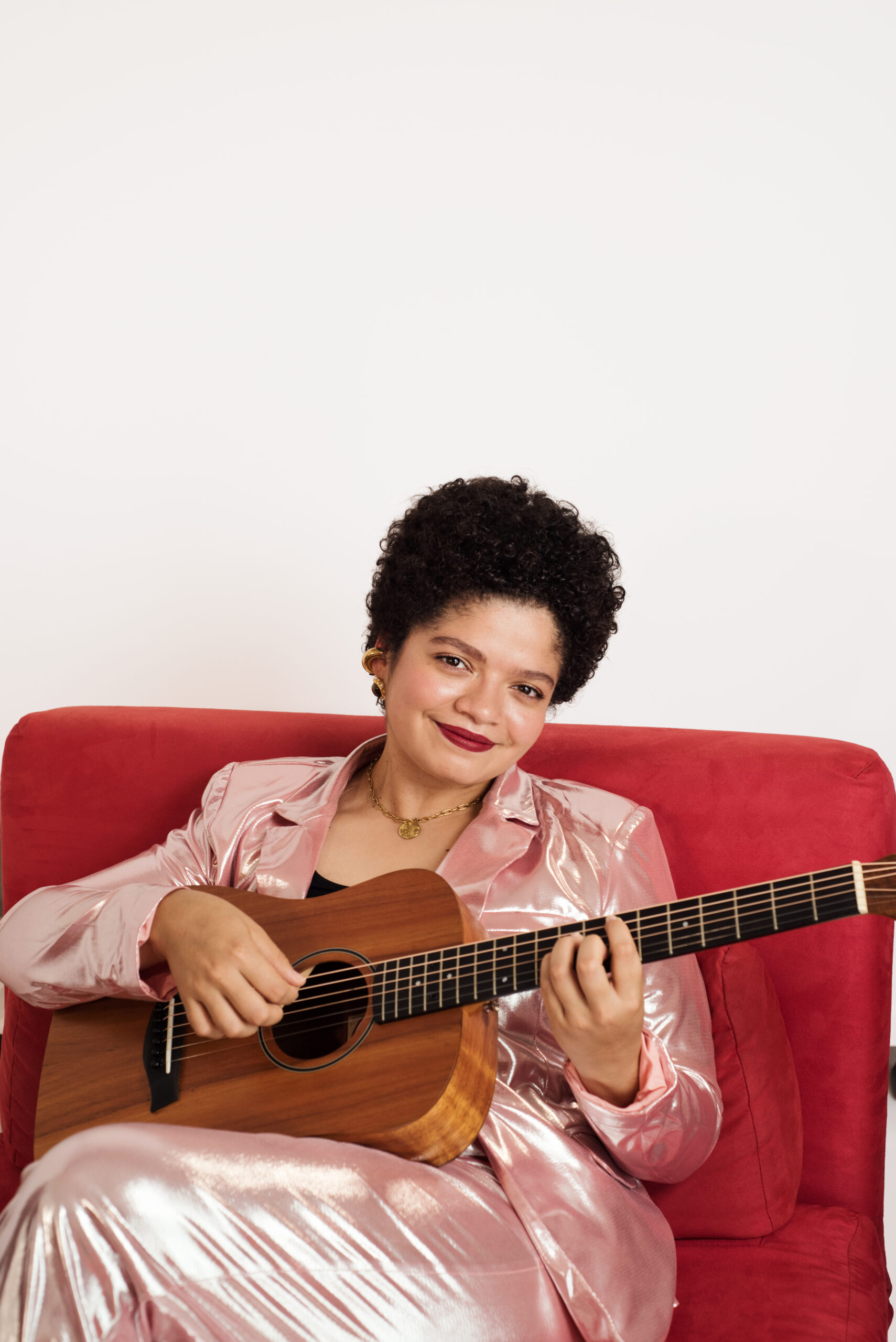
Catalina Salazar (Talca, 1987) studied Political Science, and it was then, during her university studies, that she began working on issues related to young people. In her own words: “that’s when my career as an activist began”, although she had already become interested in human rights during her secondary school years. After graduating, she decided to combine two of her great passions: music —especially hip hop— and the social sciences. At Social Hip hop, a non-profit organisation that uses music to work with young people and with people in prisons in order to strengthen their communication, social and personal skills, Catalina found her first job, but also a way of living and of being in the world. Between 2015 and 2020, she was the platform’s international affairs coordinator; and during this period she was also Regional Coordinator for the Americas of the United Network of Young Peacebuilders (UNOY Peacebuilders).
After Social Hip hop, Catalina Salazar worked on the project Multiplica pel Clima, which focuses on the fight against climate change and for climate justice in the territories. As she herself explains, “it is a hybrid initiative with in-person and online activities that aims to develop the climate capacity and resilience of Chilean youth from a local perspective.” She currently collaborates with the Ruralitats Crítiques space, where she documents precarity and lack of protection in rural Chile. She combines this work with consultancy on youth and human rights, while also studying for a master’s degree in cultural studies and organising a festival of women and literature.
In Chile, 1% of the population holds 49.6% of the country’s total wealth, which gives an idea of the deep inequality and the social divide that exist. It is a country where wealth is concentrated mainly in the financial, mining and forestry sectors. In October 2019, the government of the conservative Sebastián Piñera, who recently died, decided to raise public transport fares. Although the increase was only a few cents, this decision led thousands of students to take to the streets in protest and sparked what is known as the Social Outburst. The massive protests put Piñera’s government on the ropes; it went as far as declaring a state of emergency and imposing a curfew. The unrest, accompanied by severe police charges against demonstrators, lasted for weeks. The outbreak of the Covid-19 pandemic reduced the presence of protesters on the streets, but it did not halt the social discontent.
Although the immediate cause of those protests was the rise in transport fares, the truth is that the outburst had more to do with the social discontent that had been building for years than with the specific measure adopted by the government. Organisations such as Human Rights Watch (HRW), the United Nations and Amnesty International extensively documented the human rights violations (torture, ill-treatment, illegal and arbitrary detentions and sexual violence, among others) that took place during those days. “Between 18 October and 20 November 2019, almost 11,000 people were injured, including 2,000 police officers, and 26 people died. More than 15,000 were detained, and in some cases they were seriously ill-treated. Several dozen suffered eye injuries, most of them after being hit by pellets fired by Carabineros with riot shotguns,” reads the HRW report. For this violence against demonstrators, 75 police officers were charged, but only one of them was convicted, according to HRW.
In the midst of the crisis caused by the Outburst, on 27 December 2019 Sebastián Piñera called a referendum to decide whether it was necessary to draft a new Constitution to replace the one then in force, drawn up in 1980 during the dictatorship of Augusto Pinochet (1973-1990). Despite having been slightly amended —some 70 reforms have been applied to it—, the text retains the foundations of that time. Drafting a new Constitution was one of the demands of the Social Outburst. The 2020 National Plebiscite, asking Chileans whether they wanted a new Constitution, was called for April 2020, but the outbreak of the Covid-19 pandemic forced it to be postponed until October of that year. In October 2020, around seven and a half million people voted, of whom 78.2% opted for “I approve”: yes, they wanted a new Constitution.
Just a few months later, on 21 December 2021, and at only 35 years of age, the progressive Gabriel Boric became the country’s president with 55.87% of the vote. He thus won against his far-right rival, José Antonio Kast. Although the social crisis that had triggered the 2019 social outburst had not been resolved, with this election it seemed that Chile wanted to start afresh; to change course. Boric took office in March 2022 and continued the constituent process that Chilean society seemed to long for so much. This first constituent process, however, did not come to fruition. On 4 September 2022, Chile rejected, with almost 61.86% of the vote, the text proposed by the progressives. The message was clear in its forcefulness. Although the Chilean people had shown themselves in favour of changing the country’s Constitution, it was evident that the proposed text had not convinced them. After this failure, a second constituent process began, this time led by the ultra-conservative Republican Party. In December 2023, Chileans voted again and once again rejected the proposed text, by 55.76% .
How did you work at Social Hip hop?
We created a methodology for working with young people, especially in violent contexts; with marginalised populations in violent places, such as prisons, vulnerable schools, etc. This methodology, still in use, continues to develop; and I think it has been a hugely important step for youth work in general. All these experiences were compiled in the book Hip hop 360: Cap a un enfocament de treball amb joventuts [available at www.academia.edu] and the initiative became part of United Peace Builders, the network of young peacebuilders. The platform joined as the Chilean member and I was elected regional coordinator for the Americas. It was the time when the peace agreements with the FARC were being forged in Colombia. In Latin America we don’t have traditional wars, so to speak, like those in the Middle East, but it is a violent continent, especially for young people. It is the continent with the most murders per year, and the main victims are young people. Our first strategic objective was to draw attention to the need to work on violence prevention. Sadly, many environmental leaders are also murdered, especially in Colombia; so we also worked in that area. Through these two strands we managed to establish the notion that there is a great deal of violence in the Americas, that it must be prevented and that, moreover, activists need to be protected. We also did consultancy work for the United Nations Population Fund, UNFPA, and helped to establish the Latin American Youth, Peace and Security Agenda.
How important is it to address human rights through culture? Must culture always have a political component?
Culture is a tool for working on social cohesion and violence prevention. I think it is a very powerful tool, especially in these times. But I don’t believe art always has to have that direct political component; I do believe, however, that art generates peace, because I think that where there is art, there is no violence. Or at least, there is less. I believe art and culture are always tools for social cohesion. I respect that there are artists who want to make less political art. On the other hand, there is hip hop that is extremely combative and has a violent discourse; but personally I prefer not to criminalise these discourses. I would rather violence exist in art than in real life. It is always preferable to sing about violence than to commit it.
How did you get involved in the 2019 Social Outburst?
I had already taken part in the earlier student revolutions, which are closely connected. The 2019 Outburst was surprising and shocking. Everything became very violent. By then I had already been working in peacebuilding, and at first I didn’t know how to get involved in a role I felt comfortable with. I went to the marches, but when things got ugly, I left; it stressed me out a lot. What I did do was go and look for people who had been detained, talk to the police, and so on. I devoted myself to this support work. Then something emerged that isn’t talked about as much: the appearance of spontaneous community initiatives, such as communal soup kitchens or the councils. It happened all over the country. It was something that arose without being planned, with a community and cooperative spirit.
What did these councils involve?
We would meet informally in the squares to discuss issues as a community. We talked about civic education; and it was in these councils that the demand for a new Constitution began to take shape. From there I got involved in the campaign for “I approve” [the first plebiscite]. I was part of the Popular Assembly for Dignity. Many grassroots territorial organisations emerged from the movement, and this changed the political structure in Chile.
But the plebiscite was lost.
Yes, but the assembly carries on. At the moment we work on issues such as rurality, art and civic education. I am very fond of the first one [the first proposed reform]; it was my Constitution. For me [its rejection] came as a surprise, a bucket of cold water. We realised that it was something that had been forged by social movements, by independents.
What do you think happened?
I think it was a question of social energy: there was no energy left, people had become disillusioned. It is also true that the proposal was very avant-garde, sought to end the centralism of the State and gave more power to the regions. Some people perceived it as an abrupt and extreme change; and a significant part of the public didn’t understand it.
Just a few months ago another proposal was put forward, this time led by the far right. It also failed. What happened?
This second process was dominated by the parties, above all by the ultra-conservative sectors. I think there was a lack of participation and involvement. I think the Chilean people are fairly centrist. In short: the public didn’t buy anyone’s story: neither one side’s nor the other’s. I would also say that this last constitutional proposal seemed dangerous to me, because it was a kind of ode to conservatism. Let’s not forget that it was a proposal that came from the far right, with a lot of ‘constraints‘ built in from the start.
Speaking of conservatism: a few months ago, the far-right Javier Milei won the elections in Argentina. How do you see it from the neighbouring country?
The issue of Javier Milei’s election is complex. Ideologically I have nothing in common with him; he seems to me an extreme person and I find him dangerous, because this kind of far right tends to be authoritarian and ends up governing by decree, like Trump or Bolsonaro. I would say, however, that I think the Milei phenomenon is partly a response to the abuse that various governments have committed in Argentina, where things have been going badly for at least twenty years. In my opinion, this began with Menem, and since then they have had a series of irresponsible politicians who have sold off the country and played with inflation. I feel that Milei is a very extreme phenomenon, but one that is the response to a series of corrupt and irresponsible governments. Often, these new fascisms and conservatisms are the reactionary response to the abuses of certain groups. In Argentina the people have been abused, and not acknowledging it is an injustice.
Finally, I wanted to ask you about historical memory. This year marks the 50th anniversary of Pinochet’s coup d’état. How do the Chilean people relate to that past?
During the transition to democracy, Chile went through a kind of truth and justice process. The demand was very strong. Justice, however, remains a delicate matter. There are military officers in prison who are dying and taking memories, recollections and truths to the grave, so we need to see how to achieve greater truth under this permanent threat of oblivion. Chile, moreover, is a very segmented and segregated country where the subject is rarely discussed. There are two opposing and polarised worlds. There is a very caste-like, very sectarian sector, and that is an obstacle to generating a genuine human rights culture; because for that, you first have to sit down and talk and understand that human rights are about human dignity. I also see a certain double standard in some left-wing groups, which comes to light when Venezuela or Cuba are discussed, for example. If you defend human rights, you have to defend them always, and everywhere.